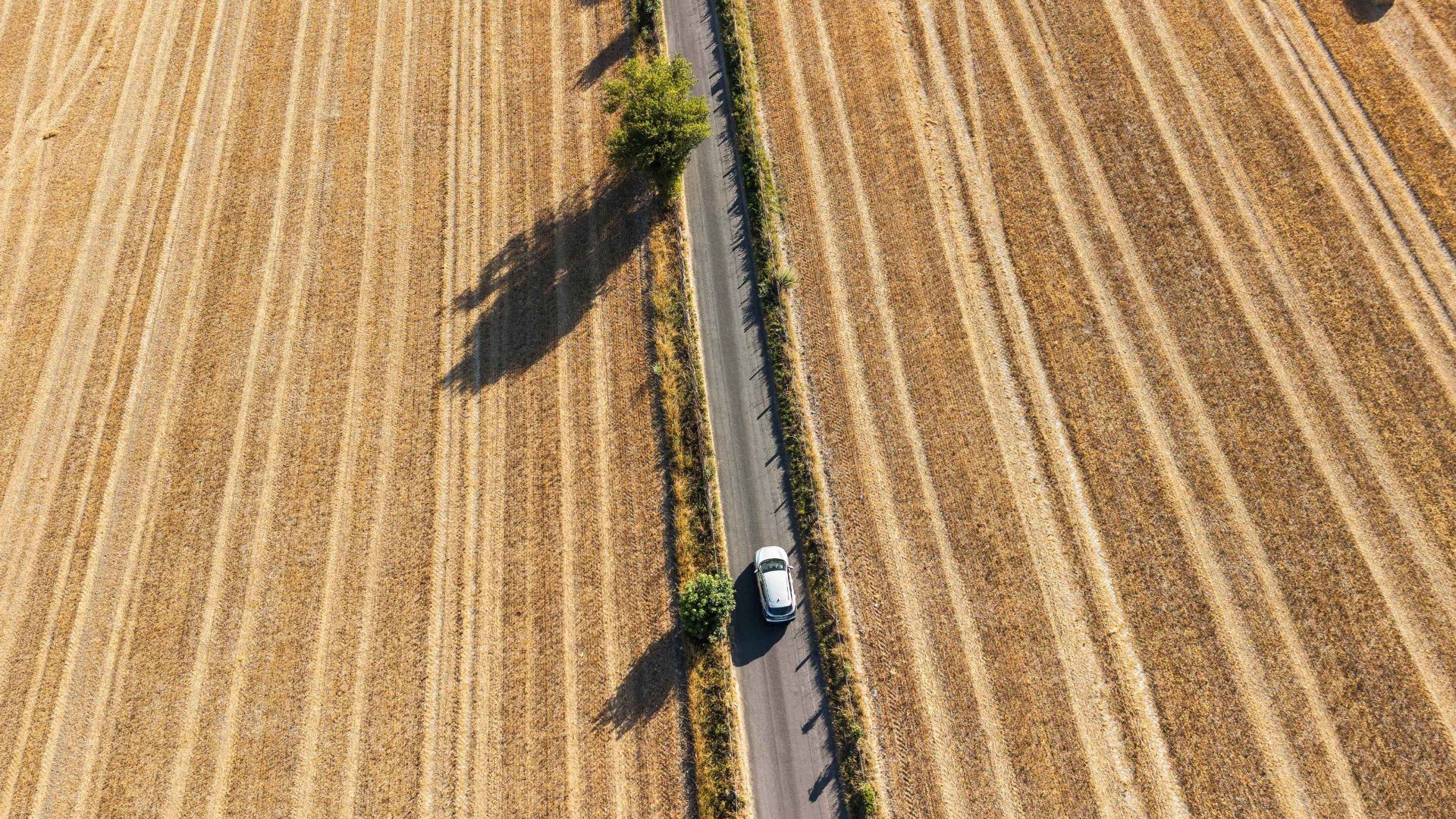
What is 10% cyan, 28% magenta, 49% yellow and 0% black? Answer: most of the British countryside. The grass, the wheat, the barley: it’s all turned a pale and dusty yellow, as have most of our public parks.
Last week, on a flight from London to Edinburgh, I got a bird’s-eye view of the effects of this epic drought. The fields have become rectangles of off-white yellow, framed by trees and hedgerows whose foliage is turning crisp and brown.
What should be the height of summer is already a mixture of autumn and the tropics. Most of our rivers are bordered by expanses of dry mud where the water used to flow.
And though Europe has been hit much harder in this summer of extreme heat, it is the UK that could be in for a tough autumn and winter in terms of food security. Here’s a note that came with a friend’s vegetable box:
“This summer’s heat stress is causing us significant pain… UK wheat yields have plummeted to an estimated 6.8 tonnes per hectare… tracking towards one of the worst harvests on record”.
Wholesale potato prices are up 40%. Lettuce up 90%. And that’s before the impact of the global fertiliser shortage triggered by the Straits of Hormuz crisis has fully kicked in.
UK prices for ammonium nitrate are now 14% above their pre-crisis levels, with products like triple superphosphate up 20%. But most of the fertiliser needed for the 2026 crop was already paid for, so it’s only now – in the coming planting season – that these prices will start to affect farmers. As a result, Bank of England local agents expect food inflation to rise by 6% by the end of the year.
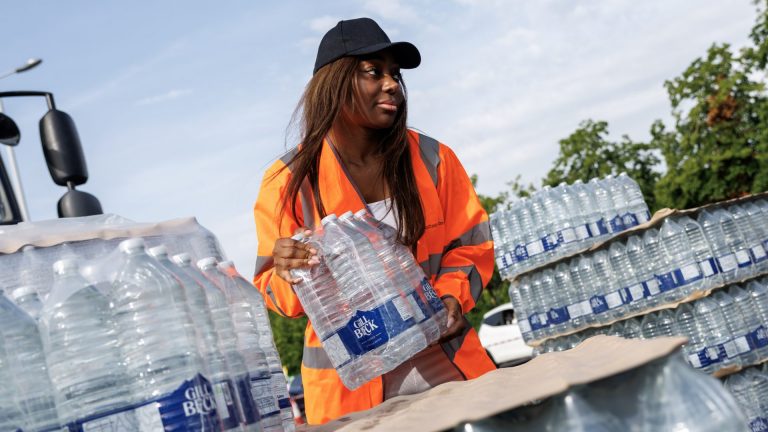

Once you factor in the price increases for animal feed, fuel and shipping triggered by the Straits closure, the drought could subject the UK’s food system to a polycrisis all of its own. With grass dying in the fields, cattle and sheep farmers are already having to start using feed designated for the winter.
Farm water reservoirs are meanwhile exceptionally low, while some report boreholes drying up. East Anglia, the UK’s centre for beet production, has seen 288 farms ordered to cut water use by 50% and 14 told to stop spraying their crops completely.
So the danger is that – irrespective of any wildfires – farmers are hit with a mixture of reduced yields, high input prices and already higher energy and fuel costs. With the farming sector already scarred by the price shock of 2022, and the weather shocks of 2023, the economics of UK family farms begin to look fragile.
That’s why the government was right to call a COBRA meeting, and right to issue a text alarm over the danger of starting wildfires with barbecues. Libertarians complained of “intrusion” when their phones started squawking last Friday night. But it’s something we need to get used to. From climate change to wars in Ukraine and the Middle East, this is an era of shocks, and we need to boost our resilience to them.
The UK imports 60% of its food requirements, but the proportions vary by category. We produce 81% of our own cereals, and could survive a complete stoppage of wheat imports. We produce more than enough milk to satisfy UK demand; the same goes for lamb; and UK-produced beef, eggs and poultry can meet around 80% of UK demand. But some of these are vulnerable to feed supplies from abroad, especially poultry.
And while the UK is self-sufficient in potatoes, carrots, turnips and cabbage – the classic school dinner veg – it is heavily dependent on imports for fruit and green vegetables, which in turn are vulnerable to the global supply shocks and droughts. And when it comes to oils and fats we are, again, vulnerable.
Suggested Reading

How water turned into a luxury
As the drought worsens and climate change intensifies, we’re being bombarded with advice about how to adapt our national diet. These converge on the idea that eating less meat will both improve our health and free up land for cereal and vegetable production.
Professor Tim Lang of City St George’s University of London, has pioneered the study of UK food vulnerability and was among the authors of a timely report in February warning that a combination of cyber-attack, extreme weather and war could lead to “widespread fear of unsafe or inadequate food, leading to violence” in the UK.
The problem, says Lang’s report, is not simply climate change: it is also “poor policy implementation, rising inequality, food supply chain consolidation and the risks from just-in-time supply of food”.
Lang’s team point out that there’s already been a tenfold increase in people using food banks over the past decade. They also point out that, historically, most revolutions have their origins in food insecurity – from Russia in 1917 to the Arab Spring.
Scarily, of all the factors they cite that could lead to an “acute food systems crisis” in the UK – all except cyber-attack already exist. And given that Russia appears to be zapping the systems of major UK firms with increased regularity, the highly digitised, “just in time” distribution systems of the major supermarkets have to be assessed as vulnerable.
The solution, says Lang’s team, is to think about food as a system: almost all our key agencies now do so. But it’s one thing to conceive the whole network of farms, factories, distribution centres, ports and fertiliser depots as a “system” – it’s another thing altogether to actually gain visibility, in real time, into its dynamics.

Beyond that, we need a better water infrastructure. Our pipes are leaking 2.87bn litres of water a day. England and Wales’ privatised water companies, having extracted £83bn in dividends and run up £83bn in debt, are still pumping sewage into our rivers and coastal waters.
Ultimately, the UK is going to have to get much better at local and regional resilience planning. All police regions now have Local Resilience Forums, where fire, ambulance, utility companies and the military meet to catalogue local vulnerabilities. But these do not exist on a statutory basis and receive little funding. In a review of the Civil Contingencies Act 2004, the government is consulting on whether the LRFs should be made statutory.
This is long overdue – both for meeting weather and supply shocks, and for hardening our society against the hybrid warfare Russia surreptitiously practises.
In the Burnham era, “neoliberalism” is out. Good. But its results were to hollow out community, society and micro-institutions that sustain them. Rebuilding societal resilience from the bottom up is an unspectacular job, because it happens in church halls, at farming get-togethers, at the door of the food bank and at the school gate.
In an atomised, neoliberal society, people’s response to crisis is to complain and go into survival mode. In a post-neoliberal society, it is to ask: how can I help?