
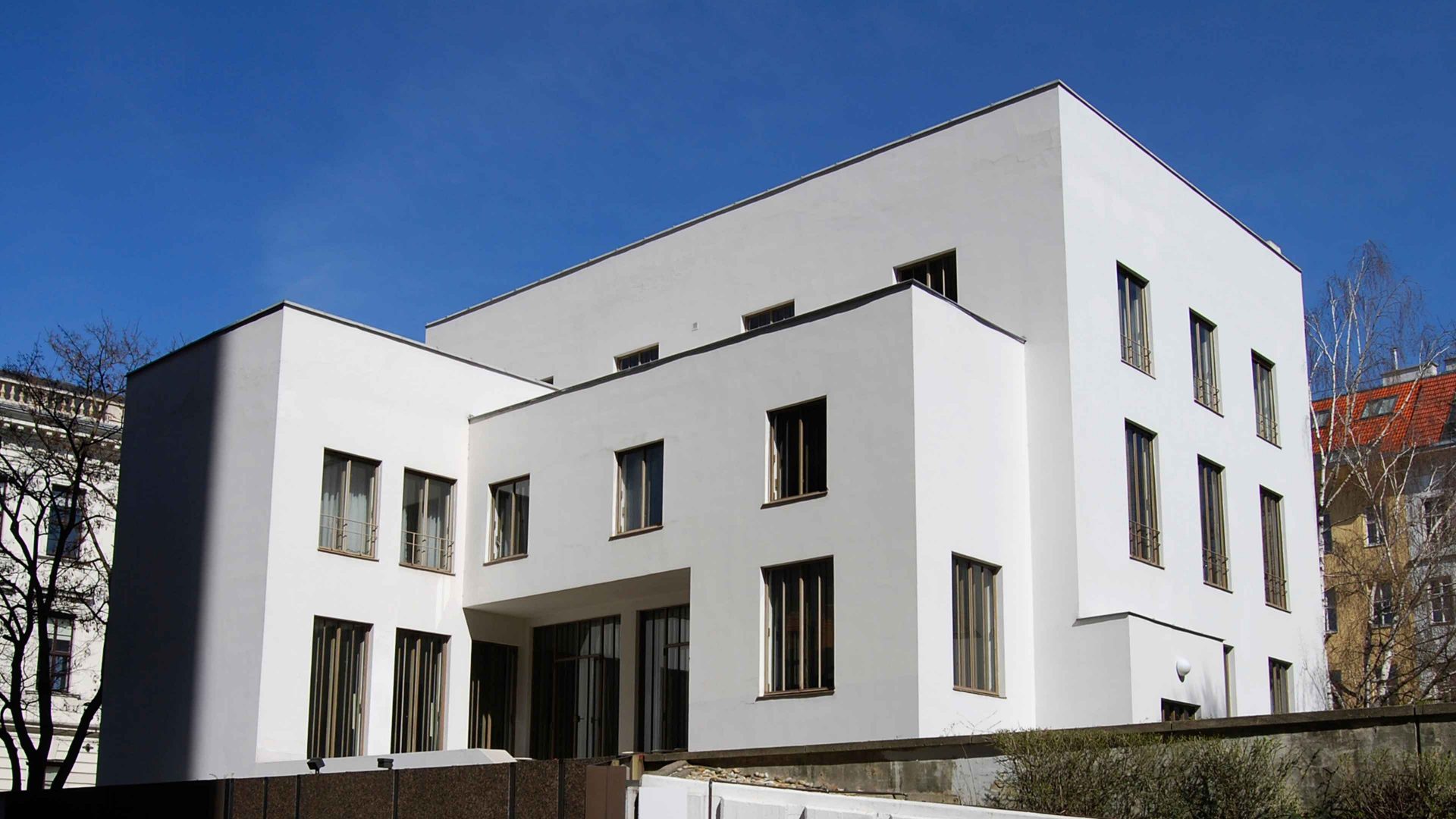
Almost exactly a century ago, the philosopher Ludwig Wittgenstein began a two-year stint as a modernist architect. He’d stopped doing philosophy because he believed he’d solved all of its important problems in his Tractatus Logio-Philosophicus. It took him some time to realise he hadn’t.
After a stint as a gardener, he’d spent several years teaching in rural primary schools. Renowned for being overly strict, he’d had to quit teaching after a scandal: he’d struck a sickly child very hard and there had been serious complaints.
In 1926 his sister Marguerite, known as Gretl, was using some of the family’s immense wealth to build a house on the Kundmangasse in Vienna. She’d employed Paul Engelmann, an architect who’d studied with Adolf Loos. Loos was famous for an essay, “Ornament and Crime”, in which he’d disparaged all decoration as a sign of decadence.
In 1912 he’d designed an apartment block directly opposite the Emperor Franz Joseph’s palace that became known as “the building without eyebrows” because it lacked the usual elaborate window cills and lintels. The emperor, no modernist, detested it.
Engelmann had begun drawing up plans for a rectilinear minimalist house for Gretl, based on three blocks intersecting and which, in Loos style, was devoid of decorative elements. At this point, Gretl invited her brother Ludwig into the mix, partly to distract him from his depression: he’d been contemplating either suicide or becoming a monk. It wasn’t long before he was signing himself “Ludwig Wittgenstein, Architect”, despite having had no formal training (his pre-philosophical background was in aeronautical engineering).
Suggested Reading
Living with the ghost of Paul Auster
Wittgenstein was one of the most important philosophers of the 20th century, but, unfortunately, in his lifetime and since, he has been elevated to guru status. It’s not uncommon to hear people praise what’s become known as the Wittgenstein house as if the philosopher’s contribution to it made him a major architect (albeit of a single building – two if you count a largely wooden house he’d had built overlooking a Norwegian fjord).
Wittgenstein was a genius, after all, they think, and so anything he did was superior. This is an instance of the fallacy of universal expertise, the mistaken notion that because someone excels in one respect they necessarily excel in whatever else they do.
Wittgenstein became fixated on the engineering features, allegedly spending a whole year designing window catches and locks, and creating pulley systems that could raise and lower metal blinds. He drove builders crazy by insisting they lower a ceiling by 30mm to achieve the exact proportions he wanted.
Suggested Reading

Are plants conscious?
When an engineer dared to ask whether a millimetre here or there made any difference, Wittgenstein bellowed back “Yes!” Eventually his sister refused to pay for his increasingly fussy late interventions. Wittgenstein bought a lottery ticket in the vain hope it would generate the funds to continue.
I visited the house, now the cultural department of the Bulgarian Embassy, in Vienna last week, and have mixed views about it. It’s a stark fortress of a building with high windows and high ceilings on the lower floor. It’s mostly devoid of anything decorative, as you’d expect.
The fittings that Wittgenstein designed with such precision have a mechanical beauty. But the long panes of the doors and windows, which created many construction problems, are not entirely functional. They’re an aesthetic, dare I say decorative, touch. The bare lightbulbs are, however, truer to the spirit of functionalism – they’re proto-Brutalist.
Gretl and Ludwig had grown up within the lavish opulence of the immense Wittgenstein Palace on what is now the Argentinierstrasse. That was demolished in the 1950s and replaced with an apartment block. The cold simplicity of the surviving Wittgenstein house was no doubt in part a reaction against that neo-Renaissance splendour and, by extension, against their domineering father, Karl, who held sway there.
The building I visited is usually described as “austere”, and is often likened to the minimalism of the Tractatus. But it lacks something when experienced from within. “Barren” might be a better description. It doesn’t achieve the transcendental purity that Wittgenstein believed he was designing, and which he achieved in the Tractatus, something he came to realise himself. Great modernists like Le Corbusier used geometry, proportion and functional design to create spaces that feel far better than this. The Wittgenstein house neglects the human scale. It’s more like an intellectual experiment than a machine for living in.