Legs wide apart, wearing a crumpled suit and tie, he stands 8.5 metres tall, looming over visitors, in the entrance of Colchester’s Firstsite gallery. One hand is thrust in his pocket, the other grasps a can of lager.
Michael Landy, the Essex-based installation and performance artist, said his sculpture was inspired by a 1990 Sunday Telegraph cartoon next to an article headlined “Mrs Thatcher’s Bruiser”. It was the article that identified “Essex Man” as a new social phenomenon: a brash, working-class Conservative voter obsessed with cars, the stock market, and the pursuit of (loadsa) money.
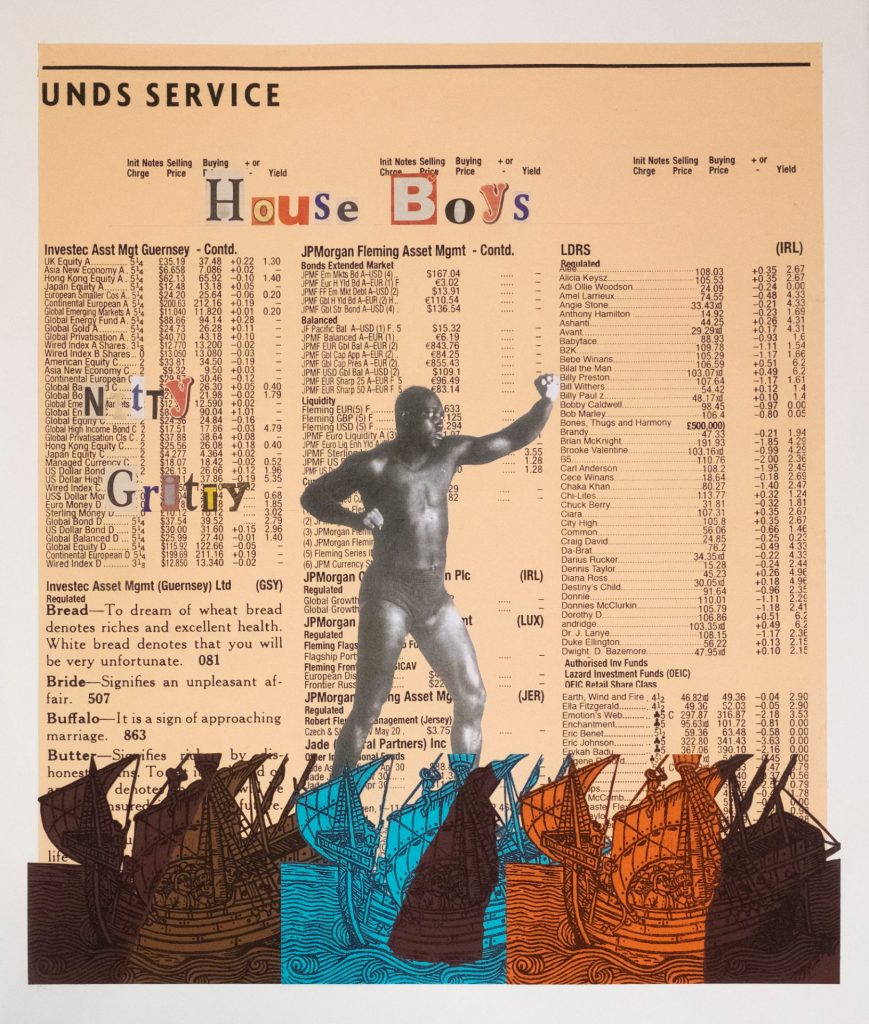
Equities, commodity prices and masculinity are also inescapable in Godfried Donkor’s solo exhibition at Firstsite, It’s a Numbers Game. For many years, the Ghanaian-born artist has used the pink pages of the Financial Times as a backdrop for his collages to highlight the pitiless exploitation of Africans in the slave trade. A copy of an 18th-century engraving of a ship might seem picturesque until you look more closely at the design and imagine the human cargo below deck.
Among the capital management figures and gilts, Donkor has inserted his own data drawn from dream books. Originally from China but popular in the Caribbean and southern states of the US, these are dictionaries of hidden meanings. For example, if you dream of bananas, it means you will be lucky in games of chance, but night-time reveries about beef denote the death of a friend or relative. “I’m using the same font as the FT to show this whole dream sequence is random, like a lottery,” he says.
In the same room, back pages of Dagens Industri, the Swedish equivalent of the FT, are covered with tiny images of guns and bullets. “I lived in Sweden for a few years and it was supposedly a neutral country, a very peaceful place”, says Donkor. “But actually, they make a lot of ammunition. I thought that was quite interesting.”
Little escapes Donkor’s gaze. The beauty of his work only sharpens its uncompromising social critique.
As a teenager, Donkor wanted to be a fashion designer, but on his foundation course at Central Saint Martins, he switched to fine art. He initially saw his collages as a way of working through ideas for his paintings but soon realised they were more than that.
He uses collage to bring clashing colours, textures and visual languages into the same frame, creating deliberately unsettling juxtapositions.
While studying African history at SOAS, he immersed himself in archival photographs and illustrations, weaving them together with contemporary imagery, Ghanaian symbols, European heraldry and African textiles to produce layered works that challenge conventional historical narratives.
Sports, and in particular boxing, feature prominently in this show. In an earlier piece, From Slave to Champ (2009), Donkor depicts boxers emerging directly from the holds of slave ships. He recasts the vessel as a grim “womb”, suggesting that it gave birth to a system that reduced Black people to their physical utility – first through forced labour and later through the exploitation of their bodies in sport. But he depicts these men as heroes rather than victims.
He pays tribute to bare-knuckle champions like Bill Richmond, who was born a slave in New York in 1763, later travelled to England and became a friend, sparring partner, and trainer to the Romantic poet Lord Byron. For this year’s Venice Biennale, Donkor created a comic book-inspired painting that imagines Superman squaring up to Muhammad Ali in the boxing ring.
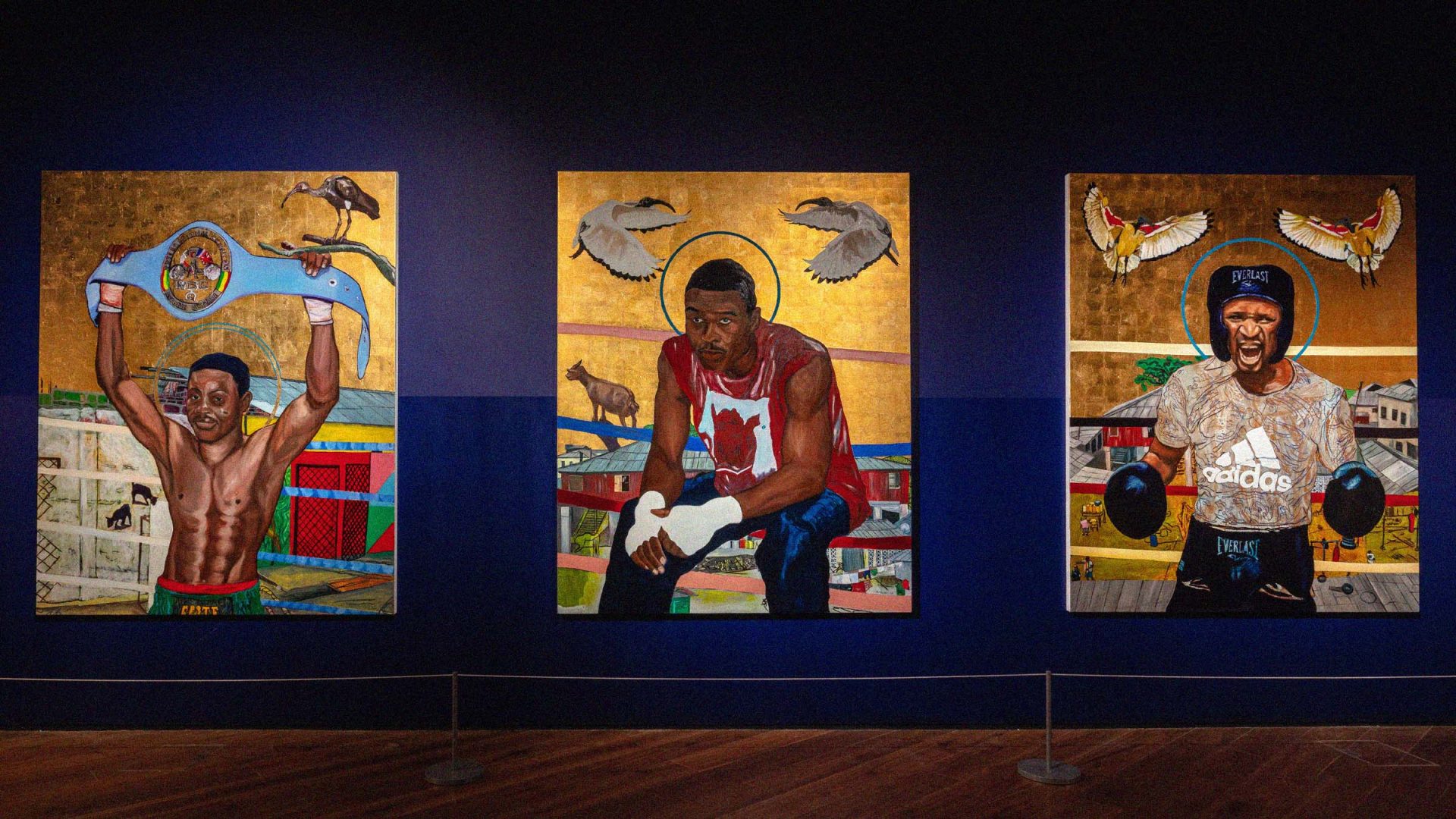
One room painted dark blue is devoted to Donkor’s pugilists, complete with a soundtrack of the ring with whooshing punches, shuffling footwork and the thud of leather gloves. He wanted to recreate the atmosphere of boxing gyms in Jamestown, a neighbourhood in Ghana’s capital, Accra, which has produced eight world champions over the years.
Among the portraits of the sportsmen, Donkor has painted some of the local gyms like the Sonia Sports Academy. “These are usually sheds with corrugated iron roofs”, he says, “sometimes they are in the courtyard of a house, often there are goats wandering around outside.”
However humble they look on the outside, Donkor sees them as temples of ambition. “If I were to get into a ring, I’d die”, he says. “I’d be dead with one hit. But boxers are trained to weave and duck the punches. It is such an art.”
Donkor is also inspired by footballers, and, like the boxers, they are crowned with gold-leaf haloes. Why has he made them look like icons in an Orthodox church?
“Well, they are worshipped, aren’t they? And when I lived in Spain for a bit, I discovered the crossover between religion and football.” He sees these modern saints as figures martyred not for their faith, but for their long struggle for racial equality.
It is no coincidence that Colchester was chosen to host the first UK institutional show of Donkor’s work. Camulodunum, the first capital of Roman Britain, embodied Roman oppression; a colonial stronghold dominated by a temple to Emperor Claudius and veteran soldiers infamous for their ruthless treatment of the native Britons.
Suggested Reading


How Moscow became the loneliest big city in the world
This inspired Donkor to unite two formidable anti-imperialist warrior queens: Boudicca, who led the Celtic revolt against Rome, and Yaa Asantewaa, who spearheaded the Ashanti resistance against the British empire during the war of the golden stool, or war of independence.
Colchester’s own past is deeply intertwined with Ghana’s in another unexpected way. It was once home to Thomas Bowdich, who led a British diplomatic mission to Kumasi in the early 19th century to negotiate peace with the King of Asante and published the first detailed European study of his empire. He produced some illustrations of local customs such as Yam Festival, an annual autumn harvest and purification ritual.
Donkor reimagines the scene in his monumental nine-panel painting The First Day of the Yam Custom: 1817. Sarah Bowdich, who accompanied her husband on later voyages to the Gold Coast, as Ghana was called at the time, became the first European woman to systematically document its plants. Her delicate watercolours are displayed in glass showcases alongside Donkor’s work.
By layering these archival images with contemporary financial news, he reveals the enduring links between empire, commerce, and art.
Godfried Donkor: It’s a Numbers Game is at Firstsite, Colchester, until August 30.