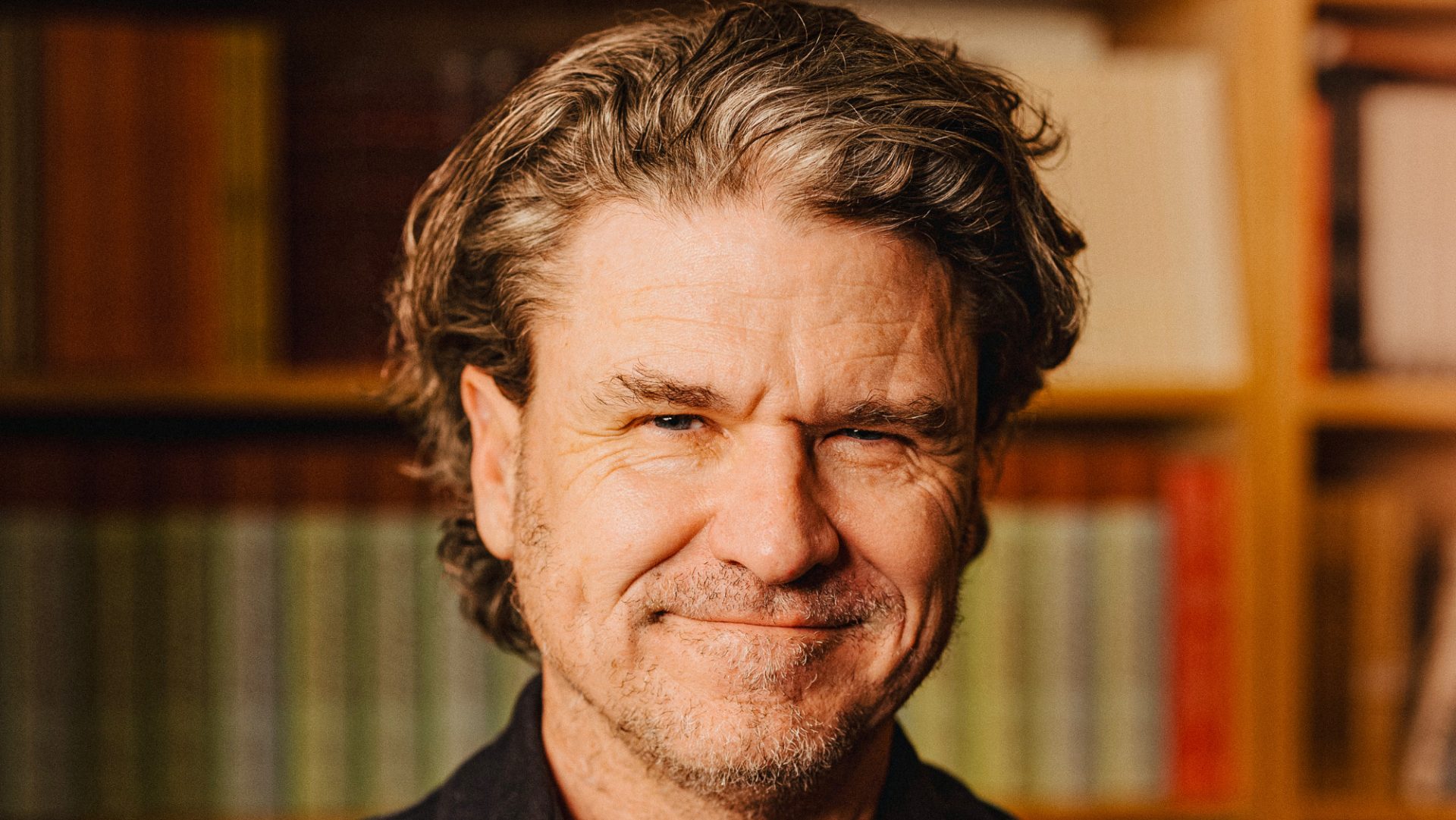
Dave Eggers arrives at his publishers’ west London offices hot and bothered on this sweltering July day. He got here, an hour late, by Lime bike, which was not the intended mode of transport.
“There was just so much traffic that I had to suddenly behave like Hugh Grant in one of his romantic comedies,” he says, running a hand through his corkscrew salt-and-pepper curls. “Total gridlock. I had to get out of the cab, run to the subway, but found that wasn’t working either, and so I got an e-bike. Had to download the app first, of course, and then plug the address into my phone. I rode like crazy.”
He exhales, to better feign exhaustion. At 56 years old, he appears strappingly fit. “It was great, but I killed, like, six people on the way…”
He grins, and stretches out his jeans-clad legs, which culminate in feet shod in a pair of workman boots so comprehensively battered and torn you figure they must be relics from a previous century. They suit him.
One of America’s most consistently interesting novelists, Dave Eggers is also perhaps the least predictable. Where his peers may attempt one Great American Novel after the other (and not always succeed), he has followed his own distinctly idiosyncratic muse. He’s written agonising family memoirs (A Heartbreaking Work of Staggering Genius) alongside deeply researched non-fiction accounts of immigrant life (What Is the What, Zeitoun, The Monk of Mokha), and the kind of speculative fiction attractive to Hollywood. His 2013 novel The Circle was made into a film starring Tom Hanks.
And now comes his latest work, Contrapposto. Thoroughly traditional in form, it’s a whole-life novel that traces two Midwestern friends – Rob “Cricket” Dibb and Olympia Argyros – from childhood into old age.
The adolescent Cricket wants to be an artist – “contrapposto” is a sculptural and artistic technique in which a standing figure shifts its weight on to one leg – and finds solace from his single mother’s complicated life (and her abusive boyfriend) by taking to the canvas. But Cricket is an introvert, which maddens the more freewheeling Olympia, who considers him genuinely gifted, convinced his gift might lead to a glittering career if he could motivate himself accordingly. But Cricket only ever seems to drift.
“I’ve always been fascinated in very talented people who know precisely what they will do in life, and also what they won’t,” Eggers says, pointing out that, like many artists, Cricket is a sensitive soul. “Every time he comes close to the flame, he flees.”
It’s a sweetly elegiac tale, and one that took Eggers 20 years to write simply because he is the kind of writer who seems always to have so much else on the go at any given time. He grew up in Boston, and by university had set his sights on non-fiction, hoping to follow in the footsteps of his literary heroes Joan Didion, Michael Herr and Tom Wolfe. But after a decade of journalism, his first book was a memoir. He was 30 years old.
“I hadn’t seen that coming,” he says, explaining that he wrote it simply because, “I couldn’t not.”
Shortly after his 21st birthday, his parents – father a lawyer, mother a teacher – died of cancer within weeks of one another. This left Eggers abruptly in charge of his eight-year-old brother Toph, and struggling to make sense of life’s summary cruelties. To process it all, he wrote A Heartbreaking Work of Staggering Genius. This was a doorstop of a book, 500 pages crammed with energy, anger, confusion and elusive catharsis. It became a global bestseller.
But success was not without its complications. Within a year, his older sister Beth died by suicide, and he is reportedly estranged from Toph. Both subjects today remain strictly off limits.
“I had no idea in a thousand years I’d write such a book,” is what he will say, “but I realised I couldn’t go around a story like that, I had to go through it. That’s what we teach at 826 Valencia [the nonprofit tutoring centres he runs with his writer wife, Vendela Vida]: whatever in your world you don’t control, whatever’s chaotic, make it orderly on the page. That way, you own it.”
When I ask whether he enjoyed the literary fame his debut brought, he shifts uncomfortably in his seat.
“I mean, we’re going back 27 years now. I’m not sure I remember it.” This seems unlikely. Surely it formed the person sitting in front of me today? He frowns. “I don’t know. I’ve written a bunch of books since, so if it hadn’t been that one, it would have been another.” Yes, but – “Like I say, what I wanted to write was non-fiction. That memoir was a weird detour.”
He has, however, gone on deliberately weird detours ever since, authoring over 30 books, which include fiction, non-fiction, children’s books, novellas and essays. Any spare time he has is spent overseeing his philanthropic endeavours.
Suggested Reading


How Trump warped the minds of the world’s young men
Why, I ask, is activism so important to him?
“Well, my mother and a lot of my friends were teachers, so it was just a daily conversation we all had – how to help kids,” he says.
The ethos behind 826 Valencia is a simple one: encouraging children to express themselves on the page, “especially now, in the age of ChatGPT and AI”. The initiative was immediately successful, but still he wanted to do more. “I thought that if I could clone myself, then I could reach even more kids.”
In lieu of cloning, he asked his writer friends to help out. “I realised that I knew a lot of ne’er-do-well layabouts with an expertise in the English language and a lot of free time…”
Nick Hornby runs something similar in England, and Roddy Doyle in Dublin. “There are now 74 schools around the world, and it’s not a complicated thing we’re doing,” he insists. “It’s one adult sitting next to a younger person and saying: ‘That’s good, keep going’.”
His optimism does not merely exist within the classroom. He remains politically upbeat, too, despite the ongoing challenges in an increasingly fractured America.
“Look, if you go back to study the last 100 years of American elections, it tends to pivot hard each time. Recently, it’s gone from Bush to Clinton to Bush to Obama to Trump – Biden was an anomaly – and so in 2028 we will go back to a Democratic presidency.”
He’s sure about that?
Nodding, he says: “There is absolutely no chance of another Republican. That would deny all statistical probability.” I wonder out loud whether one anomaly might beget another? “No. Trump will lose the midterms by a tidal wave. His approval rating is now down to 30%, which just leaves the lunatic core. All the moderates have left.”
And Trump has no obvious successor? “Who? JD Vance? He couldn’t be elected as mayor of this block.”
The subject both invigorates and exhausts him. He has written much about Trump this past decade, attending his rallies in a journalistic capacity. “I feel I’ve given him enough of my time.”
This is why Contrapposto is deliberately not a political novel, but a humane one. Approaching 60, Eggers is taking stock of his life, and appreciating those closest to him. Like his character Cricket, he has nurtured friendships over many decades, but says that the most inspiring ones right now are those more newly made, with creative types older than he.
“I saw Brian Eno last night; we’re friends. He’s 78, looks 60, acts 40, and has the idealism of 20.” Eggers smiles in admiration, and plays with a rip in his boot. “That’s my role model now.”
Contrapposto is published by Canongate