For the past 15 days in Tirana, the capital of Albania, the routine has remained pretty much the same.
At 4pm the enterprising hawkers, who in more normal times would be found outside football grounds, begin to set up their stalls, selling flags, scarves, qeleshet – Albania’s traditional white brimless cap – and the all-important whistles.
From around 5pm the broadcasters’ outside broadcast vans park up, one alongside the other. Pieces to camera are recorded, voxpops recorded on nothing more sophisticated than an iPhone and drones tested high above the air of the capital’s major thoroughfare.
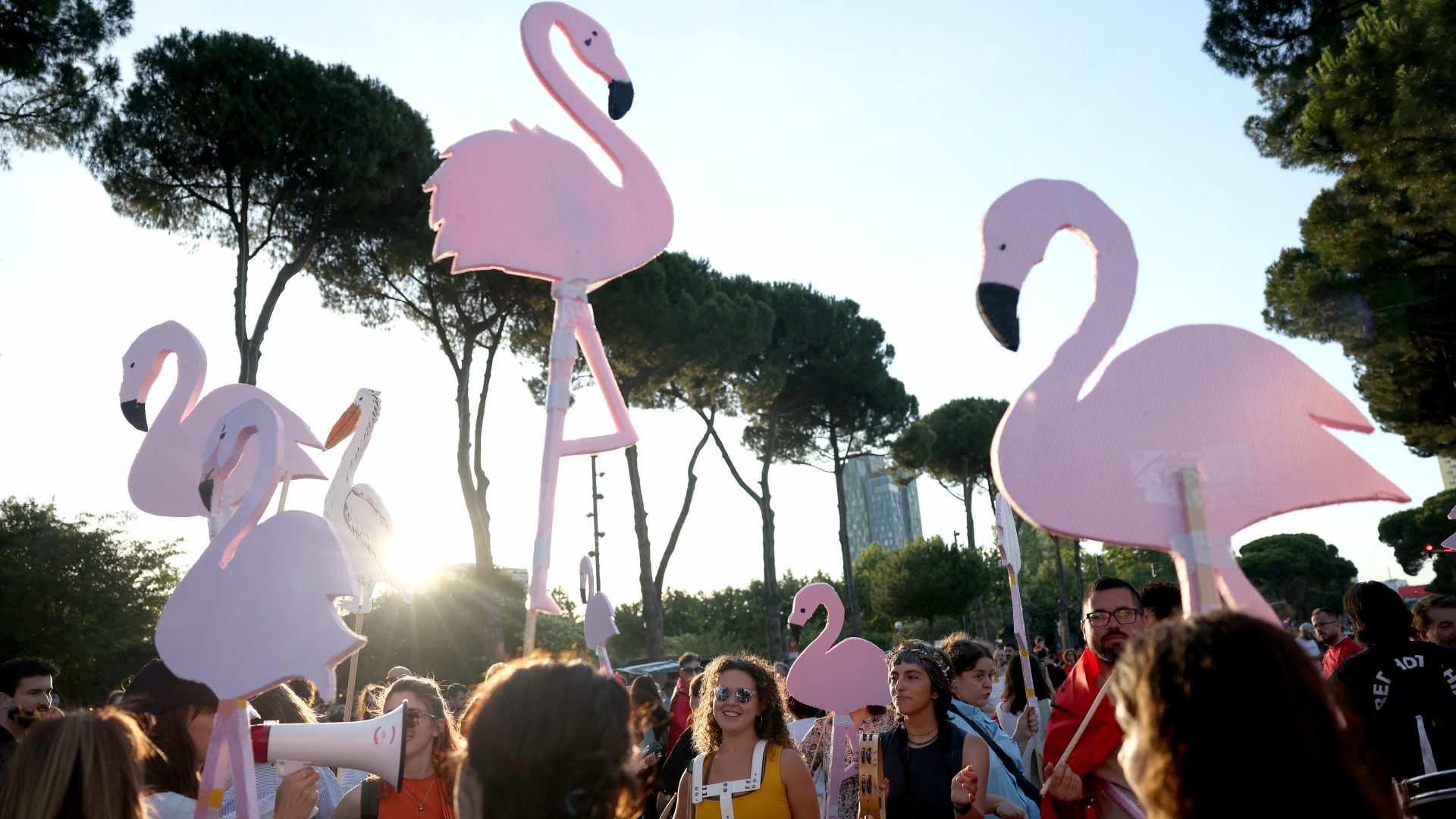
Then the crowds – thousands upon thousands of people – wend their way along Dëshmorët e Kombit Boulevard, a sea of red, waving placards and home-made flamingoes, chanting to the inevitable tune of Seven Nation Army and, as they finally gather outside the prime minister’s office inform the world, loudly but lucidly, that Jared Kushner is a c**t.
Last night was the 15th in a row that the people of Tirana took to the streets to protest against a luxury tourism project worth nearly €4bn that’s being planned by the US president’s son-in-law. His investment firm plans to build this development on a protected coastal area on the Adriatic.
Suggested Reading
This is how Elon Musk’s trillion-dollar house of cards could collapse
The project, apparently sparked by Kushner’s wife Ivanka Trump “discovering” an abandoned island while on vacation, involves the construction of a hotel complex on the former communist-era military base, Sazan Island, and the adjacent shoreline to “create a world-class destination”.
But that second site, an undeveloped stretch of beach called Pishë Poro-Narta, sits within a protected nature area, the Vjosa-Narta Protected Landscape. It is home to endangered species such as monk seals, nesting sea turtles and more than 200 bird species, including pelicans and flamingoes. It is these pink birds whose image is ubiquitous in central Tirana, the unwitting symbol of an increasingly bitter fight between prime minister Edi Rama and his people.
For the previous four nights I’d been staying just off Dëshmorët e Kombit Boulevard, which runs through the city centre. I marvelled at the size of the protests. Rama claimed there were no more than 2,000 people. But that’s absurd. Saturday’s protest saw an estimated 100,000-200,000 people take to the streets.
The crowds are young, and often made up of families, taking pictures as they go along. There is an area for children to draw and paint. Almost everyone is clad in an Albanian flag, football shirt, or both. Flamingoes – inflatable, or plastic and mounted on poles – are everywhere.
The crowd is broadly good-natured. Police look on, but they’ve not got much to do. In four nights I didn’t witness any intimidating behaviour. Yes, there is a lot of call-and-response chanting (in English) of “Jared Kushner is a c**t” but, even then it retains a festival atmosphere. Rama’s other claim, that the protestors are somehow part of an Iranian-backed “hybrid war”, seems, to put it politely, as fanciful as his estimates of their size.
Suggested Reading
Meet the Trump hire who says the president is now out of control
While the flamingoes are the symbol of the protests, the causes go deeper. Many Albanians see Rama as too keen to placate Donald Trump, to the extent of selling part of the country to his son-in-law. Albania is one of only five fully European states to sign up to the president’s preposterous Board of Peace.
“ALBANIA IS NOT FOR SALE”, say many of the placards. More awkwardly, others say “Shqipëria u përket shqiptarëve” (Albania belongs to Albanians), something Rama has seized on to insinuate far right motives.
Others are more explicit that Rama’s enthusiasm amounts to, in their eyes, corruption. One protester shows me her “NOT YET IN THE EU – FULLY INTEGRATED IN CORRUPTION” placard. For an increasing number of Albanians, it would appear even a u-turn on Kushner Island would not be enough to placate an electorate who, by their banners and chants, want to see the prime minister out.
It’s difficult to see how this situation resolves. Rama is insistent he will not turn back, saying development and nature “can coexist”, that it will transform the country’s tourism map and, somehow, strengthen its path towards the European Union (it is not clear how).
And the prime minister, usually a talented communicator, is also increasingly losing his temper with the protests, this week using his weekly podcast to denounce a portion of those taking part as being hajvan, an Albanian term roughly translated as stupid. It is unacceptable, he said, for a segment of protestors to call for a boycott of pop singers’ concerts if they refuse to speak out about the ongoing demonstrations.
Meanwhile, the protests continue. As I write this, the hawkers of Skanderbeg Square will be preparing to lay out, for the 16th time, their tables selling everything the modern protester needs. If nothing else, Albania’s qeleshe industry has not had it so good for quite some time.