In the acknowledgements to his 2013 novel An Officer and a Spy, Robert Harris thanked his long-suffering wife for sharing a home over the years with “successive waves of Nazis, codebreakers, KGB men, hedge-fund managers, ghostwriters and assorted ancient Romans.”
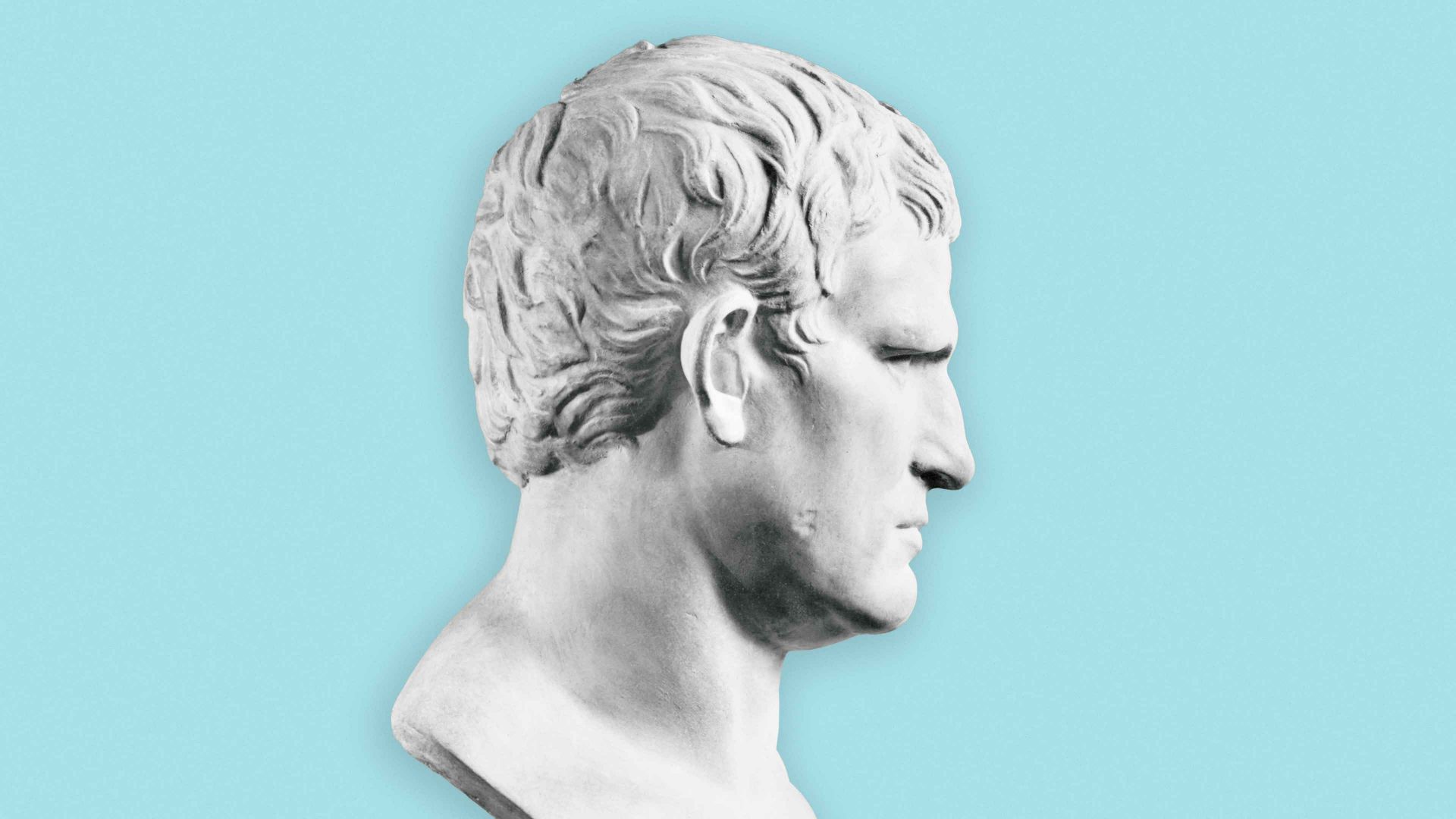
Harris’s latest novel – his 17th – sees the bestselling author giving additional houseroom to more ancient Romans, and one great general in particular. Agrippa begins with the eponymous protagonist, aged 50, retreating to his villa on the Bay of Naples to forget about his failing health and his wife’s infidelity, and devote what energy he has left to writing his memoirs.
The story he tells is one of rags to riches and ruthlessness. Born a plebeian with few prospects, Agrippa finds his life dramatically transformed just before his 14th birthday when he defends and then befriends a bullied boy at school. His fellow pupil, Octavius, turns out to be a great-nephew of Julius Caesar, who has recently invaded Italy and is advancing on Rome.
A few years later, Caesar asks both boys to join him and his forces in crushing an uprising in Spain. Agrippa’s first military expedition is a brutal baptism of fire, but he finds his calling in the heat of battle. Then, after Caesar is assassinated, his heir, Octavius, comes to rely on Agrippa as his adviser, but also his protector, especially as news gets around that Octavius is to be “raised, praised and erased.”
Suggested Reading

The strange beauty of London in flames
From this moment on, Agrippa rises through the ranks. He is elected a tribune, a senior consul and is tasked with governing Gaul. He fights in savage conflicts and acquires a reputation as the Roman Republic’s most fearsome warrior and formidable general – “so much so that the mere name Agrippa spreading from man to man across a battlefield has often been enough to make an enemy sue for peace.” He turns into Octavius’s right-hand man, aiding him when he is sickly or vulnerable or indecisive.
But then as Octavius grows in stature and becomes Emperor Augustus, the dynamic between the pair irrevocably shifts, leaving Agrippa to make some difficult choices and both men to go their own way, “after a quarter of a century of intimate friendship, torn apart by the ineluctable dictates of power.”
Despite its setting, Agrippa is a markedly different book to Imperium (2006), Lustrum (2009) and Dictator (2015), which made up Harris’s Cicero Trilogy. Those novels were rich in political machinations.
At one point in Imperium, Cicero’s confidential secretary, Tiro, tells us that “the quickest way to get ahead in politics is to get yourself close to the man at the top.” In Agrippa, the title character sticks close to Octavius and gets ahead, only not in the field of politics but rather the arena of war.
“War always breeds more war,” Agrippa reminds us. It certainly does here. After a while, as Harris’s hero dons his armour and goes into battle yet again, we start to wonder if we are getting too much of a good thing. Still, it would be churlish to fault Harris for repetitiveness when his combat scenes and set pieces are so brilliantly and viscerally depicted, not least that epic slaughter at sea, the battle of Actium.
But the book isn’t all blood-and-guts fighting. Harris fleshes out Agrippa by showing other facets of his character. He was a man of destruction but also construction, responsible for building aqueducts, the original Pantheon and, his proudest accomplishment, a strategic harbour complex. We view Agrippa’s more sensitive side when Octavius becomes increasingly capricious – first instructing Agrippa to divorce his wife to marry his niece, and then informing him that he wants to adopt his two sons.
Suggested Reading


What happens when the world stops reading books?
Harris creates tension by tracing uneasy alliances, especially the caustic rivalry between Octavius and Mark Antony. He also introduces a welcome element of intrigue surrounding Agrippa’s origins.
The result is another masterful historical work, one which deftly blends fact and fiction to simultaneously chronicle two friends’ rise to power and Rome’s descent into dictatorship.
Agrippa by Robert Harris is published now by Hutchinson Heinemann