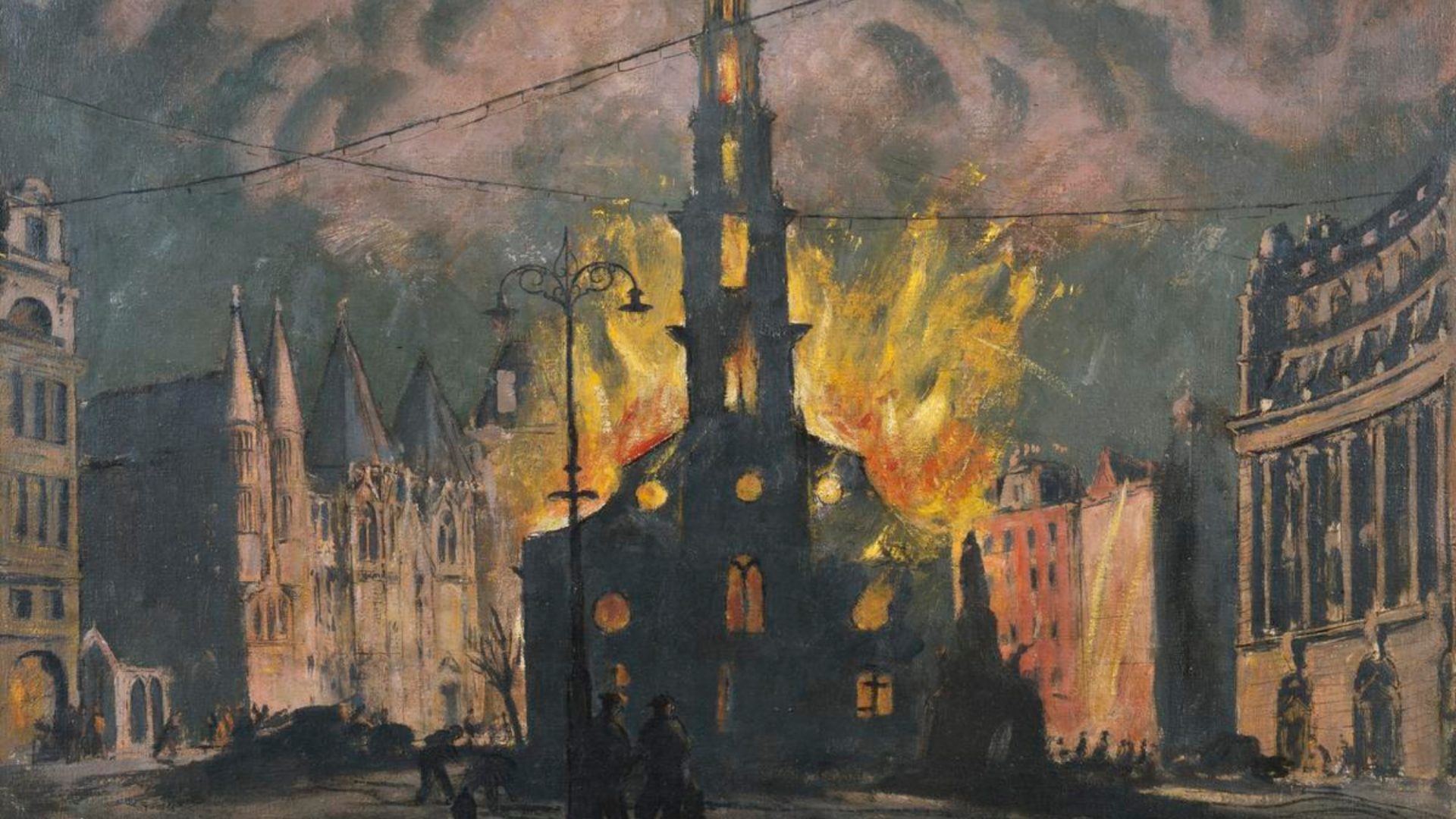
A church is in flames in the middle of the night. There is a childlike simplicity and vibrancy to the painting: squint or step back and the focal point could be a fizzing firework or a rocket blasting off. But this is not jubilant eruption, rather it is violent destruction.
The church is a hollowed-out husk, a silhouette against the raging conflagration. Yellow fire glows in windows in the nave and the tower and bathes the surrounding buildings in a pinkish hue. Above, the sky is blotted out by roiling clouds of smoke. In the foreground, two figures look on helplessly while a majestic facade turns into a charred ruin.
St Clement Danes church on the Strand was one target of a Luftwaffe raid in May 1941. The British artist Henry Carr painted it while it was ablaze. His arresting St Clement Danes Church on Fire after Being Bombed (1941) is one of many paintings on display at an exhibition at the Imperial War Museum.
Beauty and Destruction: Wartime London in Art chronicles the city’s upheavals and transformations during the course of the second world war through a series of paintings by both celebrated and lesser-known artists. Along with depictions of widespread damage, the paintings also show how Londoners kept calm and carried on through extreme adversity.
The exhibition gets under way with a quote on the wall which serves as a kind of mission statement: “Bomb damage is in itself picturesque.” So claimed the art historian Kenneth Clark. (In the caption to Carr’s painting, we see how Cecil King, chairman of the Daily Mirror, echoed this sentiment, describing the sight of the burning church emitting “showers and sparks” as “an odd and rather beautiful spectacle.”)
A brief introductory and explanatory film provides context about the impact of the Blitz on London and Londoners. It also outlines how artists did their bit for the war effort. Many were commissioned by the War Artists’ Advisory Committee, established by the Ministry of Information and chaired by Clark.
The artists were tasked with documenting the destruction and fortitude of the city. As Rebecca Newell, head of art at the IWM puts it, “Their legacy shows a city on the edge, but also reveals an uplifting story of hope, creativity and humanity in the face of unprecedented change.”
The exhibition is made up of various themed sections. The first is devoted to travel and demonstrates how important it was to keep London moving and functioning during the war despite mass disruptions.
One of the most striking paintings here, Frank Dobson’s An Escalator in an Underground Factory (1944), presents crowds of female factory workers in white overalls descending into long, deep, bomb-proof tunnels to commence work producing shells and radio equipment. On the other side of the picture, the women’s foreman cuts a lonely figure going up an escalator with his bicycle.
A second section called “Thames” highlights several aspects of the river at different stages of the war. Three paintings by John Edgar Platt, an artist for the Ministry of Transport, comprise an assortment of “wartime traffic”: minesweepers and gunboats, barges and tugs transporting war supplies, and police boats rescuing downed airmen.
Frances MacDonald gives a view of the construction of floating harbours – preparation for D-day. Further building work for the operation is in progress in Paul Ayshford Methuen’s picture of “invasion-craft” taking shape in West India Docks by way of brisk brushwork and flashes of light colour.
A selection of paintings remind us that the Thames was used by German bombers as a navigational aid to help home in on both industrial and political targets. There are Thameside scenes of blitzed buildings. In Leonard Rosoman’s dramatic centrepiece, the Houses of Parliament are engulfed in churning white smoke.
Bombs are seen in flight: in Matvyn Wright’s snapshot of dread, black shipping shapes are set against a crimson sky while in the distance a German parachute bomb falls, about to explode; in Frederick TW Cook’s hectic image, a flying bomb makes a red streak above Tower Bridge as searchlights frantically strafe the sky.
Elsewhere, in a section on streets, we find deserted houses in Pimlico, sandbags in Bethnal Green and firemen in Millbank. St Paul’s Cathedral appears in two paintings, each time rising victorious and intact amid surrounding devastation. In a work from 1941 by one of the most famous painters here, Duncan Grant, it stands proud in vibrant colour during the day, alongside a ruined church; in a painting by the less familiar Ernest Boye Uden, it looms in a nightscape above the flames and rubble of bomb-ravaged Cannon Street.
The fourth and final main section is titled “Shelter” and predominantly consists of scenes of safety in numbers. Civilians take refuge in tunnels, railway shelters, brewery cellars, “rest centres” such as schools and church halls, and of course tube stations. Some scenes look cosy: in Olga Lehmann’s vivid A Concert in a Shelter, St Pancras Borough (1941), an audience in grey is entertained by a performer on an illuminated stage.
Other paintings, often in bleak monochrome washes, attest to the harsher reality of cold and cramped conditions. Edward Ardizzone brilliantly captures the Dickensian squalor of Tilbury, the largest and most infamous mass shelter – an underground depot that housed as many as 16,000 people each night. His faceless, dehumanised individuals wander or huddle together in a vast, crypt-like space that recedes to a distant vanishing point.
The exhibition isn’t as comprehensive as it could be. It lacks potted histories of each artist, especially those who are not household names. Learning only that Priscilla Thornycroft produced uncommissioned wartime art (what she called “scribbles on the spot”) and later moved to Dresden, another wartorn city, leaves us craving more biographical detail. Discovering that Wilfred Stanley Haines – whose painting of a night sky filled with smoke and studded with explosions mesmerises – served as a fireman and died at 39 in a bomb blast whets our appetite for more information about a life cut tragically short.
Suggested Reading
A secret diarist inside the Nazi war machine
Otherwise, this exhibition is a triumph. It is hard not to marvel at the broad range of subject matter on show. Most of it portrays a city under siege but here and there we encounter welcome moments of respite.
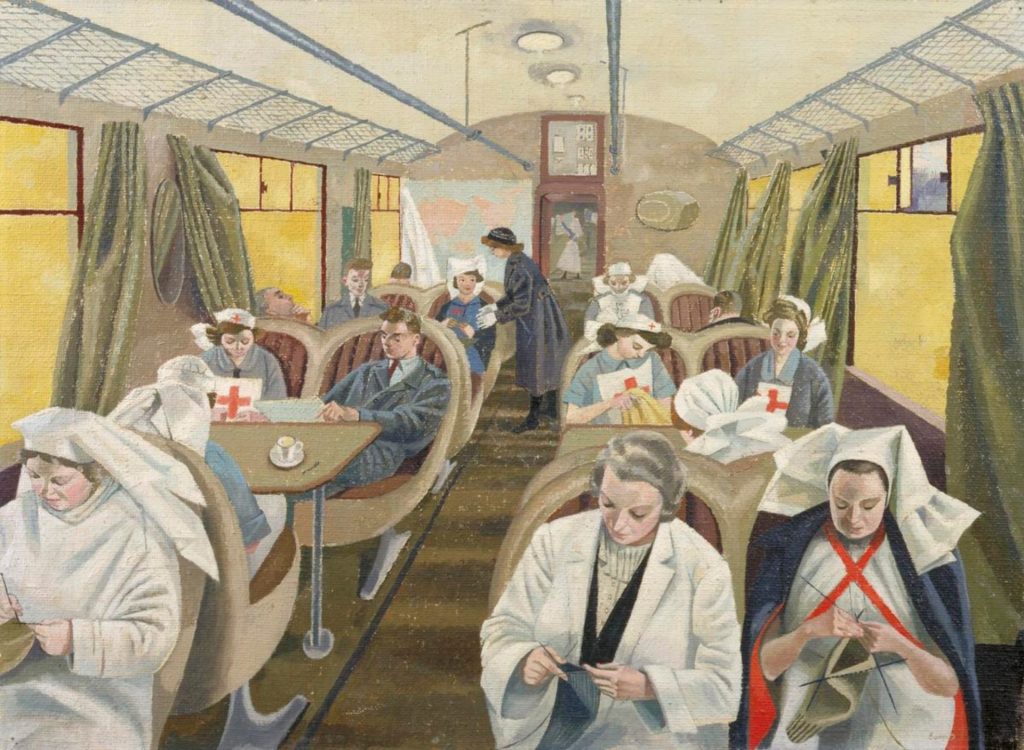
Nurses tend to patients, knit on a train or go beyond the call of duty and make camouflage nets. Soldiers enjoy the nocturnal delights of Piccadilly Circus. Civilians are bolstered by the kindness of strangers at emergency food offices and clothing exchanges.
A last room gathers insightful miscellaneous material – objects, letters, diaries, audio recordings – that relays the wartime hardships and calamities endured by ordinary Londoners. But it is the paintings that hold our attention. Few of them could be regarded as masterpieces. However, each of them has singular strengths. Collectively, they amount to something hugely significant, a grand collage of artistic interpretations of violence and resilience.
Beauty and Destruction: Wartime London in Art is at the Imperial War Museum until November 1