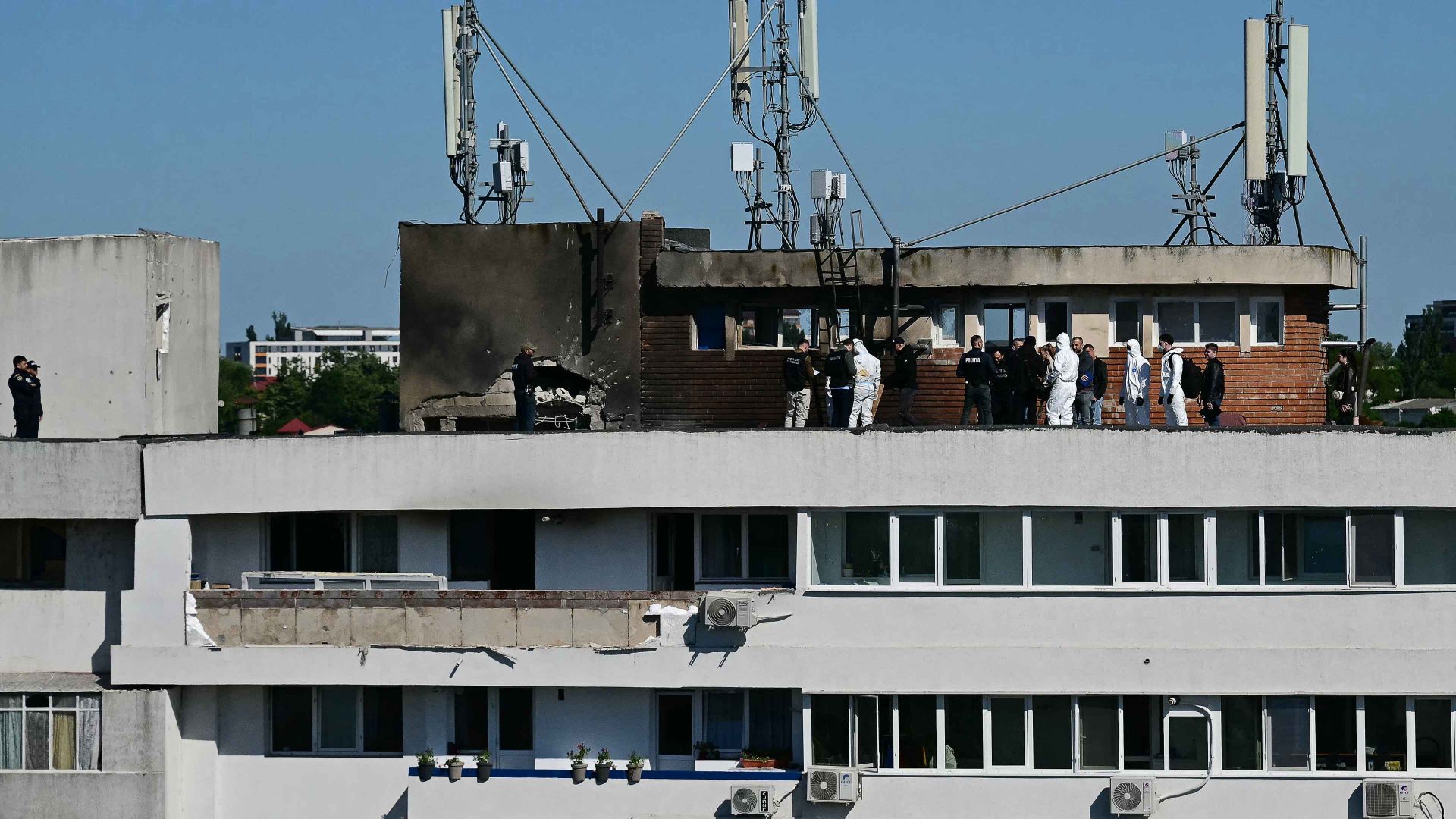
“From now on, I’ll be keeping my eyes on the sky,” says an elderly man for whom the war has moved beyond just a breaking news story; it’s now a reality that has entered the daily life of Galați, a city located near the Ukrainian border.
In the dead of night, he was woken by a powerful explosion caused by a Russian drone. This is not the first Russian drone to reach Romania, but it is the first time one has caused civilian injuries on Romanian soil.
Since the beginning of the war in Ukraine, there have been 28 drone incursions into Romanian airspace. Only the bedroom walls separated a mother and her son from an even greater tragedy: the drone that hit their apartment building caught fire in their hallway, leaving them with injuries. However, this was not the only damage.
The major damage began just a few hours after the physical strike, in an even more violent attack that unfolded on social media. Before the Romanian authorities could react and explain to the public what had happened and how serious the threat was, a disinformation operation was under way.
It is no secret that the Kremlin’s hybrid warfare technique is to create mass confusion, trying to convince the public that everything can be questioned, there is no universal truth, and that alternative truths always exist.
“The drone was actually Ukrainian”, “it’s a false flag operation”, “Russia is just a scapegoat” – these were the narratives that flooded the information space. And it wasn’t just bots and trolls: Tristan Tate, a figure under investigation in Romania for human trafficking, used X to amplify the idea that Ukraine was behind the attack.
Over 14,000 posts appeared casting doubt on Russian responsibility, and things were made worse by the Romanian authorities’ inability to keep up. In the ensuing information vacuum, the fake news began to spread.
This is not an isolated incident. As Corneliu Bjola, professor of digital diplomacy at Oxford University, says: “It should be viewed as part of a hybrid operation”, carried out “across multiple domains, military, informational, and psychological”.
Suggested Reading
Why have we let Putin get away with it for so long?
There have also been attacks in Lithuania, and taken together this broadening of Vladimir Putin’s war should be “understood within a broader pattern of Russian escalation. Moscow appears to be intensifying efforts to test Nato solidarity, particularly at a time when some US military capabilities are being redeployed away from Europe.”
In Romania’s case, it may be the start of an operation aimed at generating resistance to the idea of closer ties with Moldova. The idea of unification has become more visible in public debate in recent months, and some polls show support at 70%. “Moscow may be seeking to highlight the potential security costs associated with closer Romanian-Moldovan integration,” said Bjola, “and to shape public perceptions before the issue gains greater political traction.”
In Galați, some residents are checking the food they have in their fridges. Others fear that power cuts in the summer heat will cause food stocks to spoil. Parents worry when their children are at school because there are no public emergency plans in case of attack. Endless discussions about a growing US disengagement from the region are also a bad sign, despite the strong reactions of European allies.
Suggested Reading
Putinism has failed, and a new kind of threat has arrived
Although the residents of the building hit by the Russian drone were allowed to return home, the gas supply remained shut off to allow for safety checks. The mother and child injured in the incident remain in hospital, and their home is partially destroyed.
Despite efforts by the Romanian authorities and Nato allies to de-escalate tensions, the attack continues in its hybrid form. The sheer volume of disinformation and conspiracy theories is remarkable. But perhaps more worrying is the exceptional speed with which these “informational drones” appeared. They continue to escalate.
Magda Grădinaru hosts the podcast Punctul pe știri (The Point of the News) on Rock FM and publishes interviews with leading intellectuals and experts