The road from Taganrog to Melitopol has become littered with the wreckage of Russian supply trucks. The M14, the only supply route from east to west in the occupied provinces of Donetsk and Kherson, last week closed to non-military traffic, as Ukrainian drones began to inflict heavy losses on Russian logistics.
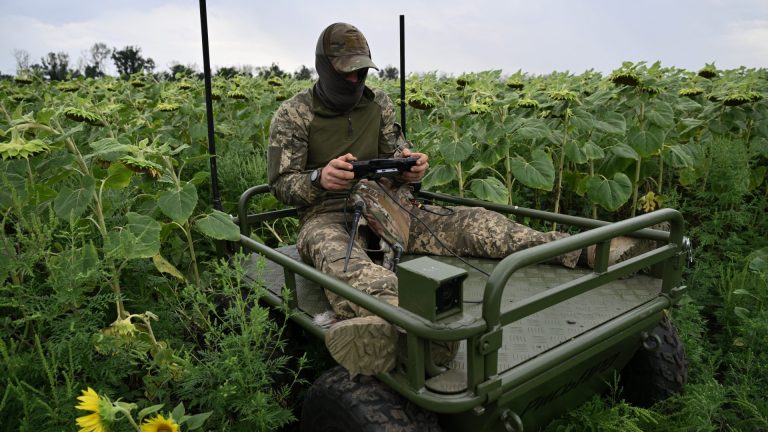
The “kill zone” for fighters at the front is now 15km on both sides. Unless protected by tunnels of netting, anything that moves can be hit by short-range drones. It has reduced infantry combat to a game of hide and seek between humans and flying objects. “We don’t use anti-tank missiles any more,” one Ukrainian officer told me last week, “because armoured vehicles can’t get anywhere near the front line”.
But thanks to large, fibre-optic controlled drones, and cheap long-range missiles, Ukraine’s logistical kill zone now extends to 150km. And while that, eventually, will even out for Russia too, since Russia is the attacker, it creates an asymmetrically grim statistic.
Last year Russia lost around 120 personnel for every square kilometre gained. This year, according to Ukrainian estimates, that figure has risen to 316. As a result, for the first time since the war began, the Russian armed forces are losing more people than they can recruit.
It is likely that 1.3 million Russian soldiers have been killed or injured. And when it comes to fighting vehicles and artillery, Russia looks to have depleted close to 80% of its prewar stock.
In short, a Russian war effort fuelled by nationalism and rhetoric is grinding against the twin immovables of geography and arithmetic.
And it is beginning to tell at the level of politics and economics. Russia’s official labour shortage has hit four million. Ukrainian deep strikes have reduced Russia’s two main oil export terminals – Ust-Luga in the Baltic and Novorossiysk in the Black Sea – to around 60% of their capacity.
Suggested Reading
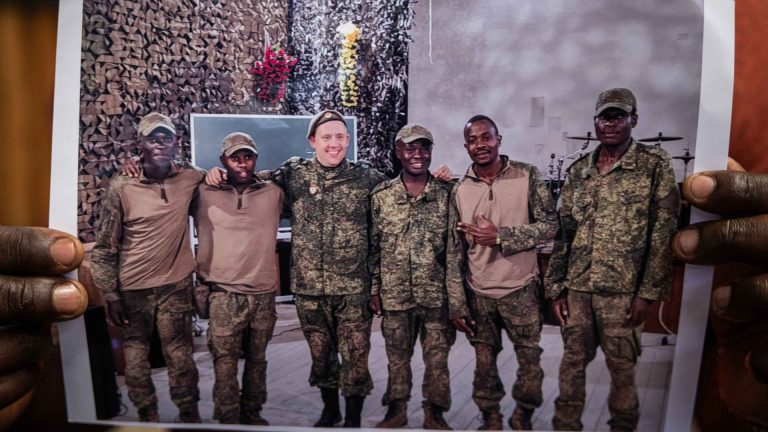
The Africans dying in Putin’s failing war
Wartime demand boosted Russian GDP growth above 4% in the first two years of the war. But in the first quarter of 2026 the economy contracted. And though Russia’s National Wealth Fund, accumulated in peacetime from oil and gas revenues, still stands at $178bn, it is rapidly depleting the assets that can be sold to fund the war, with some analysts predicting their exhaustion by the end of 2026.
So there is a crunch point coming. Vladimir Putin can either go on throwing men, trucks and supplies into a no-win war, seeing his economy stagnate and its cash reserves depleted. Or he can do something different.
A rational politician might decide to cut their losses: seek a permanent and official peace, leaving the seized portions of Luhansk, Donetsk, Crimea and Kherson in Russian hands and an end to the severe western sanctions regime.
‘Putinism is a project that has now lasted more than a quarter of a century. Its outcome is not defeat but strategic failure, and no amount of internet censorship and kitsch war movies can hide that fact from the Russian people’
But Putin’s war has, from the get-go, been driven by the irrational belief that a country whose GDP is the size of Italy’s can be a global superpower, and that the Ukrainian language, culture and ethnicity do not exist.
So the options that will be on the table are not peace but the reversion to “continuum conflict” – known in the west as “hybrid” or “cognitive” warfare – waged not just against Ukraine but against the entire western system, and/or with rapid conventional rearmament aimed at menacing Finland, Poland and the Baltic states.
Among the Russian population there is a mixture of war fatigue and elated delusional nationalism. Every public event is seized as an opportunity to dress up and re-enact the second world war. Kids appear on TV singing songs denouncing use of the internet, while the state imposes frequent mobile internet blackouts and criminalises the use of Virtual Private Networks that might circumvent censorship.
Suggested Reading
How Europe stops Gen Z going to war with Putin
Compare all this now to Ukraine. Its population, too, is war weary. But its soldiers are holding and regaining territory. Its engineers and software designers are palpably winning the innovation war, turning the country into a military-industrial powerhouse with a lucrative new market in the Gulf. We won’t know how strong its democracy and democratic culture really are until there are elections. But diplomatically Ukraine has been transformed from supplicant to equal in its relations to the EU.
Consider, too, the state of the western democracies supporting Ukraine. Yes, their polities are under stress, with pro-Russian far right parties like Reform and the AfD making gains. But they are holding, and have proved capable of shouldering the entire burden of funding Ukraine’s war effort after Donald Trump’s treacherous withdrawal.
So as State Duma elections approach, Putin is not finished, but has diminishing options. There will, of course, be no serious opposition to his United Russia party, other than from the equally bellicose communists and national liberals. The anti-war Yabloko party has seen its leaders and officials come under increased state repression this year.
But since the last Duma elections, in 2021, there has been a political counter-revolution: in the years before the war began there was a proliferation of new parties loyal to the leadership but critical of the system. That ecosystem has been expunged: no serious new opposition party has been formed for the past six years.
So though Putin’s regime remains stable, as the Dutch Clingendael Institute points out, the whole of Russian history is composed of “stable” regimes that suddenly crack.
And the fact remains: Putin chose war as the means to prevent Ukraine’s orientation to the European Union and the west, and in the 2021 Draft Treaties conceived the attack as a prelude to the total renegotiation of eastern Europe’s alignment with Nato. The result was Finland and Sweden joining Nato, the increasingly rapid rearmament of Poland, Germany and Romania, the failure of a destabilisation campaign in Moldova, and massive attrition now in Ukraine.
Putinism is a project that has now lasted more than a quarter of a century. Its outcome is not defeat but strategic failure, and no amount of internet censorship and kitsch war movies can hide that fact from the Russian people.
Suggested Reading

This is Putin’s most transparent move so far
So we are now at the dangerous moment. Last week British soldiers staged a command-post exercise in the tunnels of Charing Cross station, designed to simulate a war with Russia in 2030. But the most urgent threat we face from a desperate, criminal regime in Moscow is cognitive.
Cognitive warfare is a relatively new concept for western security analysts, but has replaced “hybrid” and “greyzone” aggression as the framework for understanding what our enemies are trying to do to us.
Put simply, they are trying to alter the chemistry of our individual and collective brains, by inducing fear, distrust, panic and confusion in the face of a tsunami of facts we cannot process.
From the phantom rape in Epping, which triggered serious public disorder by far right activists, to the “gig economy” arson attacks against Jewish premises, to the attempt by masked pro-Palestinian demonstrators to rush the doors of the Ministry of Defence, with an Iranian state media guy on hand to broadcast to the world, British politics and society are being swamped by the effects of Russian, Chinese and Iranian psychological attacks.
The British public’s willingness to go on supporting Ukraine has been admirably consistent, despite minimal attendance at solidarity demonstrations, and the low-key nature of activities at a community level. We’ve outsourced our support for Ukraine to the political class – scarcely registering the gruelling 12-hour train trips they make to pose with Volodymyr Zelensky in Kyiv, and barely noticing the massive British financial and material resources that are helping to sink ships, torch oil refineries and blow up trucks.
As this phase of Putinism reaches its endgame, it is time we noticed more. This conflict, which lurks at the edge of most people’s consciousness and barely affects British politics, is probably the most decisive event we’ve lived through.