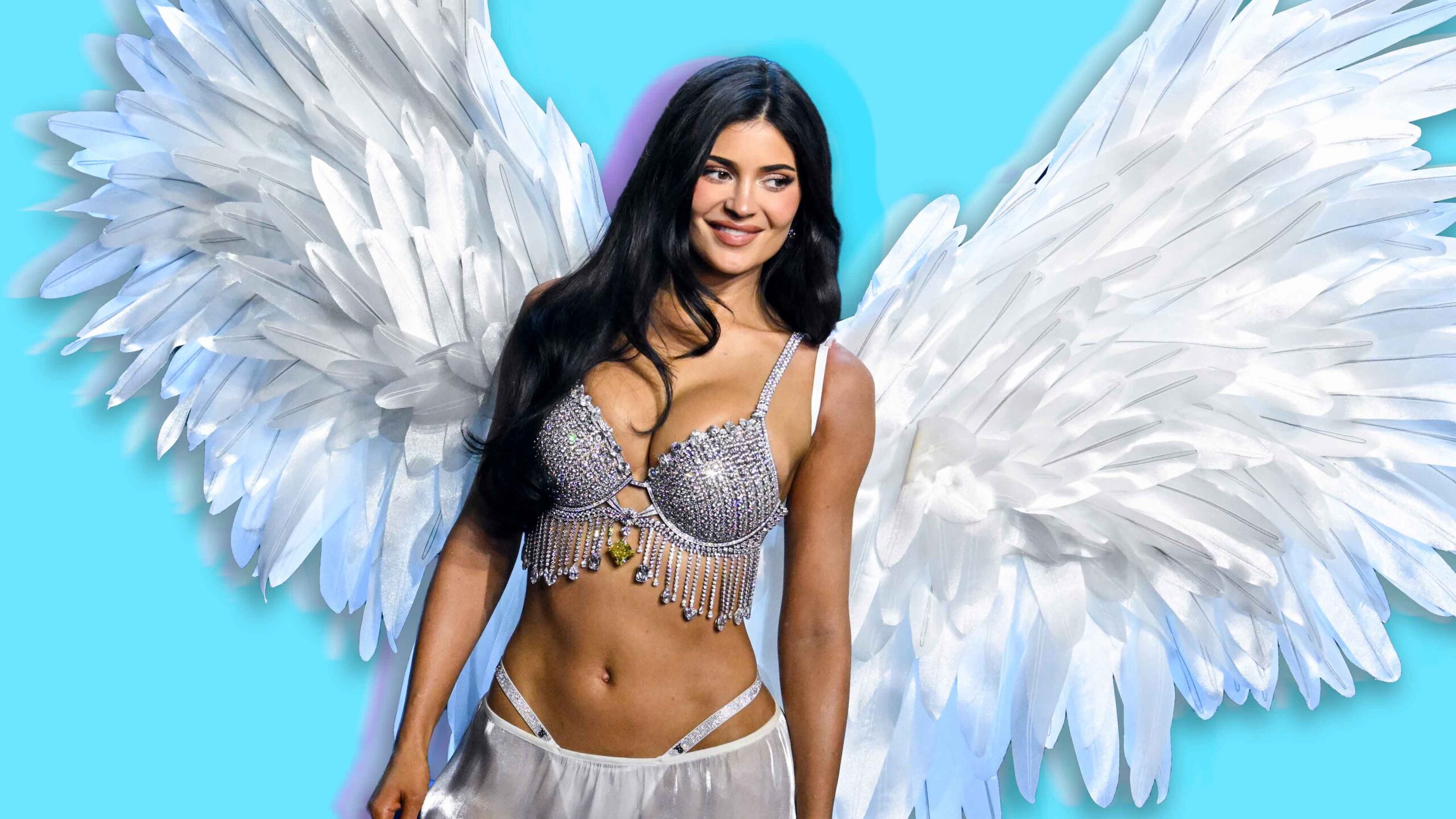
Kylie Jenner has made a lot of people very angry by wearing a bra. Not just any bra, but Victoria’s Secret’s $50 million Fantasy Bra, a diamond-encrusted confection usually reserved for the brand’s established ‘Angels’ (supermodels).
Jenner, a reality star and beauty mogul, made her runway debut in it, prompting many fashion fans to ask why a woman famous for being famous had been given the prize, rather than an actual model?
One user on X posted: “It’s bizarre to think that Kylie Jenner never walked a professional runway and yet already won a Fantasy Bra worth tens of millions. Zero merit. Family name and Instagram fame solve everything these days. Unfortunately, Victoria’s Secret has turned into a celebrity parade, not a model show.”
Obviously, this is all rather silly. Though it is also true that models are being squeezed out of their own industry, with brands increasingly prioritising follower counts over experience, talent or artistic credibility. Still, I promise there is a more serious point here.
Suggested Reading

Britain needs the BBC – but not in this current form
When did celebrities become the answer to absolutely everything? Why, whenever an industry wants to revive its fortunes, does it reach for a famous face rather than an original idea?
Instead of platforming new writers, directors or presenters, our creative industries foist upon audiences yet another series in which a famous person goes on holiday, renovates a house or explains their childhood trauma to a camera crew.
Of course we are a celebrity-obsessed culture. We have always had gossip columns, reality television, and chat shows in which famous people interview other famous people about being famous. None of us is immune to it.
But there is a difference between being interested in celebrities and wanting them to replace everyone else.
Victoria’s Secret has decided that in order to regain their dwindling relevance in the public sphere, they should put one of the most famous women in America in their most famous bra. Fair enough. It’s hardly Watergate.
But when the same logic is applied to journalism, broadcasting and public service, it becomes rather more depressing.
And if any organisation should understand this, it is the BBC. (I told you a serious point was coming)
The recent headlines have been grim. You and Yours, the long-running Radio 4 consumer affairs programme, is being axed. The BBC is scrapping its dedicated education editor role. There are cuts across the corporation, all explained by the familiar and doubtless genuine problem of insufficient money.
And yet, rather bizarrely, its apparent Hail Mary is to embrace the dubious theory that what the public really needs is more influencers.
YouTuber Lewys Ball, known online as @lookingforlewys, is launching a BBC video podcast, Tell Me I’m Wrong, alongside Morf Peyiazi. Meanwhile, GK Barry, the influencer and I’m a Celebrity contestant, has been handed a Radio 1 presenting slot. Her arrival has already prompted complaints from listeners who would apparently rather listen to almost anything else, including, one imagines, a man explaining his loft conversion on Jeremy Vine.
There is something peculiarly maddening about this. The BBC is one of this country’s great achievements. I love it, sincerely and without irony.
It is the institution that can send a brilliant reporter to a war zone, an expert to explain a complicated scientific discovery, or a properly informed person to tell us why our energy bills have gone up again. It can make a radio programme about a subject you had never considered and leave you wondering how you managed to live without it. And it has produced the greatest comedies and dramas of all time.
That is the BBC’s innate BBCness. It is not an embarrassing, old-fashioned quality to be ironed out by a digital strategy team of TikTok-obsessed Zoomers, presumably able to wildly impress their superiors by knowing how to use Canva and what a hashtag is.
People do not turn to the BBC because they want another version of TikTok, only with a slightly more expensive microphone. They turn to it because they want something better.
Suggested Reading

Sydney Sweeney and the art of political pornography
Sometimes they want a celebrity, too. There is no law against it. But a celebrity is not a substitute for a journalist, any more than a Kardashian is necessarily a substitute for a supermodel.
The trouble is that executives see enormous online audiences and mistake them for transferable assets. If someone can attract millions of views on YouTube, surely they can attract millions of listeners to Radio 1? If an influencer can sell lip gloss, surely they can sell public broadcasting?
But following the numbers is not the same as understanding an audience. And the reverse is true, too: success in traditional media does not automatically translate to the internet. Just look at Amol Rajan’s new solo venture, which charges a brave price of £999 for lifetime membership, whose flagship first interviews have struggled to get more than a few thousand views on YouTube.
Corporations, from underwear brands to our national broadcaster, need to remember that in a world where the concept of a culture is increasingly disappearing as our AI-generated algorithms shove more slop into our mushy brains, what people are hungry for is authenticity. Not celebrity.
 Most popular

‘The deep state stole my mini-budget’: An exclusive extract from Liz Truss’s new book


Nigel Farage’s attack on the RNLI and co is a new low even for this bottom-feeder

18 things that will absolutely, definitely happen if Trump gets whopped in the midterms

I went looking for Trump’s America – this is what I found