
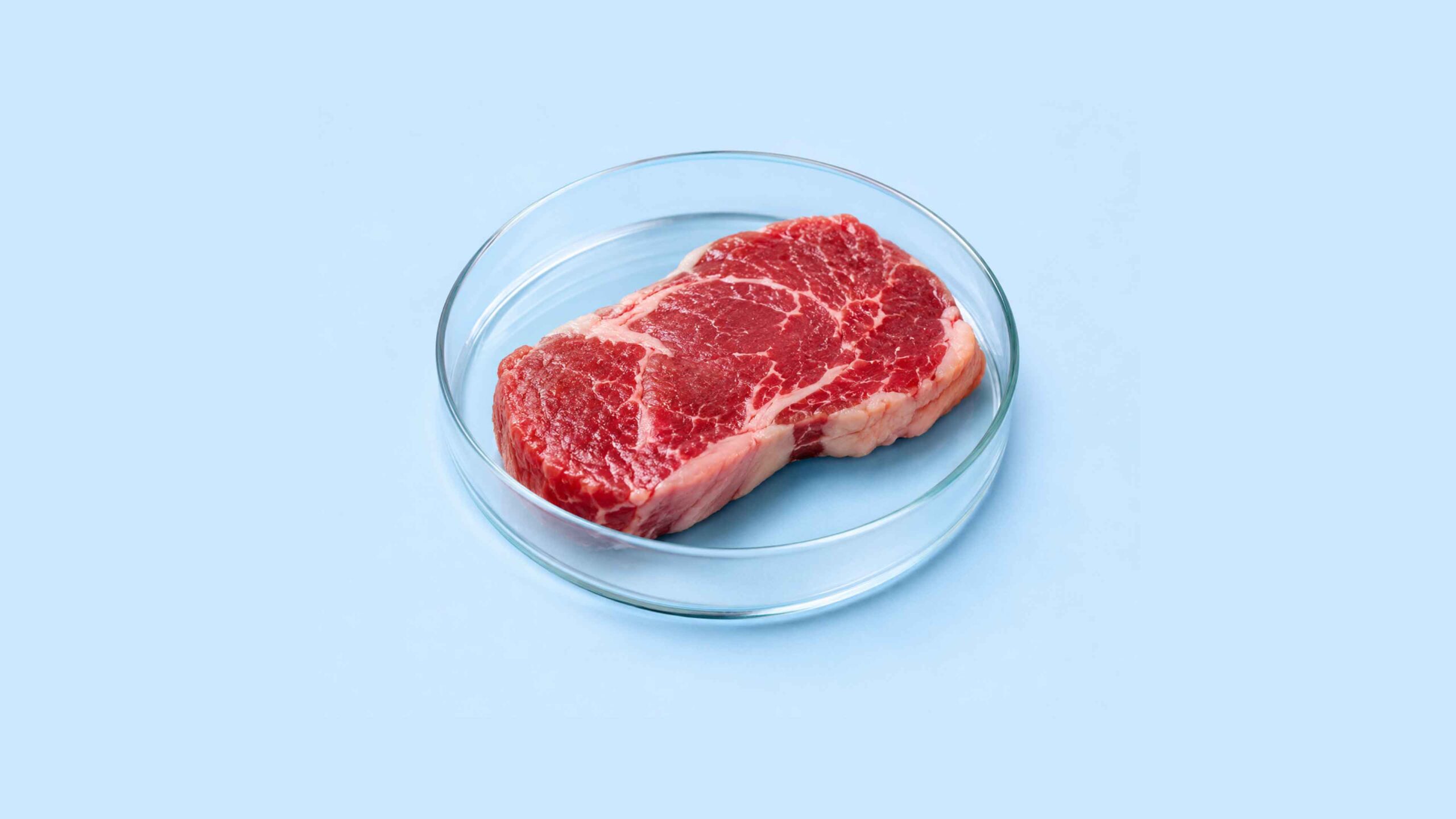
Good news! Scientists have found a way to tackle one of the biggest contributors to climate change, spare billions of souls a life of unimaginable misery, and potentially put an end to one of humanity’s most grotesque sins against nature. The downside? Your roast chicken might taste slightly different.
Hi, I’m a vegetarian. I used to work in an animal shelter, and I refused to watch The Walking Dead because a horse dies in the first episode. And I am ecstatic about the prospect of eating meat again.
Lab-grown meat is an idea that has been floating around for decades, periodically wheeled out to trigger right-wingers, vegans, or both, and occasionally deployed as dinner-party discourse when the conversation gets too dry. The first laboratory-grown beef burger was unveiled in London in August 2013 and cost €250,000 to produce. So not exactly ready to hit the supermarket shelves, unless the supermarket was in, say, Monaco.
Since then, us moral people (vegetarians) have had to make do with what the food industry has thrown at us. First came the grim years of dry tofu, falafel wraps and bean burgers with the texture of damp cardboard.
Then came the first veggie sausages, which tasted like someone had described a sausage, but not very accurately. Finally, in the last few years, we’ve had the likes of “Beyond Meat” and “This Isn’t” and “Quorn”, which are actually very good. Good enough, even, that meat-eaters will eat them without giving you too much of a withering, resentful look when you load some on their plate.
But now, finally, we appear to be getting somewhere. Enter UPSIDE Foods.
The American company has been developing cultivated chicken, which is real meat grown from a sample of cells from a single heritage-breed chicken egg. That original sample was stored and developed into a cell bank, which can be used to produce millions of pounds of chicken.
In November, its “chicken” was rolled out to restaurant venues across the US, with dishes available for under $20. Which, if you’ve seen the price of a plant burger in London, is not immodest.
How does lab-grown meat actually work? Our resident science writer Phil Ball is here to provide the facts:
“Growing meat in the lab is basically a matter of extracting special cells called stem cells from the animals concerned and growing them in vessels called bioreactors, where they are given all the nutrients they need to multiply. Stem cells can grow into any tissue type in the body, such as skin, muscle, blood and so on.”
“To make sure that the cells grow into the tissues you want in meat, such as muscle cells, and not into, say, neurons (eurgh!), you have to give them the right ‘biochemical nudges’ for them to develop in the right way. Once you’ve done that, off they go, dividing and proliferating in the bioreactor.”
“I believe that most processes use some sort of ‘scaffold’ to shape this cell culture: usually this is a biodegradable, porous polymer, a bit like expanded polystyrene but made of a different sort of plastic that will gradually get broken down into nontoxic chemicals as the cells grow over and throughout it.”
Suggested Reading

Why are all AI posters so bad?
For the first time in my life, the headlines about lab-grown meat seem to be genuinely positive. Not “scientists create Frankenstein chicken that will turn your children gay”, but actual enthusiasm.
MrBeast, the YouTube behemoth with an audience of over 500 million, recently visited UPSIDE’s production facility and sampled its cultivated chicken alongside conventional chicken, and apparently couldn’t distinguish between the two in the taste test.
Readers, I cannot tell you how refreshing this is.
For years, meat-eaters have found it hilarious to waft steaks under our noses, or behave as though the mere sight of a sausage will send us screeching into a nervous breakdown. The idea that not eating meat is some sort of weedy, nerdy, joyless exercise has been a persistent source of amusement for people who apparently cannot imagine going a single meal without consuming an animal.
Oh and there is, of course, the often ignored environmental element. Livestock production is responsible for around 12% of global human caused greenhouse gas emissions which equates to 6.2bn tonnes of carbon dioxide.
So, for all you Brompton-bike-riding, electric-car-driving, reusable-water-bottle-carrying dogooders, just remember that your weekly side of beef is doing rather a lot to mess up your green score. Your bamboo coffee cup does not absolve you from your Sunday roast.
So, a new dawn is breaking. And yet, not everyone is happy.
Some people online have argued that cultivated meat is still animal exploitation because the original cells were taken from a chicken egg. To these people I say: shut up. You are the reason literally nothing positive ever gets done on this godforsaken planet.
I absolutely despise those who let the perfect be the enemy of the good. Here we have a potentially revolutionary technology that could reduce emissions and could stop the unnecessary torture, rape and murder of billions of animals every year? Oh, but the finished product isn’t a divine miracle that materialised from thin air? Right, let’s just throw the whole thing out then!
Honestly, you begin to understand why Lenin and Stalin just shot people. And then, of course, there are those who don’t want to eat any meat at all, whether it’s lab-grown, plant-based or the conventional variety. That’s completely fair enough. I get it.
But moi? I’ll be tucking in my napkin and holding up a knife and fork like a Looney Tunes character. Because here’s the thing, I am a vegetarian because I hate factory farming, love animals and don’t particularly enjoy the idea of eating their dead bodies.
I also happen to think meat tastes delicious. I see a roast chicken and start salivating. This has been used as a gotcha against me by many an irritating meat-eater over the years.
It quite fundamentally isn’t one. In fact, I’d argue it proves precisely the opposite. I am willing to give up something I enjoy because I believe that the cost of obtaining it is too high. I have made a sacrifice because I think it is the right thing to do. That is, rather inconveniently for the people who enjoy mocking vegetarians, what having principles actually looks like.
Suggested Reading

Don’t mean to be rude, but I’ve heard you’re not having very much sex
And the most irritating type of meat-eater isn’t even the aggressively carnivorous one. It’s not the people who declare that they “love a full English” as though they’re being as rebellious as Johnny Rotten. At least they’re honest about their priorities.
No, it’s the bleeding-heart meat-eaters. The ones who go: “Oh my GOD, I love animals so much. They’re just the cutest things ever. I would TOTALLY be a vegetarian, because those PETA adverts make me SO sad. But, like, I just love a chicken Caesar salad? And chicken wings. And lamb on a Sunday roast. And bacon. And steak. And basically every single animal that has ever existed, preferably with a side of chips.”
I have always wanted to tell these people to shut the fuck up. Either admit that you love eating animals and aren’t prepared to give it up, or actually do something about your convictions. You don’t get to award yourself a gold medal for loving cows while eating a burger made from one.
I thought some of my vegetarian and vegan peers might disagree with me in my frankly indecent enthusiasm for lab-grown chicken. But I’ve been pleasantly surprised.
One of my best friends, Felix, has never eaten meat and has been vegan for five years. He told me he would absolutely eat cultivated meat, with one caveat: he’d want to know that its environmental impact was no higher than that of conventional plant-based food. A perfectly reasonable condition, and one I share.
My mother, a vegetarian for more than 40 years, is also surprisingly enthusiastic. She was once so sickened by a Beyond Burger because it tasted so much like real meat that she couldn’t finish it. Yet even she is on board with cultivated chicken.
“If it was never a conscious animal and never had to live in a cage or be butchered by a slaughterman’s knife, I’d have no problem eating it. In fact, I’d buy shares in it.”
The group who seem most unhappy about all this, however, are the massive meatheads. Their objections tend to fall into two categories: “It won’t be natural” and “it won’t taste as good.”
First of all, I’m not sure what they think is natural about modern supermarket meat. What exactly is natural about breeding millions of animals to grow as quickly as possible, cramming them into sheds, keeping them in conditions that would make a Victorian workhouse look like the Ritz, ripping their children from them, and then slaughtering them on an industrial scale?
Secondly, why on earth should I care whether something is natural? Penicillin isn’t natural. My contact lenses aren’t natural. We have spent the entirety of human civilisation inventing unnatural things to make our lives better. But when it comes to trying to make other being’s lives one of something other than suffering, apparently we must suddenly return to the pastoral innocence of the Middle Ages.
And as for taste, we’ll see. I, in the meantime, have a much bigger problem with people who seem to think that the suffering of an animal is their God given right to be able to taste.
Because if you actually WANT your meat to have suffered before you eat it, I think you need a rather urgent conversation with a mental health professional. You are a sadist, I don’t trust you, and if you’re a man you probably have a small penis and are overcompensating for it by showing off your big barbecue.
There is something so exciting and extraordinary about the idea that we might finally be able to separate the pleasure of eating meat from the industrialised cruelty that currently comes with it. It feels like a glimpse into a future where a frightening deity won’t be forcing humanity to atone.
It won’t solve every problem, but it is a potentially enormous step in the right direction, and I find it baffling that anyone who claims to care about animal welfare would rather see it fail than accept that progress sometimes arrives imperfectly.
 Most popular


Will AI kill capitalism? I built a new kind of simulation and found the answer


Westminster’s outrage machine has embarrassed itself over chicken nuggets

Inside the cult of Anthropic: The ‘good guys’ who could kill us all


GB News made him a star.. now he’s calling for the mass deportation of Jews