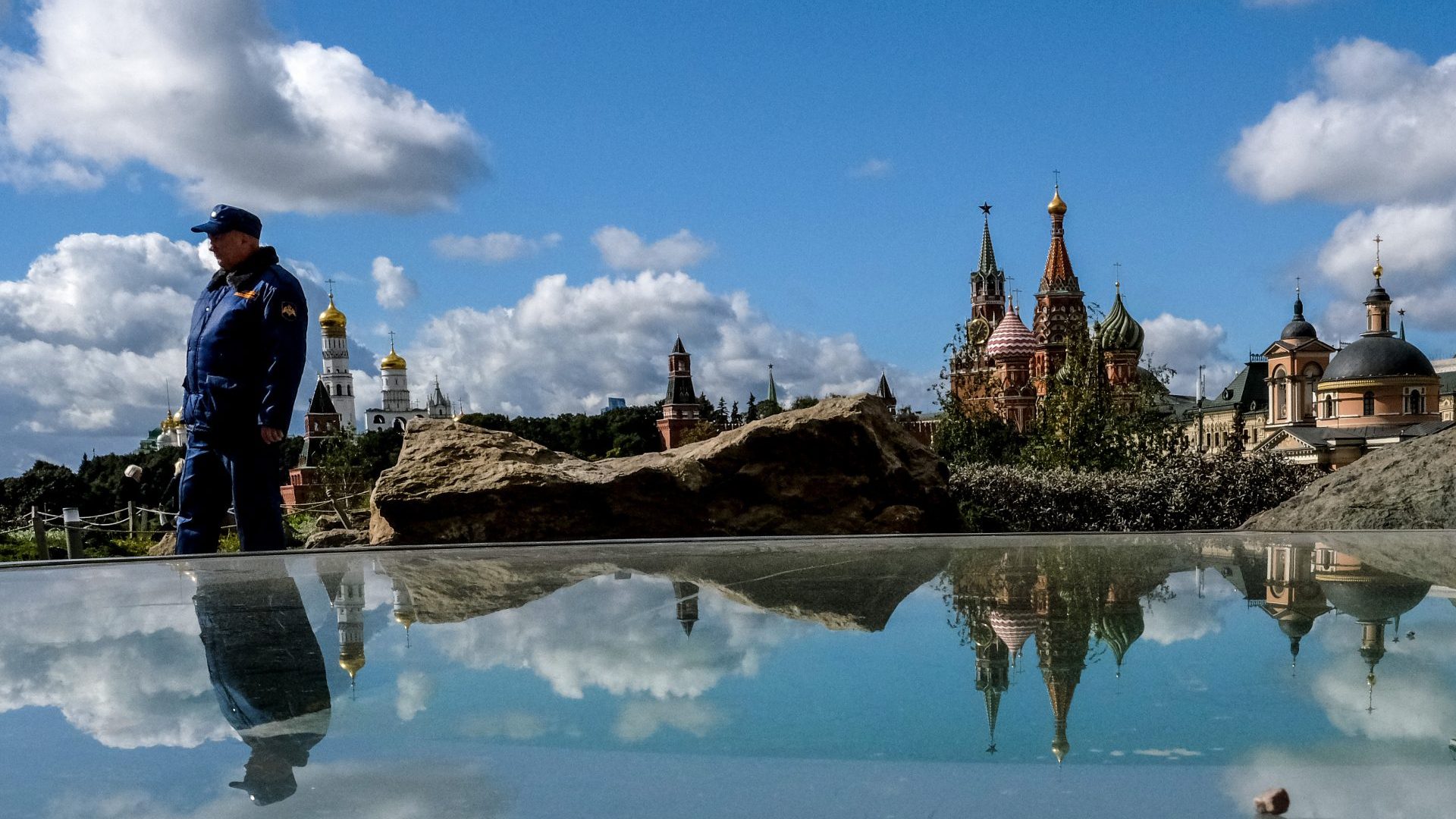
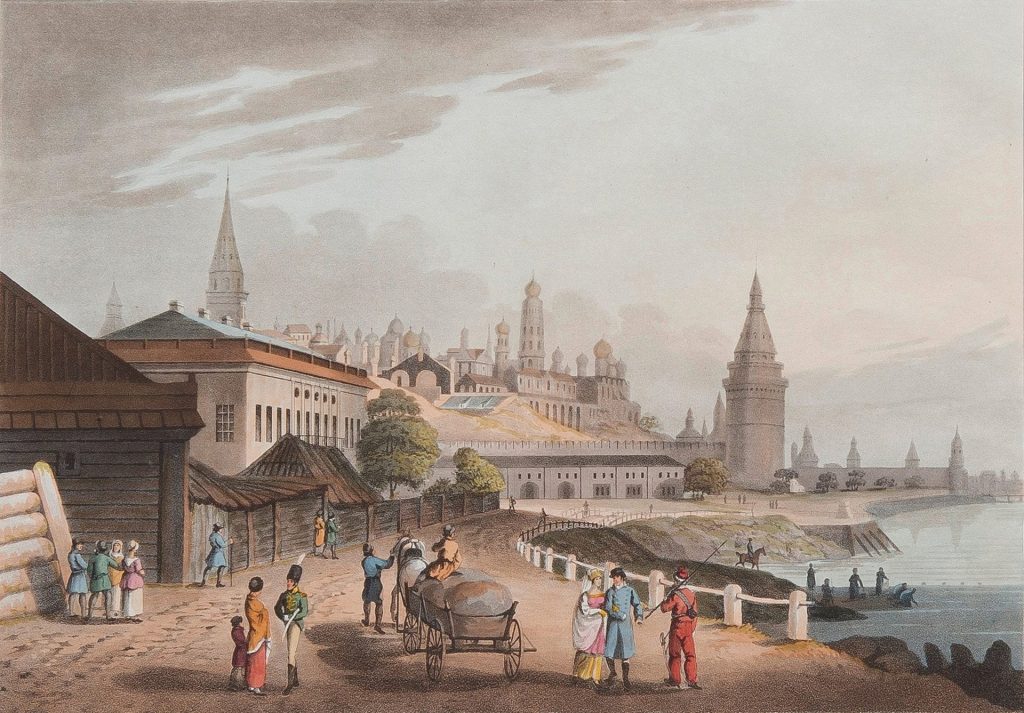
The residents of Zaryadye had clear priorities: “putting a chicken in the pot, delousing their bedding, attending confession at the local parish, and warding off illness.” Founded in the 13th century, this neighbourhood skirting the Moskva River was once densely populated with merchants, craftsmen, thieves, pie sellers and street walkers. It was also home to “the diseased who lived on soup made from vegetable peelings and disinfected themselves with vodka.” The district takes its name from a phrase meaning “the place behind the rows,” a reference to the market stalls adjacent to Red Square.
In his sweeping, near-encyclopaedic history, A Kingdom and A Village, Simon Morrison charts Moscow’s transformation from a provincial ‘big village’ to the home of 13 million Muscovites today. He immerses readers into the past so deeply, they can see, feel, hear and even smell it.
In Zaryadye, we are surrounded by dirty chintz blankets and greasy pillows, cabbage soup and lard-smothered porridge. A world in which luckless prisoners are beaten so badly, the skin on their backs has turned from “from red to purple to black”. Then for good measure, “soldiers doused them with vinegar – all to the beat of drums.”
The painful story of Zaryadye lays bare Russia’s authoritarian streak. In the 1530s, serfs built the Kitai-gorod stone wall and towers all around it to protect the trading district from Tatar raids. Wealthy nobles deserted the area after Peter the Great relocated the capital to Saint Petersburg.
In the aftermath of the great fire that followed Napoleon’s disastrous invasion of Russia in 1812, Zaryadye became a hub of the garment trade, much like London’s East End. It also became home to thousands of Jews relocating from the region known as the Pale of Settlement on the western edge of the Russian Empire. Despite bitter opposition from the Orthodox Church, the authorities eventually allowed a small synagogue to be built by Jewish soldiers who had fought with imperial troops.
But by the end of the 19th century, one man succeeded in forcing most of the Jews out. Konstantin Pobedonostev, chief procurator of the Most Holy Synod which governed the Church, was a fanatic Slav nationalist and he had the ear of the Tsar. On the eve of Passover in 1891, Alexander III signed “an ambiguous order protecting Moscow from ‘semites’ and other suddenly illegal immigrants.”
The emperor wanted to avenge his father’s assassination but, as Morrison points out, the people of Zaryadye had nothing to do with it. The bomb which tore Alexander II’s legs off when he stepped out of his carriage was thrown by a Polish aristocrat who belonged to the Narodnaya Volnya (People’s Will) revolutionary group. Still, by 1897, some 38,000 Jews had been ousted, forced to sell their hard-earned possessions for next to nothing or risk wooden handcuffs, beatings or worse.
When I first came to Moscow in the Soviet era, only a tiny section of the 16th-century walls which once encircled Zaryadye remained, and there was no trace of its Jewish community. The surviving churches were dwarfed by the monstrous Rossiya Hotel built in the 1960s by Nikita Khrushchev. On a few occasions, I stayed in one of the 3,182 rooms of that monolith, with its endless corridors and army of mice, before it was bulldozed in 2006.
Suggested Reading
What Pussy Riot did next
A decade later, when Moscow was having a makeover ahead of the World Cup, Vladimir Putin unveiled a new 14 billion rouble park on the site. It boasts jogging trails, a V-shaped “bridge to nowhere”, perfect for selfies, and a plethora of CCTV cameras. There are bag checks and metal detectors at the entrance. The park, caustically nicknamed “Putin’s paradise”, “erased the erasures”, writes Morrison, “carting away the rubble atop the rubble atop the rubble of the ancient neighbourhood.”
Cycles of urban decay and renewal play out everywhere, but in Moscow they unfold with a striking intensity. Take the story of Christ the Saviour. It was a cathedral commissioned by Alexander I to celebrate Russia’s victory over Napoleon, then it was dynamited by Stalin, turned into a swimming pool by Khrushchev, before it was rebuilt under Yeltsin to atone for the sins of the Soviet past.
The new cathedral says Morrison is “reviled by the faithful and non-faithful alike” and is now derided as a monument to Luzhkov (Moscow’s mayor in the 1990s) and “a bank machine for the Orthodox State within a State”. His book initially follows a broadly chronological order while later weaving in thematic strands, which show how radically Russia’s capital “has rebuilt and reimagined itself through the eyes of dreamers, schemers and evildoers.”
Suggested Reading
The horror that spawned Putin
Moscow’s birth is traditionally dated back to 1147, when a prince called Yuri built a wooden fort on a hill above a sluggish river. However, the origin of the city’s name remains uncertain. In Finno-Ugric languages once spoken by tribes inhabiting central and northern Russia, the word may have meant “murky water” or perhaps “female bear,” a theory popular among tour guides. Another possibility comes from the Komi language, where moska means “cow” and va means “river” or “wet.”
While Kyiv more than 500 miles to the west stood as a sophisticated and flourishing city, Moscow was little more than a boggy trading outpost. Morrison muses over the combination of influences on Kyivan Rus, the Scandinavians to the north, “a realm of brawn and brains” and the otherworldly, spiritual pull of Byzantium to the south.
Today, to the fury of Putin and Patriarch Kirill, head of the Russian Orthodox Church, the baptismal font of their revered ancient Rus—the first East Slavic state—lies in a country that no longer wishes to be tied to them. The consequences are starkly visible in Ukraine’s bloodstained battlefields and shattered apartment blocks.
Morrison’s engrossing biography of Russia’s capital continues through waves of Mongol invasions, devastation by fire, famine and plague, and the reigns of assorted rulers from the Rurik dynasty, through to the Romanovs, the Communists and the leaders of the post-Soviet era. As Moscow’s power grew, its image was refashioned to match.
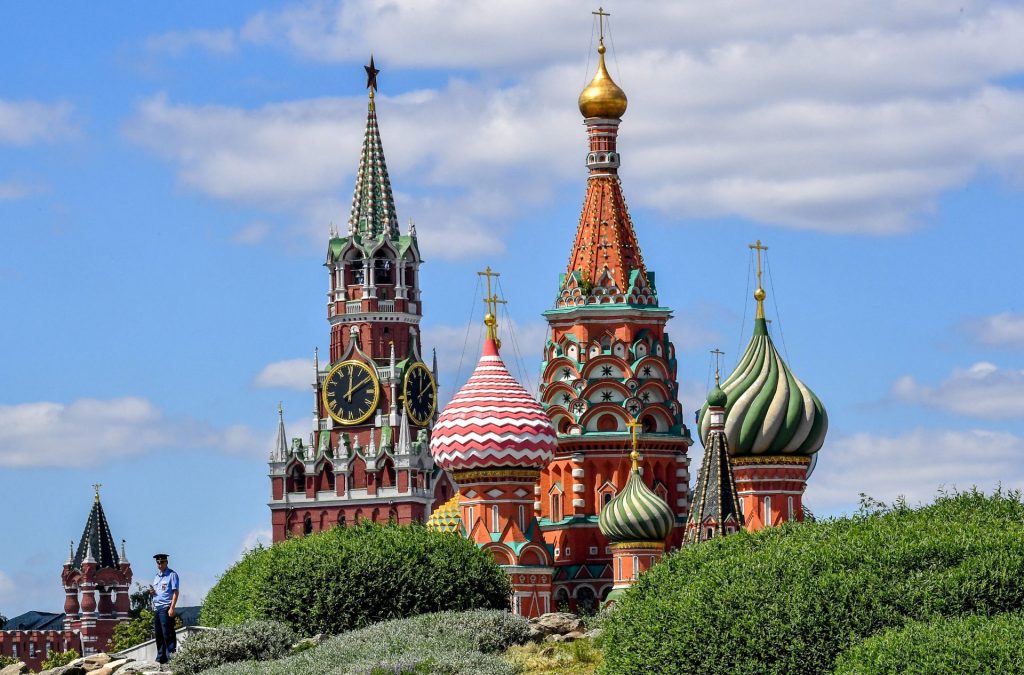
The Kremlin at its core began as a wooden fortress, until the 14th-century prince and military hero, Dmitry Donskoi, rebuilt it in limestone. The white stone however, failed to impress Ivan III. He enlisted Italian architects to refashion the Kremlin once more, this time in red brick—creating the formidable walls that still define it today.
After the architectural facelift came the spiritual one. In 1523, Ivan’s son, Grand Prince Vasily III, got a letter from a monk, Philotheus of Pskov, who sought to persuade him that Russia was a superior civilisation with a sacred mission to redeem humanity. He called Moscow the third Rome – an Orthodox Superpower after the collapse of the Roman and Byzantine empires.
Morrison rightly calls this epistle one of the most important documents in Russian history and notes that Philotheus bolstered his argument with a passage from the Book of Revelations about a woman pursued by a dragon. This beast with seven heads can pull down stars from heaven with its tail and spew floods of water from its mouths, but the woman “clothed in the sun and the moon under her feet and a baby in her arms” escapes by fleeing into the desert. To the Russian monk, she symbolises the Christian kingdom deluged by unbelievers.
The first Rome had, in this view, fallen into apostasy, as had Byzantium—later known as Constantinople. Moscow alone remained steadfast as the third Rome, and, as Philotheus famously declared: “a fourth there will not be.”
Morrison’s narrative is filled with arresting historical nuggets which throw an unexpected light on the present. He observes that Ivan the Terrible’s oprichniki, precursors of the secret police, were not very good at their job.
Those sadists riding around with severed dogs’ heads attached to their saddles failed to protect Moscow from the Crimean Khanate army, which burned down a quarter of the city’s houses in 1571 and captured innumerable blonde Slavs to be sold in Ethiopian slave markets. The moral he concludes is that “attacking is easier than defending, bullies are cowards and what Ivan considered to be Moscow’s best defence was no defence at all.”
The author says in his introduction that he has assembled the book “with a focus on the rulers first and the ruled second”. But there are also chapters focusing on the people living in different neighbourhoods of Moscow, including the merchants’ quarter, Zaryadye, the Theatre District centred around the Bolshoi and the Arbat – a gentrified district that became “the who’s who of Moscow”, home to eminent artists, musicians, actors, dancers and writers. It was the epicentre of poetry during Moscow’s famed Silver Age ignited in the 1890s when a creative fever gripped Russia on the brink of revolution.
Suggested Reading
Inside the cultural war to rewrite Poland’s past
One of Moscow’s undisputed glories, its Metro system, also gets its own chapter. Morrison recounts an unusual family outing when Stalin decided to visit the newly opened Okhotniy Ryad (Game Market) station with his son Vasily and his daughter Svetlana in tow. It was clean and bright, but “had the smell of damp lime from a house that hadn’t yet dried”, Svetlana’s governess noted in her diary – just one of Morrison’s many surprising sources.
The “vaulted ceilings, tetrahedral columns, stucco mouldings and tall floor lamps” were meant to make passengers feel they were in “a sunlit castle” rather than deep underground. But the 75,000 young men and women who dug the tunnels by hand during inhumanly long shifts got little thanks – many were later repressed. As for the head of construction, Adolf Petrikovsky, he was accused of anti-Communist intrigues and left to rot in a cell for ten months before Stalin authorised his execution.
If one Russian bishop had prevailed, the transit system would never have been built in the first place. Before the Revolution, Metropolitan Sergei tried to block the project, arguing that penetrating the underworld was a sin and that it was wrong to poke around in Satan’s domain.
Morrison’s approach is multi-disciplinary, drawing on medieval chronicles, imperial decrees, the church, crime reports, assorted dispatches and memoirs, music, literature, stories from neighbours and baristas and more. He often portrays the city through its most creative people and is sometimes seduced by its dark glamour.
But like many visitors and residents, he has a love/hate relationship with Moscow. He calls it “the loneliest of all the world’s metropolises,” even while it has long portrayed itself as the epitome of a utopian and communal society.
When I first moved there in 1990, I was constantly struck by the contrast between grandeur and squalor. I lived at the top of one of the Stalin-era Seven Sisters skyscrapers designed for an aviation elite of celebrated military pilots and aircraft engineers. The marble foyer and delicatessen on the ground floor were impressive, but the shelves were mostly empty, and the lifts frequently broken, so I had to climb up 17 flights of stairs littered with cigarette butts.
Today’s “showcase capital”, with its pristine parks, designer boutiques, and well-stocked supermarkets, can at times feel almost indistinguishable from other global cities. The glass-and-steel towers of the Moscow City business district could just as easily stand in Shanghai or Dubai.
Morrison’s last chapter, titled Neverland, describes a hollowed-out city, in which all irritants to the Putin regime have been flushed away. Even an unfinished novel by the Russian nationalists’ idol Dostoevsky has been yanked from the shelves over alleged lesbian undertones in the friendship between an orphaned girl and a prince’s daughter.
Naturally, no-one criticises or even mentions the war. The focus is on traditional values and an imagined glorious heritage. Once “a small town ruled by brutes”, Moscow has become “the uncertain metropolis of the present, its ruler looking to the past for the future.”
A Kingdom and a Village: A One-Thousand-Year History of Moscow by Simon Morrison is published by Bodley Head. Lucy Ash is the author of The Baton and the Cross, about the Russian Orthodox Church.