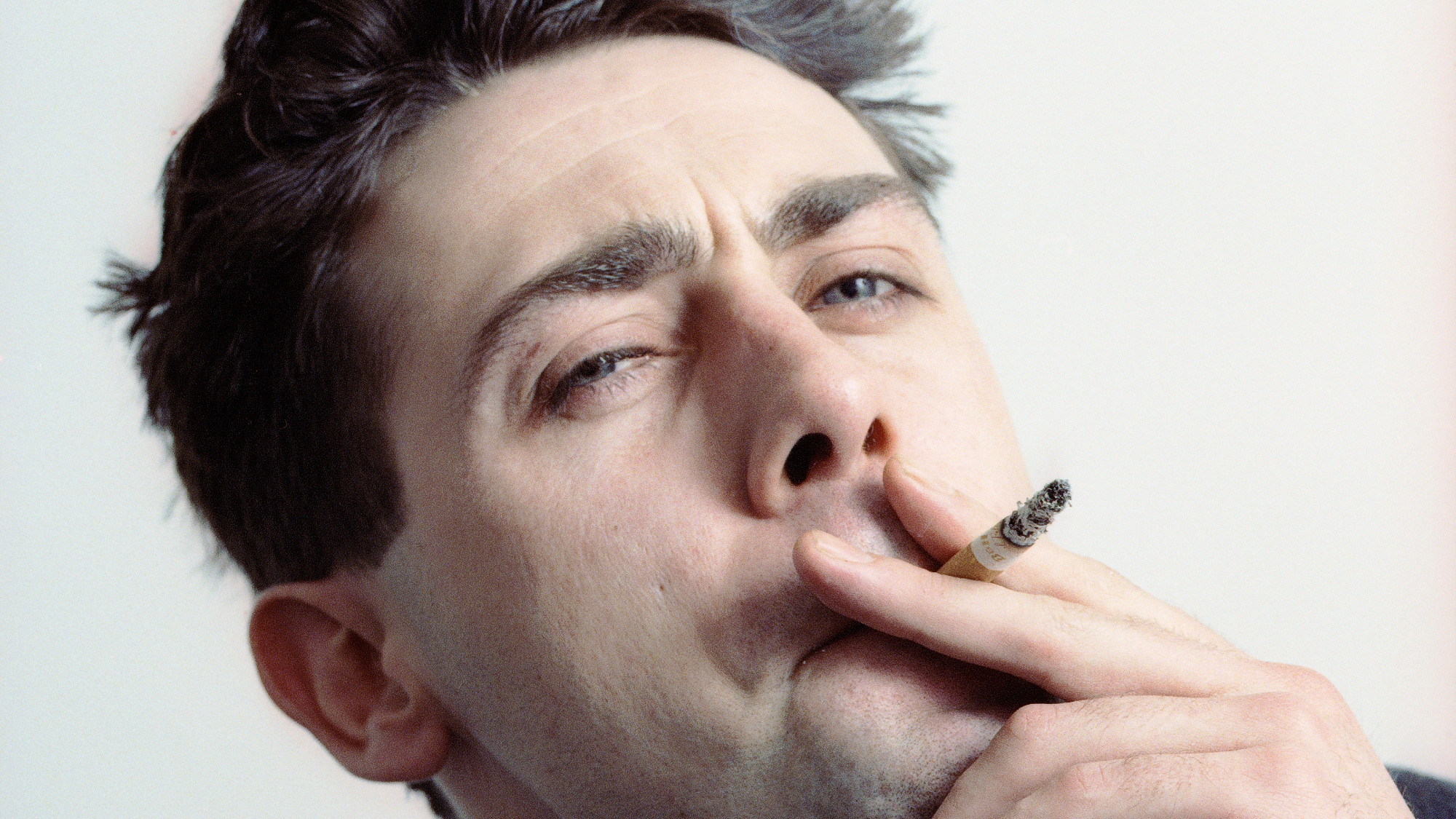
November 10, 1965 – October 16, 2017
Drenched in sweat, Sean Hughes puts the microphone back in its stand and takes in the rapturous applause. Out of the corner of his eye, he sees a group of people walking on to the stage with the Perrier award and a bunch of flowers, hands outstretched as they stride to congratulate him.
His show, A One Night Stand with Sean Hughes, is the talk of the 1990 Edinburgh Festival. With the stage dressed to recreate a bedsit, Hughes is presenting not a succession of one-liners or routines, but weaving theme and narrative into an hour of what felt like a stream of consciousness.
“Comedy is set-up, punchline. I wanted to try and bring ambiguity,” he said of a show in which he unashamedly admitted to feelings of despair and isolation. Some reviewers called it a play, others a monologue. To Hughes, this was the way he knew stand-up had to be performed.
The shambolic nature of how the most prestigious award in comedy was presented to Hughes – people he’d never met shuffling on to the stage at the end of his show – reflects the way stand-up was regarded at the start of a decade that would later, in part, be defined by it. Aged 24, Hughes was everything the 1990s was to become, effortlessly cool, confident in his own abilities if not in his personal life, creating important, heartfelt work.
Cultural types of a sensitive disposition, some still reeling from the recent break-up of The Smiths, a band central to Hughes’s cultural identity, revelled in the success of comedy’s new anti-hero. His act offered a tonic to comedy of the 1980s, paving the way for the following year, when newcomer Frank Skinner beat the relatively unknown Steve Coogan, Eddie Izzard, Lily Savage and Jack Dee to the Perrier. In the space of a year, the game had changed.
Winning in Edinburgh gave him the opportunity to make the cult Sean’s Show for Channel 4, where he took his lovelorn bedsit setting to the small screen. It was a format which riffed on his Irish literary heritage, playing a man trapped in a sitcom, unsure how a studio audience had arrived in his bedsit. He could have made more episodes, but felt the dynamic of his audience was changing. If it affected his stand-up, it had to stop.
With age, the melancholy of unrequited love turned into loneliness, or at least an acceptance of being alone: “I’m 47, not married and haven’t got children, and I’m seen as an oddball, but these are life choices. I want people to know that being childless and unmarried in your middle age is fine.”
When Hughes briefly gave up alcohol in his 40s, friends said he was the most stable he had ever been. After a seven-year break from stand-up, Hughes returned to the stage and immediately felt at home again.
He spoke of the joy of sobriety, of the gift a comedian has in making a room of strangers laugh: “That’s your buzz. Don’t destroy it over the next three hours trying to chase that natural high. At my age I realise that doing the show is the actual drug.”
Nevertheless, worried that people found him boring without a drink in his hand, his drinking returned. “My skillset is to be depressed about life,” he said in characteristic deadpan style, “and that’s all I can do.”
Achieving such acclaim at an early age is never easy for an artist, but his later stand-up shows retained the energy and stagecraft of A One Night Stand with Sean Hughes. His return to the stage was motivated by the sense that he once again had something to say, and an audience who needed to hear it.
“Society tells us how to behave and we, like sheep, follow. It gives me such joy to tell an audience it’s OK not to do those things,” he said. After his sudden death, at the age of 51, he continued to be identified with outsiders and the left-behind, leaving £4m in his will to Shelter.
His career was one of unlikely paths and contradictions; “a poetic lonely soul” who spoke of his desperation to be away from the limelight, but was probably most famous for his six years as a team captain on Never Mind the Buzzcocks. He had prominent roles in The Railway Children, Coronation Street and in CBeebies’ Rubbadubbers, where he found a new generation of fans as Finbar the clockwork shark.
Deep down, it always remained clear where Sean Hughes’s heart lay. “I’m a stand-up comedian. It’s the only place I feel comfortable in my life. That’s a sadness for me, but that’s the way it is.”