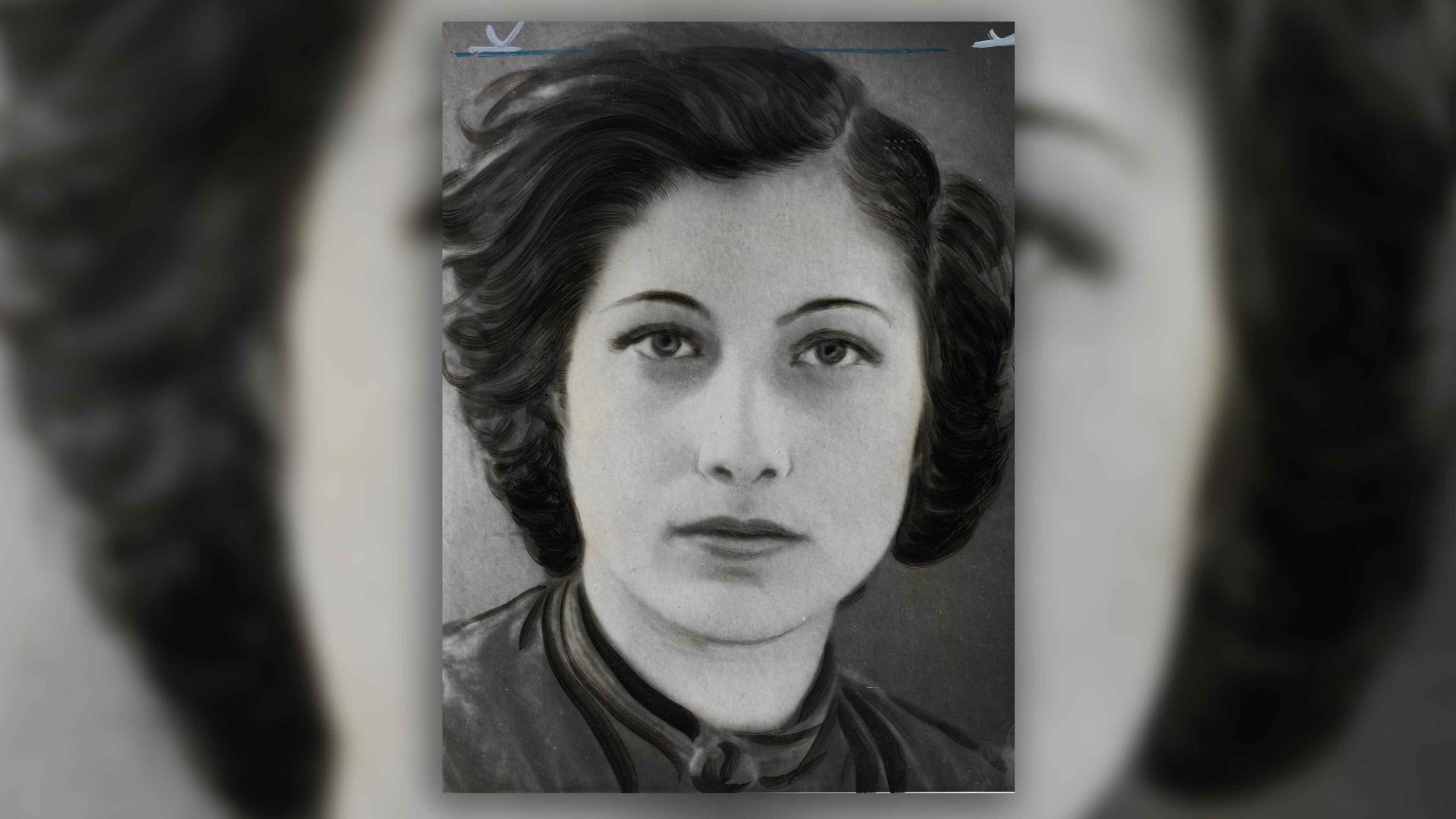
On June 16, 1943, a classically trained musician named Noor Inayat Khan arrived in occupied France to start life as a secret agent. Dispensing with the identity of Noor, she took the name Jeanne-Marie Renier, and was tasked with sending encrypted messages back to London.
She knew the risks: capture would lead to certain execution; there would be no chance of protesting innocence. The 15kg of radio equipment could have only one explanation: subterfuge, espionage, guilt, death. As well as being given her own code name of Madeleine she was given a cyanide pill… just in case.
On arrival, as instructed, she contacted “Cinema,” the codename of Émile-Henri Garry, a French Resistance fighter, who introduced her to members of the underground Prosper network, vital in maintaining contact between the network of underground French Resistance operators and London. Khan, a pacifist descended from Indian royalty, had infiltrated occupied France.
Her pacifism was inherited from her father, a renowned teacher of Sufism, and also her mother, a poet. The two travelled the world teaching messages of love, harmony and spiritual unity. Had it not been for the second world war, Khan may have followed this life. But instead she felt an overwhelming sense of duty to join the Women’s Auxiliary Air Force and train as a radio operator. Her passion and commitment to fighting fascism did not go unnoticed and led to her being recruited by the British Special Operations Executive. At that moment, a life of peace, classical music and poetry was replaced with espionage, reconnaissance and the threat of violent death.
Suggested Reading

Goodbye Gloria. I’ll never give up fighting
Khan was familiar with France – before the war she had studied music at the Paris Conservatory, specialising in the harp and piano. The dexterity this gave her was an invaluable skill for a wireless operator to possess. Morse code messages needed to be tapped out accurately, and fast.
Despite repeated instructions to abort, as the Prosper team folded and the Nazis closed in, Khan continued her mission. A plane was sent for her safe return, which she refused. She had to stay out there. It was what she had trained for, she did not give in.
Being a radio operator was incredibly dangerous. The Nazis used radio detection vans to locate the position of any transmission and the act of sending a radio message was extremely cumbersome. An aerial had to be raised, sometimes up into the high branches of a tree, or disguised as a washing line, leaving the operator dangerously exposed. Having sent a message, Khan had to move fast, carrying the heavy radio set, changing both her location and appearance.
After three months, twice the length of time a wireless operator was expected to last in the field, she accepted she could do no more. She was exhausted. She missed her family. It was time to go home. With her departure imminent, she returned to her apartment. A Gestapo officer was waiting there, with a gun.
In the interrogation she gave no information. She was held in solitary confinement at Pforzheim Prison for 10 months, where she was classified as Highly Dangerous, beaten and interrogated, always stoically refusing to give any details of anything she knew. It was there, along with other prisoners, that she heard about D-day.
Suggested Reading
Inside the wild film flop that unlocked Robin Williams
Not until a year after the war ended were her family able to find out what had happened. She had not revealed any of her secret work to them. They only found out about her activities for SOE at the same time as they learned her fate. In 1944, at the age of 30, Khan had been executed in Dachau, shot through the back of the neck along with three other female SOE agents. Her final word, reportedly: “liberté.”
Years after Khan’s death, Renée Garry, who had been part of her network in Paris, stood trial, accused of betraying Khan to German intelligence in exchange for 100,000 francs. Garry was acquitted, but later interpretations of the story suggested that a member of the Resistance had chosen Khan over Garry, leading a furious Renée to seek revenge.
A passionate believer in Indian independence, Khan had a clear motivation for fighting against fascism. “I wish some Indians would win high military distinction in this war: if one or two could do something in the Allied service which was very brave… it would help to make a bridge between the English people and the Indians.”
In Bloomsbury, a statue of her, the first memorial in the UK dedicated to an Asian woman, now stands proudly, honouring a pacifist, someone who refused to give in and who sacrificed their life in the fight against fascism.