July 21, 1951 – August 11, 2014
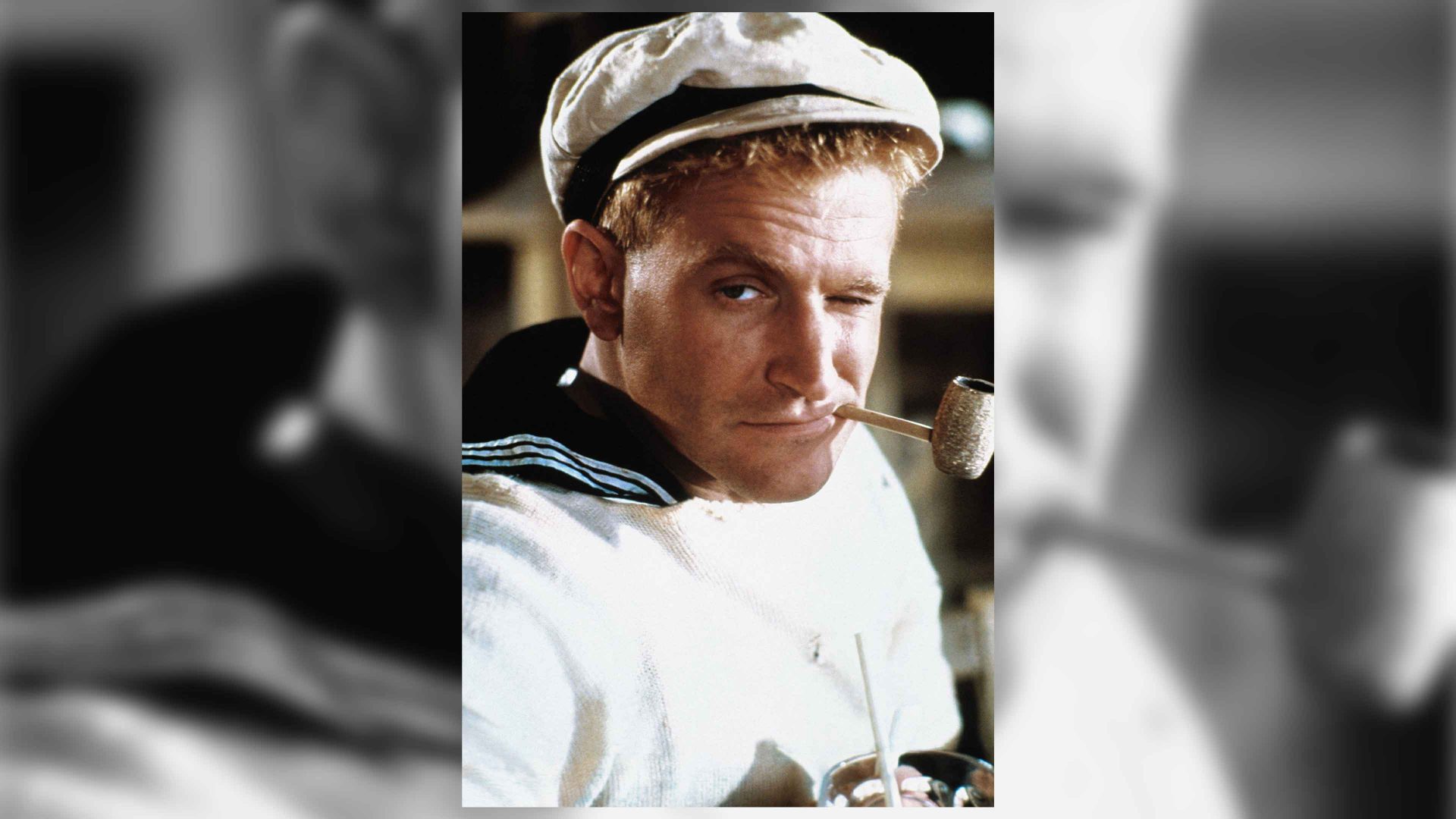
Sailor’s hat on, pipe in the corner of his mouth, huge prosthetics swelling his arms, Robin Williams sits with director Robert Altman. Scene after scene on their new film, Popeye, has resulted in chaos, with Williams making the crew laugh, improvising, bouncing in and out of the script. Despite the pressure to complete filming, they reach an agreement: trust your instincts. Keep doing what you’re doing.
The scale of the Paramount Pictures project is huge, a remote bay in Malta transformed into the town of Sweethaven, hand-built to replicate the one in the original animated series, with wooden buildings, a harbour and crooked, painted streets, all built and created by set designers to make this feel like the home of Popeye, Olive Oyl and Bluto.
In preparation for his first feature film, Williams has studied Popeye’s mannerisms obsessively. He performs with one eye closed and delivers his lines with his pipe in his mouth, but his quickfire mutterings are too authentic, and he has to redub his entire dialogue. “People couldn’t understand what I was saying. I sounded like a killer whale farting in a wind tunnel.”
When the movie is finally released, the reviews are mixed, the New York Times calling it “a thoroughly charming, immensely appealing mess of a movie.” Other publications are much less polite, but it is an experience no one involved in its creation will ever forget – not least because of an on-set party atmosphere bolstered by the presence of legendary carousers like Harry Nilsson, who wrote the soundtrack, and ounces of cocaine smuggled on to the island in film canisters.
Despite being hampered by these constraints and by interference from the studio, Altman believed in Williams when others didn’t. Nevertheless, Popeye posed more questions than answers.
Was Williams a comedian or an actor? Could he be trusted with a script? Was there life beyond Mork, the alien he was then playing in sitcom Mork & Mindy? Was he too unique for Hollywood?
His improvisational skills had been honed at a comedy workshop in California, then at the Holy City Zoo comedy club in San Francisco, where his manic, mesmerising appearances led fellow comic and future talk show host David Letterman to compare him to a hurricane.
Seven years after Popeye, director Barry Levinson gave Williams the space and freedom to explore the breadth of his talent in his Good Morning, Vietnam, leaving big gaps in the script for the comedian’s instinct to take over. Trusting Williams to do what he did best resulted in a best actor nomination at the Oscars. It was becoming clear that to get the best out of Robin Williams, you had to allow him to be Robin Williams.
In 1992’s Aladdin, he did exactly what he had done on set during Popeye, but without the budget worries and time constraints, allowing him to improvise as the Genie for hours with full permission from his employers.
Even in his smaller, quieter roles, he found room for improvisations that would remain in the final edit of the film rather than on endless blooper reels. They included the last line of Good Will Hunting, which Williams helped get made by agreeing to reduce his fee by three-quarters.
The role of wounded psychologist Sean won him the best supporting actor Oscar, which he accepted in tears, admitting: “This might be the one time I am speechless”. Then he thanked his late father: “When I told him I wanted to be an actor he said ‘Wonderful, just have a back-up profession like welding.’”
Anecdotes like those fuelled his breathless appearances on chat shows as he exhausted himself and his audience with voices, stories, routines and meanderings. Cocaine no longer did – he gave it up after waking up in March 1982 to discover that John Belushi, with whom he had been partying only a few hours earlier, was dead.
Suggested Reading
The night Fela Kuti turned music into a weapon
He gave up alcohol too, but relapsed in 2004, just at a point when the increasingly broad or mawkish roles he had been taking were being replaced by darker and far more interesting work like Insomnia and One Hour Photo. He said it had been a fear of everything that made him drink. “It’s just literally being afraid. And you think, oh, this will ease the fear. And it doesn’t.”
That was perhaps a clue to what would follow, but Williams kept it at bay with work, cycling and the love of his children. But by the end of 2013 he had been diagnosed with an aggressive form of dementia that affected his mood, sleep and behaviour, and by the end of summer 2014 he was dead.
Williams was mourned in Malta, where the original wooden Popeye Village still stands today, now with a lifesize statue of him as the sailor as one of the attractions in a splendidly ramshackle tourist destination, commemorating the place where he learned what it meant to be an actor.
Of his role in Popeye, Williams could easily have been talking about himself. “I wanted him to be real,” he said. “I didn’t want to do an imitation.”