June 10, 1893 – October 26, 1952
It was after 11pm in the Cocoanut Grove on Wilshire Boulevard in Los Angeles on leap day 1940 when Bob Hope got up to speak. Beneath the nightclub’s fake palm trees and faux-exotic drapes, the comedian was making his debut as host of the Oscars, and 1,000 of Hollywood’s finest had come out to watch.
A couple of wisecracks loosened the crowd; a performance of Over the Rainbow by the 17-year-old Judy Garland, winner of a special juvenile award for her role in The Wizard of Oz, brought them to their feet. Yet with a leaked list of the night’s winners already printed in that day’s Los Angeles Times, and no live radio or TV broadcast, a night to celebrate an incredible year of cinema lacked its own drama.
Until the best supporting actress category was announced.
Olivia de Havilland, nominated for her part as Melanie in the blockbuster Gone with the Wind, was sitting with the film’s producer David O Selznick and its leads Vivien Leigh and Clark Gable. Seated away from them, on a small table set against a wall, was Hattie McDaniel, nominated for her part as Mammy.
The Ambassador Hotel, home of the Grove, was segregated and Selznick had to pull strings to get her into the ceremony at all. It was nothing new for Hattie, who had been excluded from the film’s premiere in Atlanta three months earlier by Georgia’s Jim Crow laws.
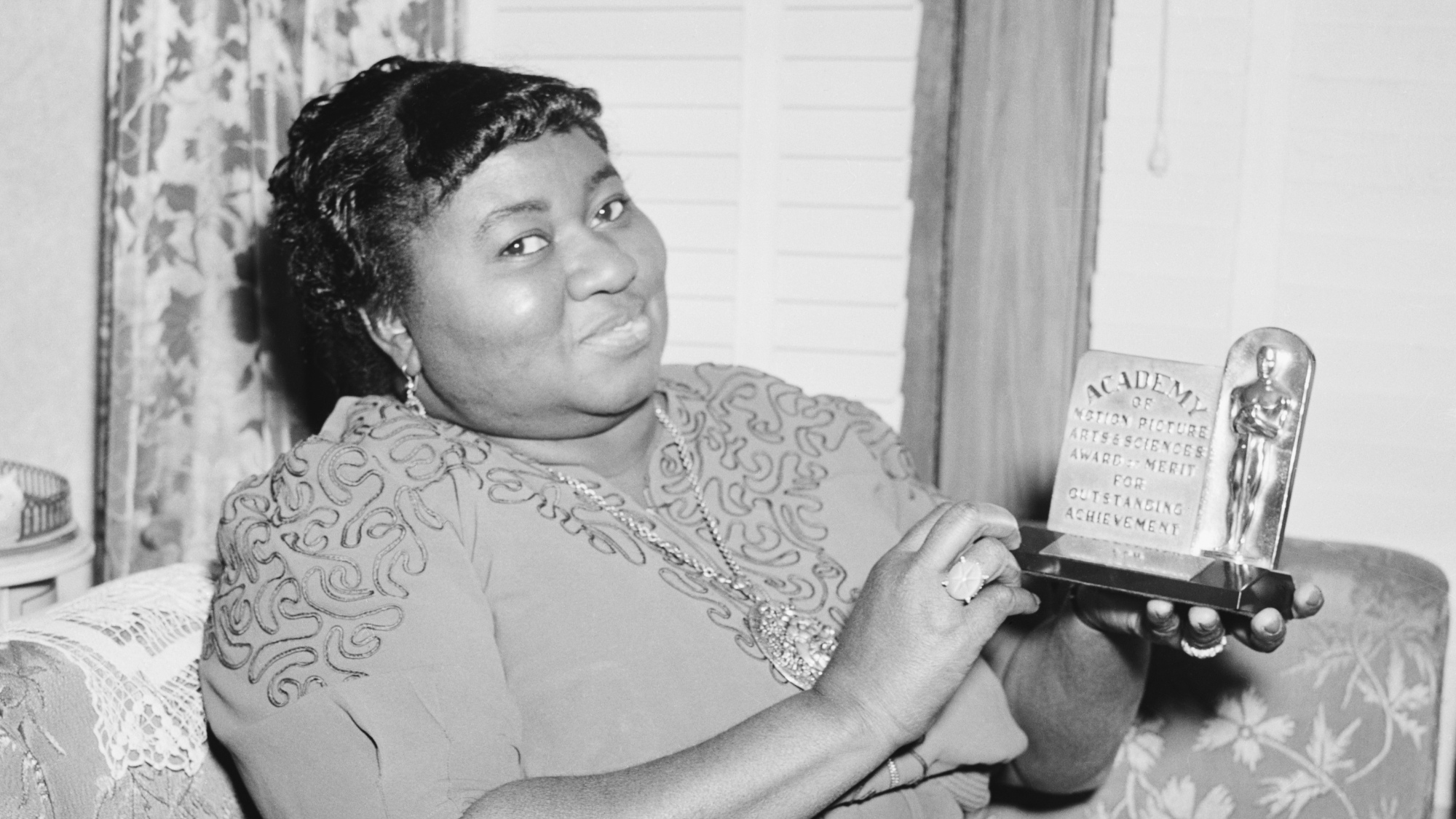
When the previous year’s winner, Fay Bainter, read out McDaniel’s name, prefacing it with the words, “It is a tribute to a country where people are free to honour noteworthy achievements regardless of creed, race or colour,” Hattie walked to the stage in her royal blue gown, white gardenias in her hair.
“I sincerely hope I shall always be a credit to my race and to the motion picture industry,” said the woman who was now not just the first black person to win an Oscar, but the first to even attend an Oscars ceremony, despite this being the awards’ 12th year. “My heart is too full to tell you just how I feel, and may I say thank you and God bless you.”
De Havilland stopped by McDaniel’s small table to congratulate her before – whether for reasons of pride or regret – bursting into tears, running into the hotel kitchen and having to be comforted by Selznick.
Born in Wichita, Kansas, and growing up in a home filled with music, McDaniel had dreamed of being on the stage from the age of eight. “I knew that I could sing and dance, my mother would give me a nickel sometimes to stop,” she said.
At 15 she went on the road with her brothers, founding her own song-and-dance troupe, developing a fearless stage persona, building up a repertoire of tongue-in-cheek observations of the way Black people, particularly women, were perceived by society.
Her passion was for the blues. She wrote her own songs and recorded as a solo artist in the 1920s, showcasing her powerful vocals with songs celebrating strong female protagonists. She was one of the first black women to broadcast on radio in America, initially as a singer and then, after moving to LA, as a comic actor, creating characters including the irrepressible Hi-Hat Hattie.
Her force of personality was reduced to silence in her film career, where she was given roles as voiceless background maids. Gradually, she earned lines of dialogue as producers noticed the magic about her, eventually being cast in the role in which she would make history.
With praise came a backlash. McDaniel was scorned by some in the black community for her “credit to my race” comment. Others disdained her for accepting the role of Mammy, to which she replied, “I’d rather play a maid than be a maid.”
Her character starts the film as a slave, and both McDaniel’s parents had been born into slavery. “I tried to make her a living, breathing character, the way she appeared to me in the book,” she said, noting that her grandmother had worked on a plantation similar to Gone with the Wind’s Tara.
Once the 1940 Oscar ceremony was over, and McDaniel had been excluded from the afterparty because of her colour, things in Hollywood returned to normal. Bob Hope went on to host the Oscars another 18 times. Olivia de Havilland won two best actress awards.
And Hattie McDaniel returned to playing sassy maids, including in a stage show as Mammy, in the deeply regrettable Disney movie Song of the South and on a TV series, Beulah. All were criticised for perpetuating racist stereotypes.
Meanwhile, it would be 51 long years before the next black actress won an Oscar, Whoopi Goldberg for her appearance in Ghost. By then, Hattie McDaniel had been dead for nearly four decades, denied a burial in the Hollywood Cemetery because of segregation.
At the 2010 Academy Awards, for her role in Precious, the best supporting actress award was won by Mo’Nique, who took to the stage in a royal blue dress with white gardenias in her hair. She clutched her statuette and said to the world: “I want to thank Miss Hattie McDaniel for enduring all that she had to, so I would not have to.”