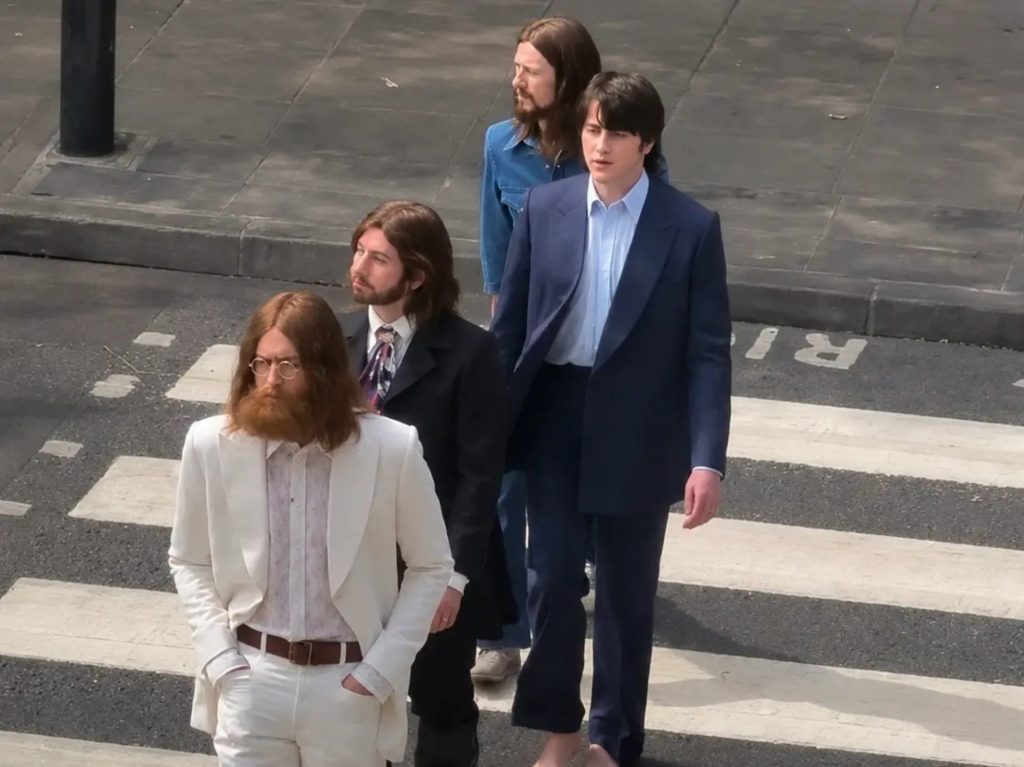
It’s not fair to start judging a film on the basis of a couple of photographs leaked on to the internet, but as Friedrich Nietzsche once said: “Since when has fair been fun?”. Sam Mendes’s quadrilogy of Beatles movies prompted healthy scepticism when it was first announced and then again when the cast was announced. And once more, now with the first glimpses of wigs and JESUS CHRIST, MY EYES, the beard. Since when did John Lennon have a little chin ledge in his beard?
In what is being called by the film-makers a “four-film cinematic event”, due for simultaneous release in April 2028, Harris Dickinson, Paul Mescal, Joseph Quinn and Barry Keoghan play John, Paul, George and Ringo in four separate films, each one focusing on their Fab journey. Jez Butterworth, Peter Straughan and Jack Thorne have co-written the scripts.
These are all good actors; all good writers. But Mendes is not a good film director. After debuting with American Beauty, a film which asked the question “what if Jeffrey Epstein were a suburban dad and kinda cool?” he went on to make the best (Skyfall) and worst (Spectre) Daniel Craig Bond films and then 1917, a first-person shooter version of the first world war.
Mendes does have some important things on his side – the blessing of the remaining Beatles and their families and, crucially, permission to use the music. But then there is his patchy record as a film director (Jarhead, Revolutionary Road, Empire of Light) and the fact that the band is notoriously difficult to get right on screen.
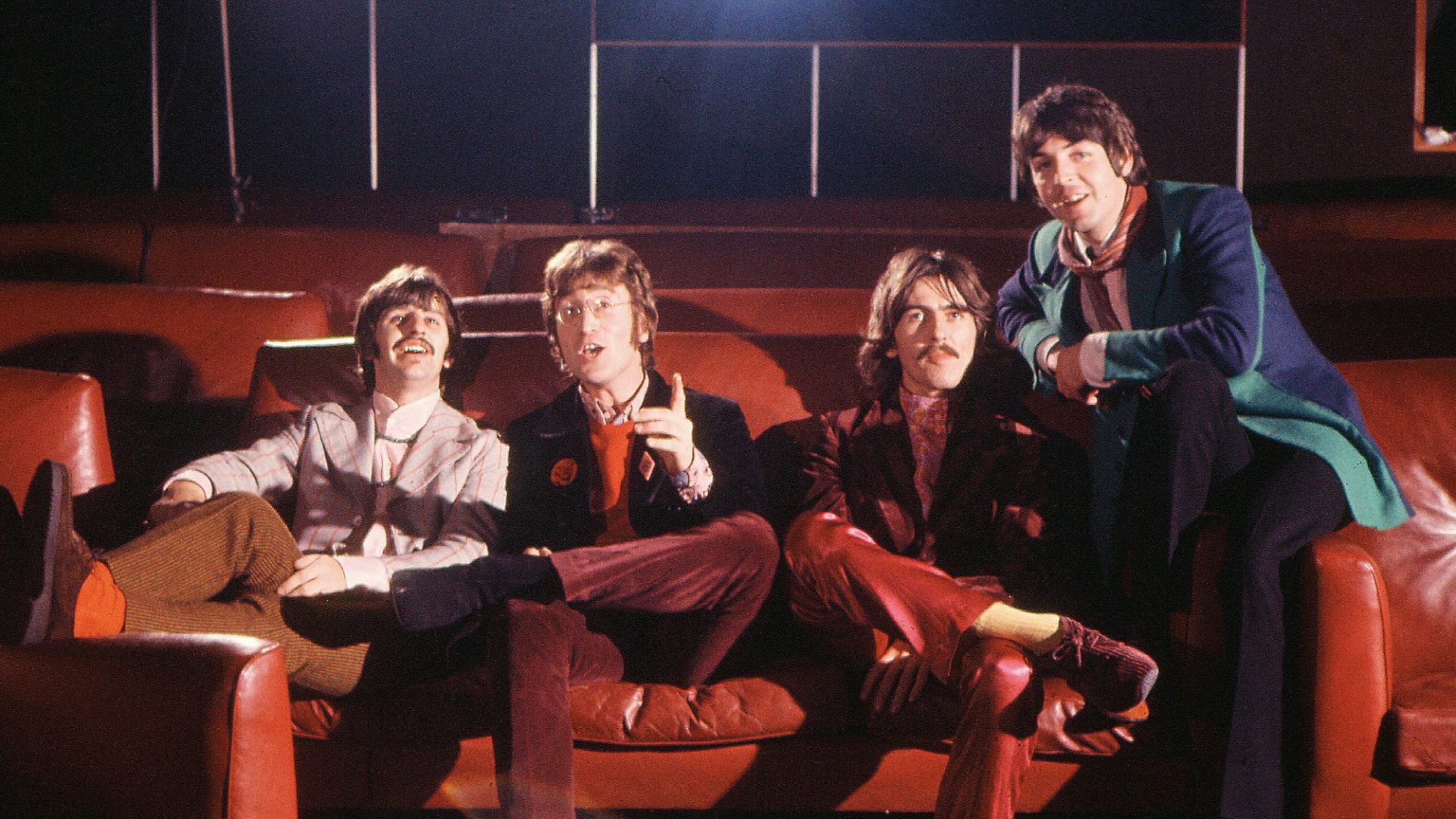
Why? The answer is probably because the Beatles themselves have already made the best Beatles films. Not only did they do the best “this is what they’re really like” Beatles film – A Hard Day’s Night – they did others which created the template for music films and TV shows and MTV for the next few decades.
No Help!, no Monkees. They did a wild arthouse movie with Magical Mystery Tour, a film that deserves rediscovery – it was after all written and directed by the Beatles – and perhaps the Peter Jackson treatment.
Suggested Reading
The race to save the Beatles
And a documentary so good in Let It Be that it inspired another amazing documentary in Jackson’s Get Back. His epic three-parter astutely realised that the only answer to the Beatles was more Beatles, so the Lord of the Rings director used Michael Lindsay-Hogg’s b-roll to create one of the best portraits of being in a band. Not only do you get the arguments and jokes and songs, but you also get the sitting around and eating toast and drinking tea. Yellow Submarine had the least to do with the Beatles, but was still supping from the same ingenious well.
The other problem is that the Beatles were really fucking good. Obviously, they were amazing in terms of the music, but also their presentation, the way they played the media, the way they played themselves, is virtually note perfect and therefore really hard to convincingly convey.
A fictional reconstruction will likely make straw men of the press so the Beatles can easily knock them down, but the Fabs were faced by an intelligent and articulate set of career journalists who had seen fads come and go. And they didn’t just need to knock them down, they needed to seduce them along with audiences who were no idiots. When Lennon told the posh people at the Royal Variety Performance to “rattle your jewellery,” it was working on so many levels that Jacques Derrida would’ve needed a Gitane and a coffee to sort it out.
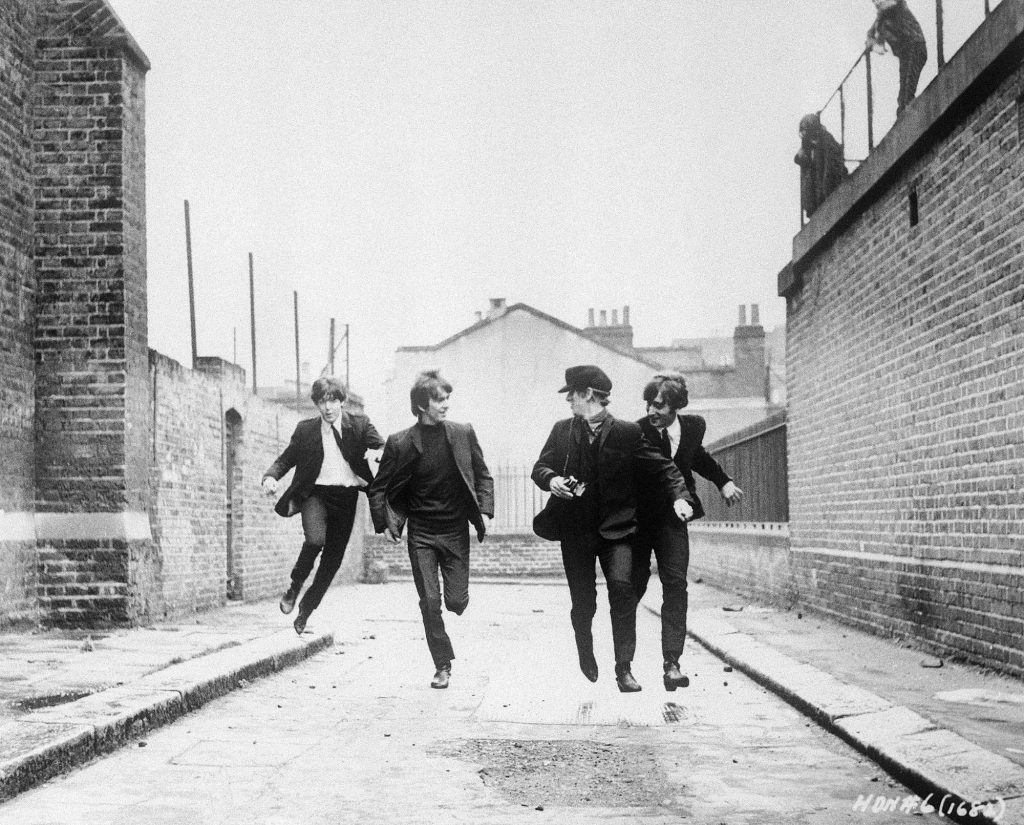
The press conferences, behind-the-scenes interviews, TV and radio appearances and concerts all involved a performance that was both in character – John, Paul, George and Ringo – and themselves – John, Paul George and Ringo. In her book on A Hard Day’s Night, Samira Ahmed shows how that film fed off the Maysles brothers’ 1964 documentary What’s Happening! The Beatles in the USA. And what’s notable in that film is how often the Beatles themselves pick up the cameras and start filming each other.
Given how good the Beatles were at making movies of themselves, film-makers have come up with different strategies for handling them that in their obliqueness admit to the difficulty of aiming at their subjects head-on. They’re like we all were on August 12, trying not to look directly at the sun while wanting to see the eclipse.
There have been some truly oddball attempts at Fab films, including those that avoid the Beatles themselves. From 1976, All This and World War II, which set second world war footage and wartime Hollywood clips to Lennon/McCartney songs, so we could all watch Hitler in his mountaintop lair, the Eagle’s Nest at Berchtesgaden, soundtracked by The Fool on the Hill.
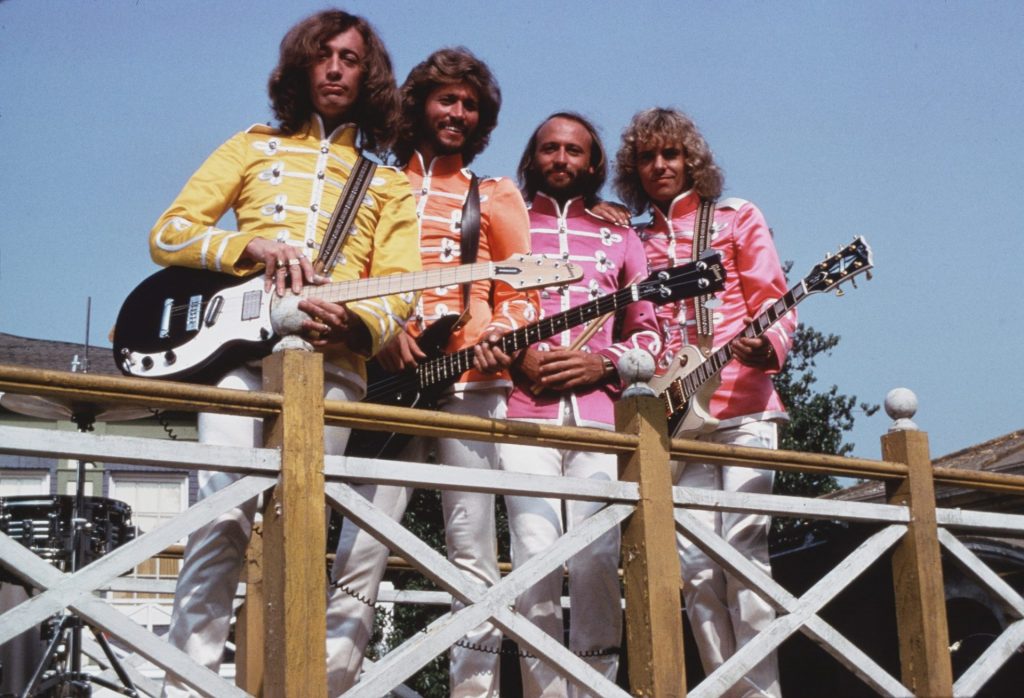
Perhaps notoriously, a 1978 musical of Sgt. Pepper’s Lonely Hearts Club Band featured the Bee Gees, Peter Frampton (as Billy Shears), Frankie Howerd (as Mean Mr Mustard), George Burns (as Mr Kite) and Earth, Wind & Fire (as Earth, Wind & Fire). Robin Gibb said: “Kids today don’t know the Beatles’ Sgt. Pepper. And when those who do see our film and hear us doing it, that will be the version they relate to and remember. Unfortunately, the Beatles will be secondary.” High-pitched warbler he was; Nostradamus, he was not.
In 2007, another jukebox musical – Julie Taymor’s Across the Universe, written by the screenwriters of Porridge and Never Say Never Again – starred Evan Rachel Wood as Lucy and Jim Sturgess (wow, that’s a name I’ve not typed in a minute) as Jude. Both films made one essential mistake – which was also their raison d’être: they tried to make the Beatles American. In Sgt. Pepper’s, the band come from Heartland, USA, as if they’d been thought up by Frank Capra. Across the Universe, with its anti-war, pro-civil rights mélange, was just a second-rate Hair knock-off.
Another way of sidling up to the Beatles is to do so via a fifth Beatle. Fortunately, there are lots of fifth Beatles to go round.
In 1994’s Backbeat, Stephen Dorff plays Stuart Sutcliffe, John Lennon’s best friend, a gifted artist and the band’s original bassist, who stayed behind in Hamburg and died of a brain haemorrhage at a tragically young age. This lesser-known story and the fact the Beatles are portrayed at an embryonic period of their career gave director Iain Softley more leeway, which in one case attracted the ire of one of his subjects.
Paul McCartney was thoroughly pissed off by the way he was portrayed, complaining they took his rock’nrollness away by giving John Lennon Long Tall Sally to sing. Ian Hart, who played Lennon, was reprising the role as he’d played him in the 1991 film The Hours and the Times, a fictionalised account of a holiday Lennon took with another fifth Beatle, manager Brian Epstein.
Epstein is also the subject of Midas Man, a film that turns everything it touches into shit. It doesn’t have the Beatles music, so relies on covers and not even the best ones, swapping Money for Twist and Shout as well as introducing soupy orchestral pieces.
The film is an audiobook with pictures as director Joe Stephenson and star Jacob Fortune-Lloyd literally walk us through Brian Epstein’s life with every tragic gay trope included and tasteful period re-enactment the order of the day. These films always present the world as King Charles must see it: shiny, just polished cars and always smelling of fresh paint. (Incidentally, watch any documentary footage and you’ll not only see the Beatles but smell them too. The 60s was a decade of weekly baths and constant smoking.)
Suggested Reading

The strange death of sex in the movies
More visual discrepancies stand out. Fortune-Lloyd’s Epstein towers over a Hafling-like John Lennon, played by Jonah Lees, despite the fact Lennon was, in reality, almost a six-footer himself and had a reputation for being physically intimidating, which Eppy certainly was not. The Beatles are reduced to working-class pillow-fighting rascals who Brian has to shepherd to fame, tutting good-humouredly as he narrates another turn in the story of his boys.
From infantalising the Beatles to Beatles infancy, as Sam Taylor-Johnson’s Nowhere Boy essentially prequels the band with a story that takes on John Lennon’s (Aaron Taylor-Johnson) teen years, his embryonic talent and his relationships with strict Aunt Mimi (Kristin Scott Thomas) and his free spirit mum (Anne-Marie Duff).
There’s just no way of writing or playing a scene where Paul McCartney meets John Lennon that isn’t going to be naff (The only exception to this is Walk Hard: The Dewey Cox Story, which should have been the point when we all stopped). Nowhere Boy does its best by making it a non-event, but still…
As with Backbeat, it also struggles with the fact that it’s stuck with telling the least interesting part of a bigger story. I mean, do we really give two wet fucks on a Sunday about Aunt Mimi? If I want to know how Lennon felt about his mum, I listen to his songs Mother and Julia.
You have to ask sometimes: what is biography for? What are biopics trying to explain? They’re never about revealing the true story, or what really happened, or the story behind… no matter how much they advertise themselves as that … because they’re always inaccurate, or they take liberties, or myth-make.
Musical biopics can just be surreptitious jukebox musicals, like Bohemian Crapsody or Sprocketman. And yet I can’t help but think most biopics actively/secretly hate their subjects. There is an unconscious urge to contain, cut up, box and own the subject.
Harold Bloom in his book Anxiety of Influence talked about a violent misreading of authors by writers who come later. The same could be said of film directors making films about the Beatles. The violent misreading is part of the point. We all ultimately wanted to be in the Beatles and we can’t be, so we psychoanalyse and explain the artists and so feel better about not being as good as them.
Watch any fictional version of the Beatles – and I doubt Sam Mendes’s The Beatles will prove me wrong – and then watch the actual Beatles. Every single musical biopic is written and directed by Antonio Salieri. It’s about mediocrity trying to pinpoint where genius comes into the picture and getting it wrong every time.
Sam Mendes’s The Beatles – A Four-Film Cinematic Event is scheduled for release in April 2028