
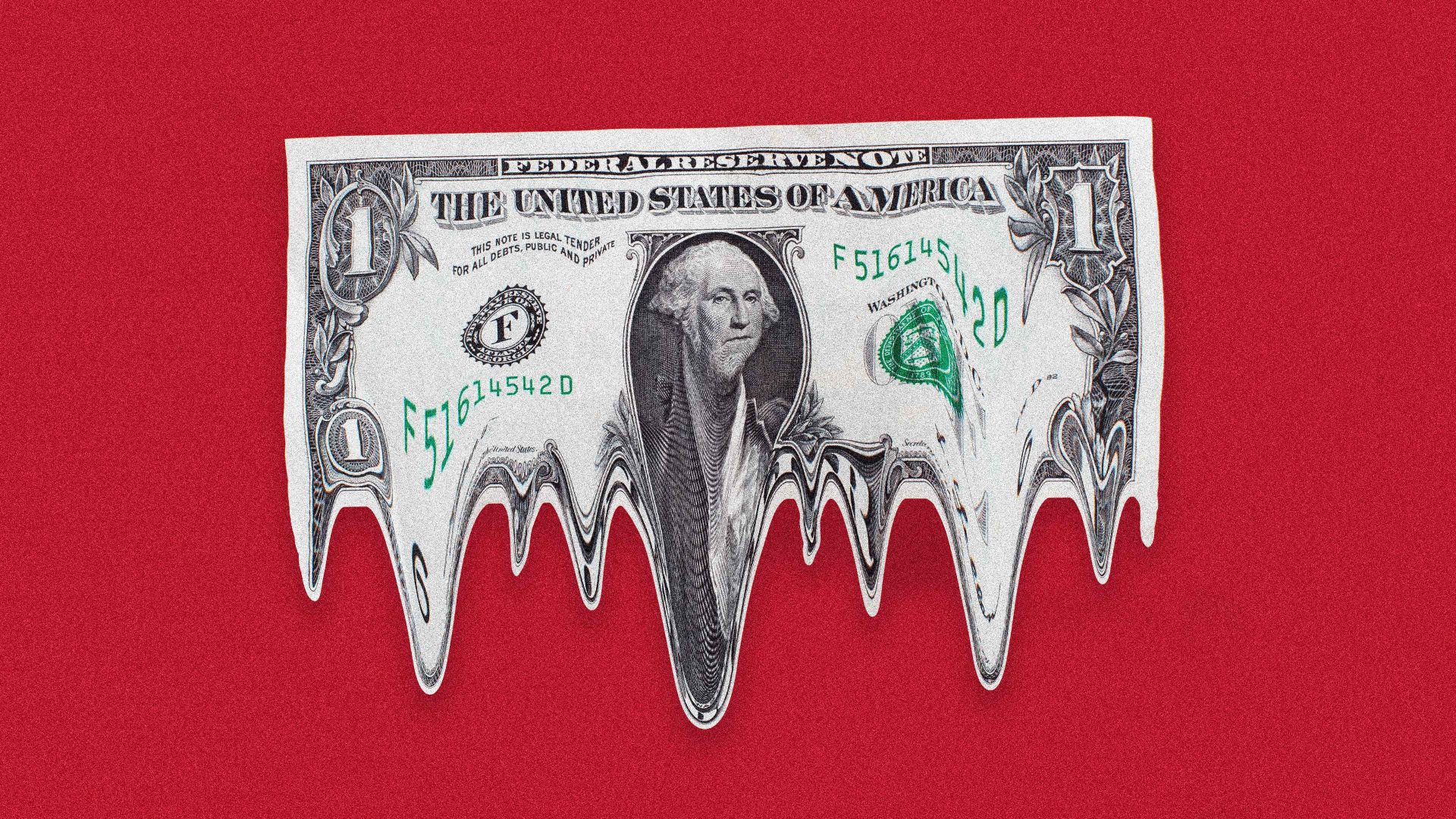
You might not have noticed, but we are now at the 20th anniversary of the beginning of the Global Financial Crisis. The date people remember is Monday September 15, 2008, the day Lehman finally went down. But that wasn’t the start of the crisis. It was the point when it could no longer be contained.
The autumn of 2006 was the moment when people first began talking about an impending Minsky Moment. That’s the tipping-point theory named after the American economist Hyman Minsky, when a long period of intense speculation collapses into crisis, triggering a wave of economic and financial terror. And what seems clear is that, if you were going to create the perfect scenario for a global financial and economic crisis, it would look very much like what we see now.
Twenty years ago, when the crash was starting to build, I was editing a finance and banking journal – a fairly high-fibre read on regulation, bank rules and derivatives. But what became clear, as the panic rose throughout 2007 and into 2008, was that this was not a problem of the financial markets alone.
The crisis had causes that went deep into the economic and political history of the twentieth century, to America’s fiscal hangover from the Vietnam War, to China’s entry into the global economy and to the rise of the modern global financial system itself. To blow up the world, it turns out you needed a long list of ingredients. We now face a scenario that, if anything, looks even more worrying than the picture that confronted us back in 2006.
A classic Minsky Moment needs an asset-price bubble that suddenly goes “pop”. Last time round it was the US housing market that went super-critical, enriched to weapons grade levels by a cascade of cheap money, light regulation and iffy financial engineering.
This time round, the prime candidate for detonation is AI. As Capital Economics said in a recent report: “There are plenty of signs that we are now in the late stages of a bubble in AI.” They are not alone in that judgement.
Consider SpaceX, for example, which contains Elon Musk’s AI business. That company now has a market cap of over $2 trillion, and yet has never made a profit. Another AI company, Anthropic, has announced that it is profitable, just so long as you ignore the money it has spent developing its latest model – which is to say that it is not profitable at all. Anthropic has decided that it is also worth over $2 trillion, and is soon planning to offer its shares for sale.
The important thing to keep in mind is that these valuations are a fantasy. They don’t come from anything like sales, or revenues, or from any conventional commercial success. They originate from a shared mania, a belief that at some indistinct point in future these companies might make large profits, even though no one knows how or when that’s going to happen, not even the people who run them.
Those valuations were made to look even more flimsy when Dario Amodei, the CEO of Anthropic recently put out a note suggesting that AI companies needed to slow the rate at which their models were advancing. Wall Street’s tech index dropped sharply. Even Nvidia fell 3%. When Musk said he thought the same, SpaceX shares dipped by 2%. The point is that, if these AI valuations are based on nothing other than speculation, it takes very little to knock them over. A change in the mood would be enough to do it.
If you happen to run a multi-trillion dollar company whose value could vanish in a puff of market paranoia, then how do you protect yourself? Alex Karp, the CEO of Palantir recently proposed an answer. “These businesses have to be nationalised,” he told CNBC, “because if you don’t nationalise it, every single one of my clients is going to sue.” It was surprising to hear a dedicated capitalist like Karp calling for a move straight out of the socialist handbook.
But what he’s suggesting makes sense – for him at least. Nationalising the AI companies would push all the financial risk they represent onto the taxpayer, which means that Karp’s enormous fortune would effectively be underwritten by the state. This is socialism for the rich. It is also what happened to the insolvent banks back in 2008.
Suggested Reading
Is the AI bubble about to go “pop” – and what happens if it does?
The thought that the state might step in to prop up the AI industry and save the fortunes of its top executives is about as unappealing as it gets. But Karp’s idea is a reflection of a grim new reality: the AI industry has become too big to fail. Investment in the US linked to AI currently accounts for anything up to 44% of US economic growth. If AI’s contribution to US GDP drops, the knock-on effects for the US, and for the world economy, would be terrible. Imagine if, after all this, the whole AI thing just doesn’t happen. The shock to global confidence would be devastating.
And global confidence is already thin on the ground. A large part of that is down to the two wars started by men who thought they could score easy wins and who both turned out to be wrong. Putin was so confident he could take Ukraine in hours that his initial assault troops carried dress uniforms for an impromptu victory parade through Kyiv. As for what Trump thought he was doing when he attacked Iran, that’s anyone’s guess.
The Trump-Putin wars have caused immense misery, suffering and death. They have also had punishing global economic consequences, the most obvious being inflation, which has been driven upwards by a creeping sense of economic uncertainty, and the rising price of energy, particularly oil. Before Trump attacked Iran, oil was at $56 a barrel. Now it’s over a hundred.
Inflation makes everything more expensive, which makes voters miserable – and angry. In the US, inflation is now at 3.4%, high enough for the Federal Reserve to announce an increase in interest rates at its last meeting, much to Trump’s frustration. Inflation also drives up the cost of government borrowing, which means there’s less money to spend on everything else – unless you put up taxes, which, again, voters tend to hate.
And speaking of government borrowing, America’s total outstanding debt now stands at $40 trillion. That figure is 100 times greater than the number of stars in the Milky Way, meaning that the US debt pile is literally on the cosmic scale. And the cost of all that US government debt? In 2026 alone: $1 trillion. The Congressional Budget Office reckons that over the next decade it will double. No wonder the appetite for US government bonds is weakening.
As debt and inflation both rise, there seems to be no real effort under way to end the wars in Ukraine and Iran, which are costing so many lives, and causing so much economic devastation. Trump has sent a team consisting of his son-in-law and his golf partner to negotiate peace settlements with Putin and to push for censessions from Iran. The result has been more death and ruin in Ukraine and the spread of the Iran war to the Arabian peninsular. Their proposed solution for Gaza has sunk without trace.
The Kushner-Witkoff duo has been so spectacularly ineffective they could almost be mistaken for some kind of Trumpian insult. Whatever their intentions (self-enrichment) they show that Washington is currently incapable of engaging in diplomacy, in the commonly understood sense of that term. A startling further example came recently when Trump visited Ireland and met both the Taoiseach and president. But it soon became obvious that the only reason he was there was to attend the Irish Open, which happened to be taking place on one of his golf courses.
Trump’s gauche diplomatic ways are absurd – almost comic. But what they also make clear is that, if there were to be a sudden AI-driven economic reversal, the US would be incapable of leading any coherent response.
Suggested Reading
Trump’s latest economic ruse – Greenlandic seal clubbing
That is a significant contrast with 2008, when leaders of substance, including Obama and Brown, were on hand to marshall a global emergency plan. The current White House would not be able to play such an international role, as the current president has no such international standing.
Trump, pathologically incapable of taking responsibility for anything, would probably just blame everyone else – or simply give up and walk away, leaving his (presumably) democratic successor to clear up after him.
That would leave any solution to the “international community”, or what remains of it. And here, you come to the problem of all those populist, authoritarian political movements around the world: in France, Italy, Britain, Germany, not to mention Greece, Hungary, Turkey, Georgia, India and Russia, where nativist politicians would howl in protest at any international economic clean-up operation. The result would be chaos. The opportunity for China to step into the power vacuum would be enormous.
It might not happen. We must all hope it doesn’t happen, and no one can tell the future. I also have to remember that people who watched the 2006-8 crisis at very close range came away with a Quixotic tendency to see potential crashes everywhere.
But what we can say is this: we have a systemically large AI bubble, global inflation, wars, an energy crisis, huge government debt, weak global leadership and rampant political populism. From here, it wouldn’t take much. Not very much at all, in fact.
 Most popular

Emily Maitlis’s diary: As I was saying to George Clooney just the other day…

A new film about Elon Musk reveals him as so awful it’s almost tragic. Almost

The strange case of the Lib Dem writer who fell for Farage


The right wing media hounded Jason Arday and ignored James Orr. It’s obvious why