
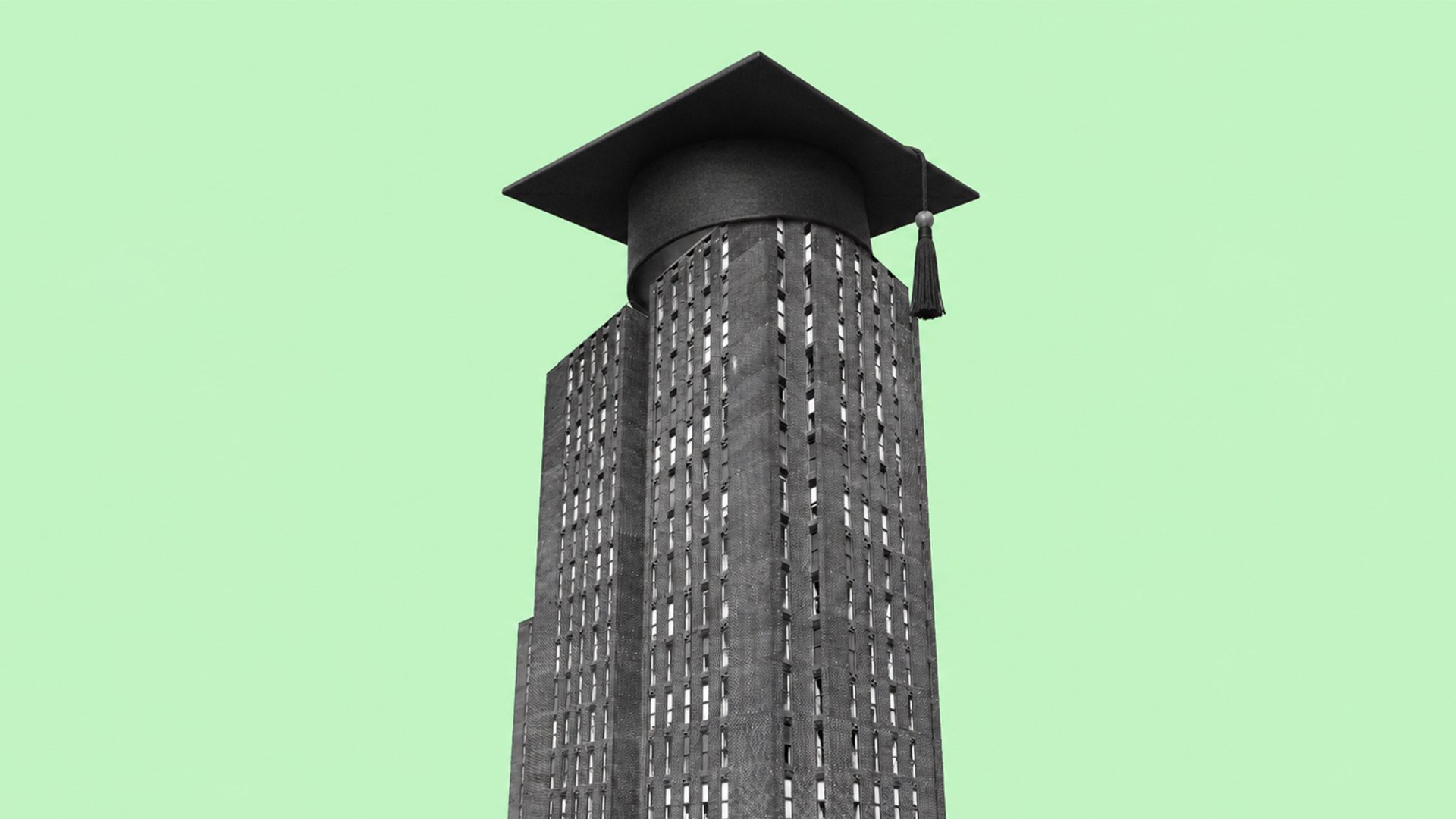
The British historian William Whyte is worried about the future of our universities. That is not because they are facing a funding crisis, though they are, or because of the disastrous effects of Brexit on higher education, which are huge. Instead, he is worried about student housing.
Just 30 years ago, almost all young students moved away to study, finding a first flush of independence in leaving the family home. University accommodation was a central part of that experience. Since then, higher education in England has undergone a profound shift. All students now pay fees to attend university, which has effectively turned them into consumers. Wealthy international students have also become increasingly important to British universities.
But then you come to the difficult question of where these students are all going to live. You can see the answer to this in every major town and city in the UK. While the government is struggling to meet its target of 300,000 family homes a year, and prime minister-in-waiting Andy Burnham is looking for ways to fund a new generation of council housing without raising income tax, the student housing sector is booming.
Look up, and you’ll see the scaffolding around yet another block of student apartments. Purpose-built student accommodation (so significant that it’s already known in the property world by the acronym, PBSA) now accounts for 7% of all UK building projects, costing around £900m a year. It houses a quarter of all students in the UK.
Suggested Reading


The issue that makes voters angriest of all
With general housebuilding and regeneration schemes stalled across the country, it can seem like the student flats industry is the only large-scale construction activity actually taking place. Burnham – who has developed a very close relationship with global property investors through privately-funded and publicly-backed regeneration projects in Greater Manchester – will no doubt be looking to this sector for inspiration in getting new homes built.
But this surging industry is threatening to undermine the student experience itself. Because, along with the en-suite bedrooms, sushi vending machines, therapy pet visits and bookable podcast studios (all real world student housing perks), the rush to snap up private accommodation has removed something from the student experience – a sense of academic community.
As William Whyte writes in a July paper for the Higher Education Policy Institute (HEPI): “Wedded to a narrow doctrine of ‘student experience’, the sector has travelled too far away from the idea of the university as a collective endeavour.” He adds that universities “need to rediscover and rearticulate the notion of community”.
Whyte says, thanks to the range of student housing now available, young people are being intellectually short-changed. They are no longer bunking down with a group of like-minded individuals facing the same academic challenges at the same time. Losing that sense of intellectual community undercuts the overall value of the university experience.
As Whyte also explains, the costs of this new wave of student housing are so great, that it has “created a perverse outcome in which students are forced to undertake detrimentally large quantities of paid employment during term in order to fund their accommodation.”
The student housing market has flourished despite these pressures because, as the student population increased, universities couldn’t keep up with demand and had to start pushing their responsibilities onto private providers.
As Burnham already knows, these agreements with private providers make student housing very attractive for investors, in that it comes with a guaranteed return. You know there is a constant stream of young students who move away from home and need somewhere to live.
And so the student accommodation sector flourished while private domestic housebuilding has stalled and social housing has almost collapsed.
The incoming PM is preparing to devolve power over new council housing to local authorities, and because there is a growing waiting list for social housing, the same guarantees may soon be available to investors working with local government on social housebuilding.
It seems likely that the student property boom will soon reach its zenith. In the UK, a debate over the value of an expensive higher education is raging. After an increase during the covid years, student numbers are starting to dip. Currently 21% of full time students live back home during term time, but since the pandemic, that figure has been rising steadily by about 1% a year. This is Whyte’s collapse of the university environment in action. The university applications service UCAS predicts that the number of students living at home will increase even more, as UK enrollments continue to decline.
Meanwhile, demographic change is preparing to bite. “Demand for higher education, at least among young school leavers, is basically related very closely to how many 18-year-olds there are in the population,” says HEPI director Nick Hillman. “Come 2030, the number of 18 year olds drops off a cliff. People are very worried about that.”
Global forces (including Brexit, and the improvement of universities across Asia) are also reducing overseas interest in British education. In the academic year 2024-25, international student enrolments to UK universities fell by 6.1%. Much of that decline was down to the impact of losing EU students who can no longer pay home level fees in the UK.
These declining rates can cause serious financial pressures. In November 2025, the drop in the number of Chinese students choosing the UK was bad news for Empiric Student Property. Just 10 weeks earlier, its shareholders had approved a £645m takeover by Unite, another giant of the student property market. But Empiric found that its reservations were down, with only 89% of its rooms booked for this academic year. The target occupancy rate is 97%.
A further complication is that student landlords providing traditional shared houses, where groups of friends rent a home on a regular residential street together, are selling up due to the added burdens set out in the new Renters Rights Act. The law grants tenants new protections which complicates the process of renting out a house for only part of the calendar year. That is predicted to leave large numbers of students with fewer options, making pricier, purpose built housing even more attractive.
Meanwhile, universities struggling with funds are selling off or demolishing rather than remodelling their oldest accommodation. They are relying on private providers to meet their housing obligations to students. At the high end, the market for the most luxurious student housing is still extremely competitive: market watchers Unihomes say that cities including Liverpool, Bath, London, Coventry and Derby are predicted to have the highest student demand.
The players in the student housing market are extremely savvy, building rapidly in areas of high demand and selling off quickly where the student population is shrinking. Rapid new development is rarely contested, unlike proposals for new social housing.
Suggested Reading


Student loan repayments are crushing an entire generation
One option for that sold-off student apartments is to convert into housing for mobile but cash-strapped young professionals, with small spaces available at reduced rates with social and other events priced in. City councils, including Bath, are already consulting on a change to planning use regulations to make conversation from PBSA to other types of shared accommodation easier.
As he prepares to become prime minister, Andy Burnham needs to be open to this kind of lateral approach. He has described how he wants to grant even more freedom to local authorities both to build and repurpose their existing property stock. The freedom to transition properties from one use to another could not only help solve the problem of a shrinking student housing sector, but play a part in the push to develop more social housing for low income families with councils as the accountable landlord.
The big challenge for Burnham’s team will be how to ensure that devolved powers get it right. Some of the worst emergency housing provided by the government to people in need has been carved from the carcasses of under-used office blocks.
But with the housing crisis in full swing, graduates are also feeling the pinch. The question it leaves is another version of the same dilemma: just as our students are being deprived of a full academic experience, is it really appropriate for our young, independent adults to be expected to live like lifelong students?
 Most popular

I was at Eton with Charles Spencer – this is how it explains his battle with the royals


Emily Maitlis’s diary: My deep dive into Jeffrey Epstein’s hidden empire – and the network that let him get away with it


The linguistic logic behind dropped syllables

Putin’s wartime economy is heading for catastrophe