
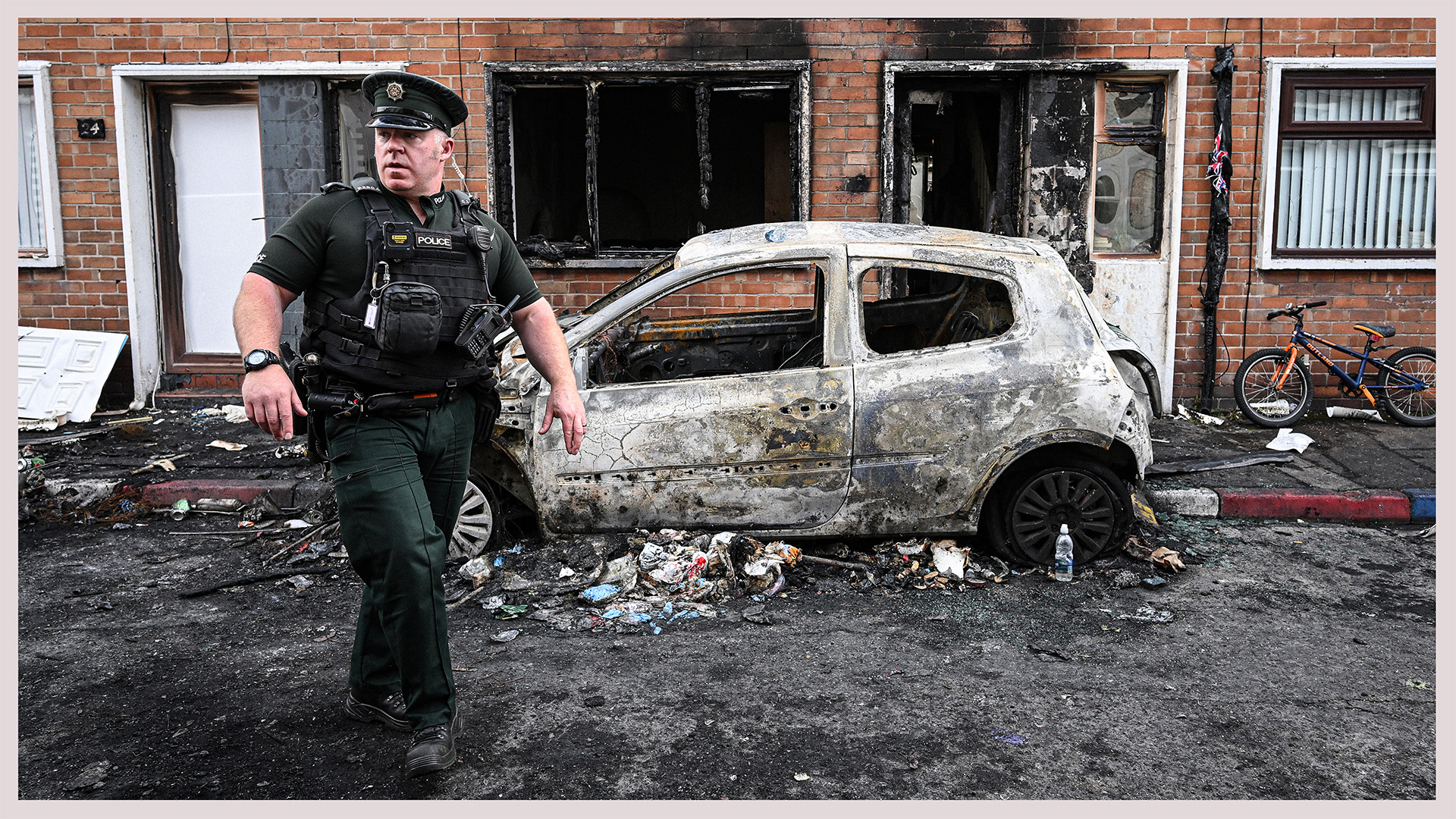
The horrific Belfast knife attack, which led to a Sudanese national being charged with attempted murder, took place in a republican area. But the anti-immigration violence that erupted 24-hours later occurred in loyalist areas in the east and north of the city.
Hadi Alodid, 30, from Sudan, appeared in court in Belfast on Wednesday charged with attempted murder. He was remanded in custody.
As the wheels of justice turned, the images from the streets of Belfast were reminiscent of Northern Ireland’s tribal conflict of the early seventies. Families, including one with a two-month-old baby, were forced to flee as groups of masked men chanted “foreigners out” and set fire to houses. Rioters also lobbed petrol bombs at police and burned vehicles.
But this time round these were not Protestants or Catholics being burned out of their homes, but people from ethnic minorities. In total, 27 people have been made homeless because, as a UK minister said, “people went door-to-door to try and target foreign nationals”.
Stephen Ogilvie, the victim of the knife attack, has lost his left eye, has injuries to his right eye, neck and back and remains in hospital. His family has said they were “disgusted” by the unrest, and that “peaceful protest is the only way forward”.
They added that “migrants make a deeply valuable contribution to our country, including in our healthcare system and hospitality sector”.
The rioting was in direct opposition to the wishes of the family, and though loyalist paramilitaries denied orchestrating the race hate riots, they said they would not prevent further violence.
Which raises the question of why loyalist communities are destroying their own areas in response to an attack that took place in a republican neighbourhood. The answer lies both in Belfast’s difficult history and in the modern-day pressures which face people living in economically deprived working-class districts.
Suggested Reading

The New IRA terrorists who turn men into bombs
The reality is that these sections of Belfast have been contested for 200 years. Its residents know where Catholics live, where Protestants live and what neighbourhood is adjacent to their own. Sectarian tensions are now held at bay by the peace walls that separate rival communities that live cheek-by-jowl. It is a small city that contains a huge well of animosity.
In just a few years there has been radical change – a whole new migrant population has arrived and they are predominantly housed in the working-class areas of Northern Ireland, particularly in Belfast.
The management of housing for migrants is not transparent, but the shortage of social housing is very real. The problem is that not enough new houses are being built and this has led to a perception that new arrivals get preferential treatment over families who have lived there for generations.
These tensions have been particularly acute in some loyalist areas, where lower rents and more available housing stock initially led to greater numbers of newcomers.
The pace of migration into these areas was high. The hope was that they would integrate into a society that, despite the end of the Troubles, is still not at peace with itself.
It would have required a tremendous sequence of good luck for nothing to go wrong in these circumstances. Unfortunately, good luck has always been in short supply around here. It’s worth recalling that this week’s violence comes exactly a year after anti-immigration riots in a unionist area of Ballymena, Co Antrim. Last weekend, a former Gospel Hall on Belfast’s loyalist Shankill Road, that was to be turned into an Indian grocery store, was gutted in a racially-motivated arson attack.
Away from the street violence, immigration, like everything, tends to be viewed through the prism of Green and Orange politics, with the nationalist Sinn Féin, SDLP and cross-community Alliance supportive of open borders, while the Democratic Unionist Party, Ulster Unionist Party and Traditional Unionist Voice want more controls.
The suspect’s backstory plays right into this political argument. He had boarded a bus in Dublin and travelled to Belfast where he immediately claimed asylum and was granted leave to remain for five years. He was able to do so because the Common Travel Area, which has existed since 1922, allows unimpeded movement between Ireland and Northern Ireland.
Potentially reigniting the old Brexit argument, DUP leader Gavin Robinson has called on the prime minister to close “the open, porous border” between the two jurisdictions.
On the ground, however, it is not only loyalists with their traditional conservative/right wing allegiances, who find immigration problematic. There is a growing feeling in nationalist areas that changing demographics are a problem. The attack on Monday will inevitably bring some of that to the fore.
The attacker was eventually clobbered by a have-a-go hero named Maitiu Mag Tighearnan, who used a hurling stick – a distinctly Irish sporting bat. This detail has taken on symbolic significance across the border in Ireland, where anti-migrant feeling has been growing for a number of years.
Suggested Reading

Blue Lights: Belfast’s reality TV
On the same day as the attack, the trial began in Dublin of an Algerian who had allegedly stabbed three children in Parnell Square in 2023. That stabbing led to widespread rioting in the Irish capital and it changed Ireland’s reputation overnight. Suddenly, the Emerald Isle was maybe not so much the “Ireland of the Welcomes” as once believed.
Wednesday was the second night of violence in Belfast. Police came under attack and used water cannon to disperse the crowds. A rioter in Portadown, Co Down, set himself on fire while trying to throw a petrol bomb. However, it was not as widespread as the violence of the night before.
The family of Stephen Ogilvie offered a “profound thank you to the local people” whose “quick actions absolutely saved his life” and added: “We do not want this terrible tragedy to be used to divide people or fuel hostility.”
But as with so much else, momentum is everything. The week’s events demonstrated two things: the fragile state of stability in Northern Ireland; and that there is now potential for ongoing trouble.
 Most popular


Emily Maitlis’s diary: As I was saying to George Clooney just the other day…

A new film about Elon Musk reveals him as so awful it’s almost tragic. Almost


The strange case of the Lib Dem writer who fell for Farage


The right wing media hounded Jason Arday and ignored James Orr. It’s obvious why