
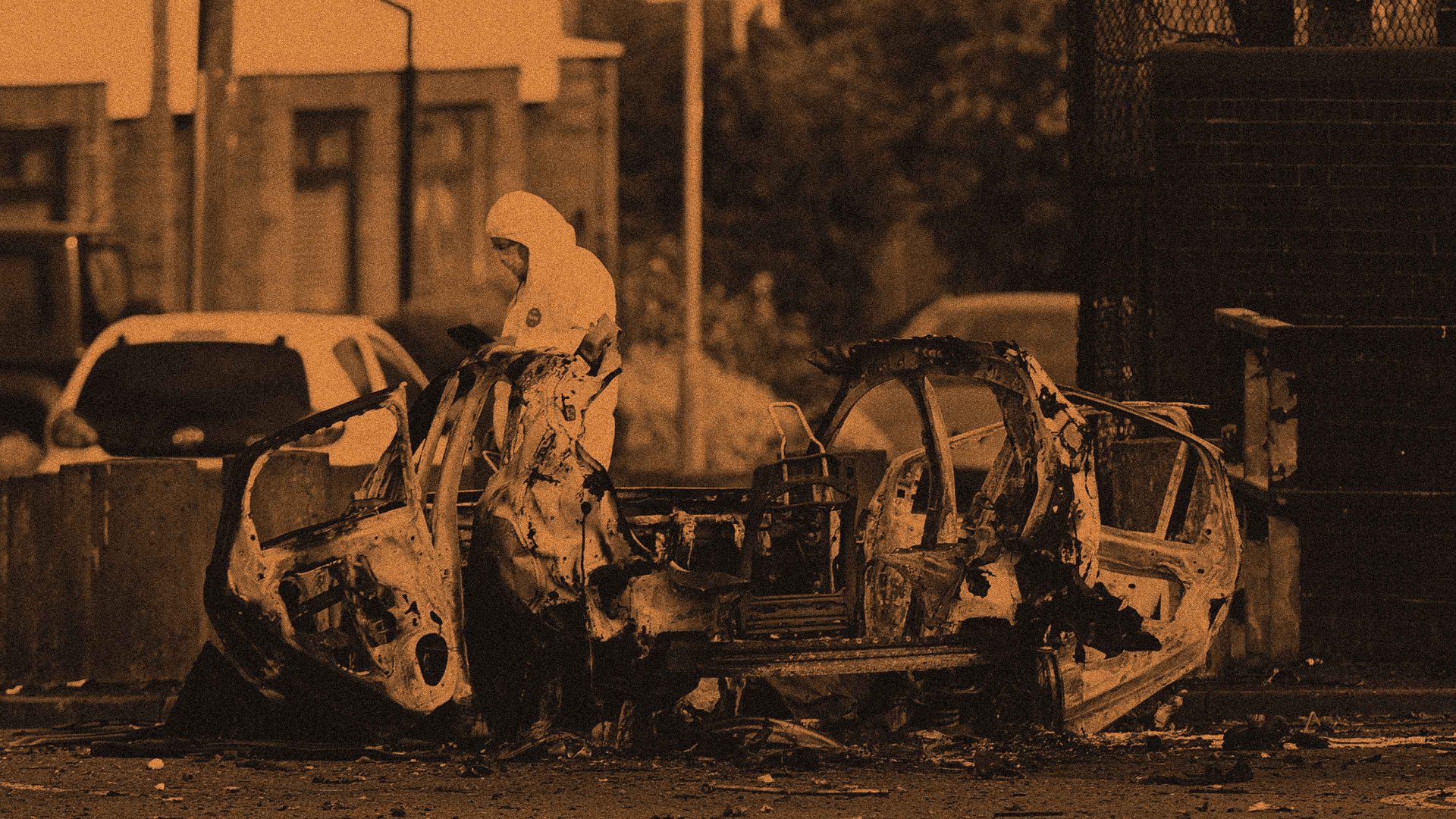
The morning headlines in Northern Ireland last month about a New IRA car bomb attack on a Belfast police station was like something from the eighties. Terrorist violence once dominated daily life here. Now a small group wants to bring it back.
A delivery driver’s car was hijacked by a masked gunman and fitted with a gas cylinder device. The hostage was then ordered to drive his car to Dunmurry police station. This was a throwback to one of the most shocking weapons used by the Provisional IRA during the Troubles: the proxy human bomb.
The attack took place in a heavily-residential area. When the bomb exploded, bodycam footage from police on the scene showed how lucky residents were to escape injury.
The New IRA soon claimed responsibility, and in the statement accompanying the attack used language that evoked the days of the Provisional IRA. Northern Ireland heard once more that antiquated warning to those “collaborating with British crown forces” and a vow to continue the terror campaign “until the British give a declaration to withdraw”.
A month before this attack in Dunmurry, the New IRA attempted to bomb a police station in Lurgan, County Armagh, which is around 20 miles away. The method was the same: a pizza delivery driver was hijacked by two masked men, one armed with a pistol. They placed a device in the boot of his car and ordered him to drive it to the police station, threatening to kill him if he refused.
Suggested Reading

Migrants bring Sinn Féin a reality check
Once there, the driver fled his car and managed to warn security staff. One hundred homes were evacuated and residents spent the night in the Town Hall. The device was made safe in a controlled explosion. This is 2026. The peace deal was 1998.
Jon Boutcher, chief constable of the Police Service of Northern Ireland (PSNI), described the Dunmurry bombing as “deliberate, reckless and stupid”. It was an “absolutely irresponsible, unacceptable act of violence. We hoped these days were behind us”.
“We didn’t anticipate this,” he added. “We need to address [it] very quickly, arrest them and put them where they belong – which is in prison.” This month, two men have been charged with attempted murder, one relating to the Dunmurry attack and the other to Lurgan.
The gap in intelligence which allowed the terror group to target two PSNI stations within weeks, is alarming given that the New IRA has been heavily infiltrated by police and MI5.
The New IRA claimed to have used Semtex in both attacks. That explosive has a terrible legacy in Northern Ireland, and was used by terror groups from the 1980s onward. It was also used to bring down Pan Am Flight 103 over Lockerbie in 1988. But that claim has drawn a sceptical response. These were not sophisticated devices – they were crude, unpredictable and potentially highly dangerous.
The New IRA is one of a number of dissident republican groups that broke from the Provisional IRA and that does not accept the Good Friday Agreement. At least two groups have recently taken to social media to post videos of themselves, armed and masked, making threatening statements. Linked to growing anti-immigrant sentiment in the Republic of Ireland, these appearances are menacing.
Formed in 2012, the New IRA is made up of members of the Real IRA, which was responsible for the 1998 Omagh bombing that killed 29 people and two unborn children. It also includes members of Republican Action Against Drugs, a republican vigilante group that carried out punishment shootings against suspected dealers and bomb attacks on their homes. Active members of the Real IRA include veterans with former links to the Provisional IRA. Security experts say that, compared to the number of IRA members during the Troubles, numbers remain low.
Suggested Reading
Northern Ireland is still broken
Michelle O’Neill is first minister of Northern Ireland and the vice president of Sinn Féin, which was regarded as the political wing of the Provisional IRA during the Troubles. In Belfast, O’Neill stood side by side with deputy first minister Emma Little-Pengelly of the Democratic Unionist Party and stated: “We are absolutely united in condemnation of what has happened. Nobody wants to see this on our streets.”
It was a rare moment of unity for the two main parties in the current, highly dysfunctional power-sharing executive. The feuding, which has seriously hindered the progress of legislation, is being ramped up ahead of next year’s Assembly elections.
The New IRA attack in Dunmurry was timed to steal the headlines from Sinn Féin’s annual party conference being held in Belfast. The habit of kicking the party in the shins under the table is a dissident tactic to remind the leadership that there are others waiting to replace them.
Belfast is a more fertile political territory now for Sinn Féin than many parts of the Republic. From a position of unassailable strength in opinion polls south of the border only a few years ago, reaching a lead of 10-12 percentage points, Sinn Féin have found themselves rummaging in the basement of percentages along with the two government parties, Fianna Fail and Fine Gael. Immigration is a bitter electoral issue and has eroded SF’s working-class vote.
It looked as if Sinn Féin was on a path to government in both the north and south simultaneously. But that path to political unity has remained just out of the party’s grasp as it has faced a wall of political, social and economic challenges across both jurisdictions.
The New IRA, meanwhile, styles itself as continuing the “armed struggle” in order to force “the Brits” from Ireland. Its members know they have no chance of achieving this, but if they can disrupt policing in nationalist areas, that will be enough.
In a sinister twist, the terror group’s statement claiming the Dunmurry attack included a threat to target police officers in their own homes. This puts them at odds with Sinn Féin, which spent a long part of the peace process resisting calls to “support” the new police service – but eventually they backed it. Sinn Féin politicians now sit on the Policing Board.
But Sinn Féin’s position on the police issue is a difficult one because the old resentment against policing within the nationalist community is ripe for exploitation by the New IRA. The number of Catholics joining the service has declined, such is the scale of the dissident republican threat.
The catalogue of New IRA activities is substantial. Prior to its formation, some members were thought to have been involved in the 2011 murder of the police officer Ronan Kerr in Omagh and the 2009 murders of British soldiers Patrick Azimkar and Mark Quinsey outside Massereene Barracks in Antrim.
In 2012, the New IRA attacked the prison officer David Black, shooting him dead on a motorway as he drove to work in Maghaberry Prison. Four years later, it murdered another prison officer, Adrian Ismay, who died 11 days after a bomb exploded under his van in Belfast. Notoriously, it murdered 29-year-old journalist Lyra McKee in Derry in 2019. Three men are awaiting a judgement in that case, while six others face charges over rioting on the night of the murder.
Four other men including one of the New IRA’s suspected leaders, Thomas Ashe Mellon, also face a judgment over charges linked to a dissident rally in Derry in 2023.
Its last major attack before this year’s bombings was in February 2023, when the senior police detective John Caldwell was shot in Omagh, Co Tyrone. He was seriously injured but survived. The New IRA appeared to have collaborated with criminals in that attack, including some from loyalist backgrounds.
Emphatically, there is limited support for dissident republicans. But this roster of attacks and murders would be completely unacceptable and regarded as a crisis in any other region of Europe.
Policing on both sides of the Irish border and intelligence work have significantly undermined the organisation. In Operation Arbacia, the MI5 agent Denis McFadden embedded himself deep within the New IRA and bugged high-level meetings. Ten suspects now face a range of charges from directing terrorism to preparing acts of terrorism.
Earlier this year, MI5 sent suspected New IRA members a 60-second video showcasing articles from the Sunday Life, a Belfast-based newspaper. The footage opened with text saying “New IRA – your 2025 in review”, before displaying articles about the terror group’s “loan sharks” and drug dealing, as well as coverage of how police were cracking down on them.
In Northern Ireland, the debate over the constitutional future continues, with divisive Green and Orange rhetoric already intensifying ahead of next year’s Assembly elections.
But its people are united on two things – their disdain for a failing executive and their resolve that whatever shape the future takes, it will not be settled by a return to the gun and the bomb.
 Most popular

My truly deranged encounter with Trump apologist Kellyanne Conway

Suella Braverman’s book has sold only 106 copies. This is why

The moral depravity of Robert Jenrick

Hungary’s lesson to the world: Populism isn’t permanent