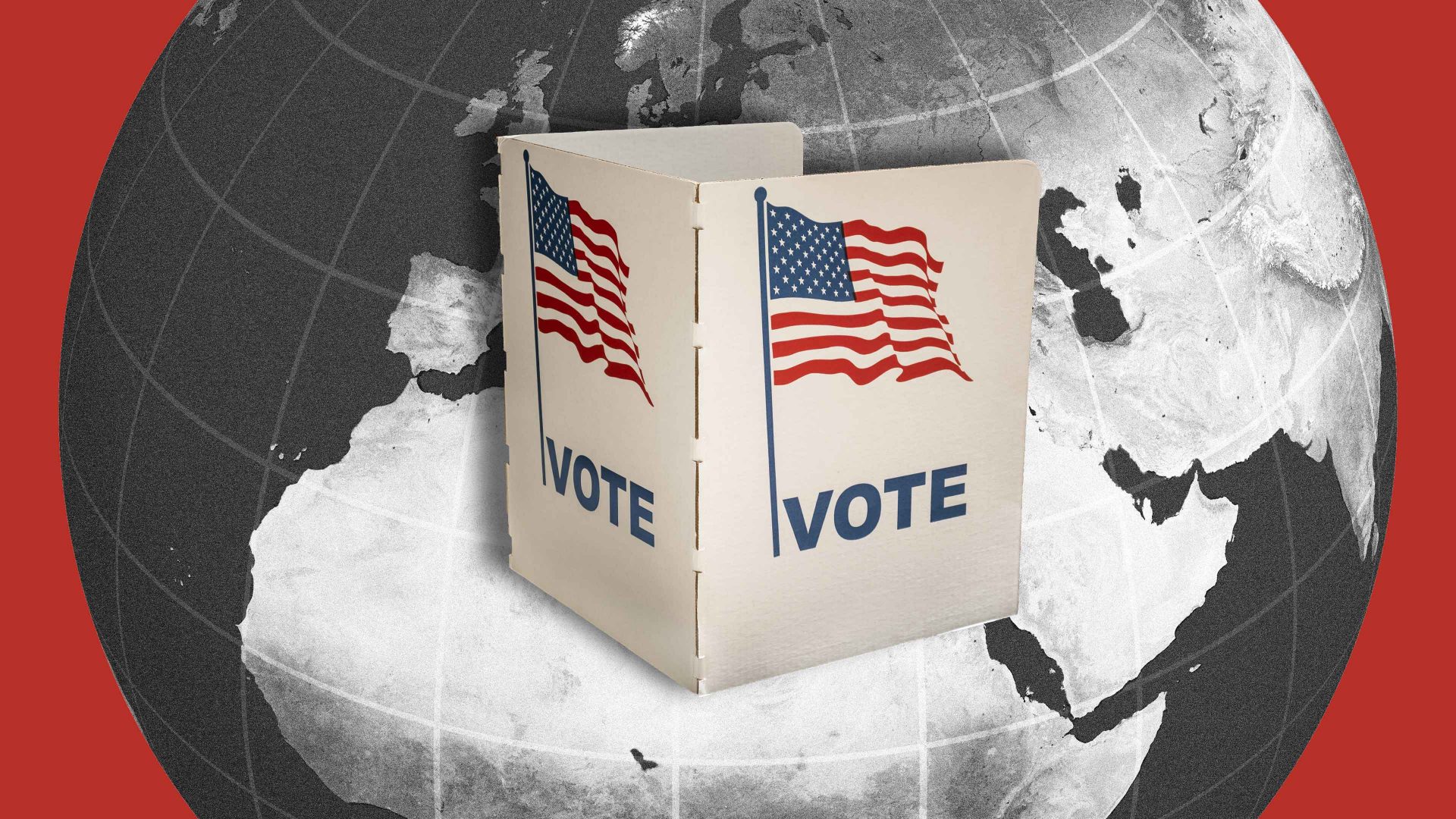
“The Democrats are talking about how they’re working so hard to get millions of votes from Americans living overseas,” president Trump posted to his Truth Social platform on September 23, 2023. “Actually, they are getting ready to CHEAT!” Three years on, the fight for the overseas vote has only intensified.
The UK is home to the second largest number of US citizens eligible to vote worldwide, trailing only Canada. Although rarely recognised, Britain’s American population is the target of a significant campaign ahead of the 2026 midterm elections.
“I often say that in races like these, overseas voters are the margin of victory,” says John, who works for Democrats Abroad, the official arm of the party serving US Democrats overseas. He reminds me of the Democrats’ 2020 result in Georgia, where Joe Biden won by 11,779 votes. Out of the 5m votes cast, 18,008 came from overseas and military voters.
Suggested Reading


Will the Democratic Socialists save or spoil the midterms?
Only 11% of overseas Americans who are eligible to vote did so in the 2024 elections. And the shifting demographics of these voters have led to a tussle between Democrats and Republicans, with Democrats leading efforts to increase the vote among overseas Americans while the Republican National Committee (RNC) has launched a coordinated wave of legal challenges against overseas voters who have never resided in the US.
Republicans have filed lawsuits in seven states, arguing that overseas voters favour Democrats. Cases in Michigan and Pennsylvania have been dismissed, while North Carolina courts have twice ruled in favour of the RNC. Cases in Colorado, Virginia, Arizona, Nebraska and New Jersey have yet to be decided.
“Voting is not a partisan action, everyone should be encouraged to vote. But unfortunately, the current environment has started to make it feel like it is,” Elizabeth Kelly, a volunteer with Democrats Abroad, explains over the phone. It’s a position that appears to have become a fault line between the two parties.
Though Democrats Abroad explicitly aims to elect Democrats by mobilising their vote, they also engage in non-partisan efforts to increase voting among overseas Americans. Greg Swenson, the chair of Republicans Overseas UK, sees that as self-serving.
“I think the Democrats have a much greater incentive to get people registered,” he explains over the phone from New York, “because they’re more likely to be Democrats if they’re an American living in the UK.”
He argues that college-educated voters are more likely to vote Democrat, and Americans living abroad are most likely to be professionals with a degree. That leads to a simple tactical conclusion for the Republicans: “we don’t put our resources into getting out the vote because it’s just bad math.”
Instead, they focus their efforts on the overseas constituency in the UK that is more likely to return a Republican vote: the military. There are at least 12 US military bases in the UK and more than 10,000 US military personnel in the country.
Suggested Reading

Trump has been reduced to crawling to China – it’s humiliating
Republicans Overseas engages with service members and their spouses through various social networking groups, but are battling an increasing share of overseas votes going to Democrats. And yet overseas voters with ties to the military are at risk of political attack from the domestic Republican Party.
That is concerning for Sarah Stryder, the executive director of the non-partisan Secure Families Initiative who, until recently, was resident in the UK as a result of her husband’s posting.
“Military life will often send us very far away from home, and not only does that impact us in terms of connection to family, friends, childcare support, it also impacts our ability to vote,” she explains.
“There’s a 27% deficit between military voters and civilians,” she continues, “and so if we’re not a voting bloc that lawmakers are accountable to, there’s going to be a policy disconnect.”
Ultimately, the battle over overseas voters – in the UK or further afield – is not just about the votes for individual parties and efforts to maximise or minimise them, but a more fundamental question about the ability of eligible voters to act on their democratic right to vote.
“I’m very concerned,” Alex Duprey, a 31-year-old American citizen, previously resident in Maryland and currently residing in France, tells me, “about the discourse around mail-in ballots – not in my state, but around larger federal actions.”
She will be voting abroad for the first time.