Amid the media scramble to interview the curator at the opening of The Bayeux Tapestry exhibition at the British Museum, Michael Lewis is asked an unexpected question: “How many penises are there in The Bayeux Tapestry? 93? 94?” Lewis hesitates, then replies, “I don’t think about it, to be honest. It’s kind of a strange aspect of tapestry studies…”
Since then, the question has cropped up on Nicky Campbell’s BBC Radio 5 Live show, where Professor Janina Ramirez dismisses any hint of facetiousness. “The penises are important,” she affirms. “The tapestry was almost certainly made by nuns… but in the 11th century, they were the powerhouses. The women doing this tapestry were women of the world.”
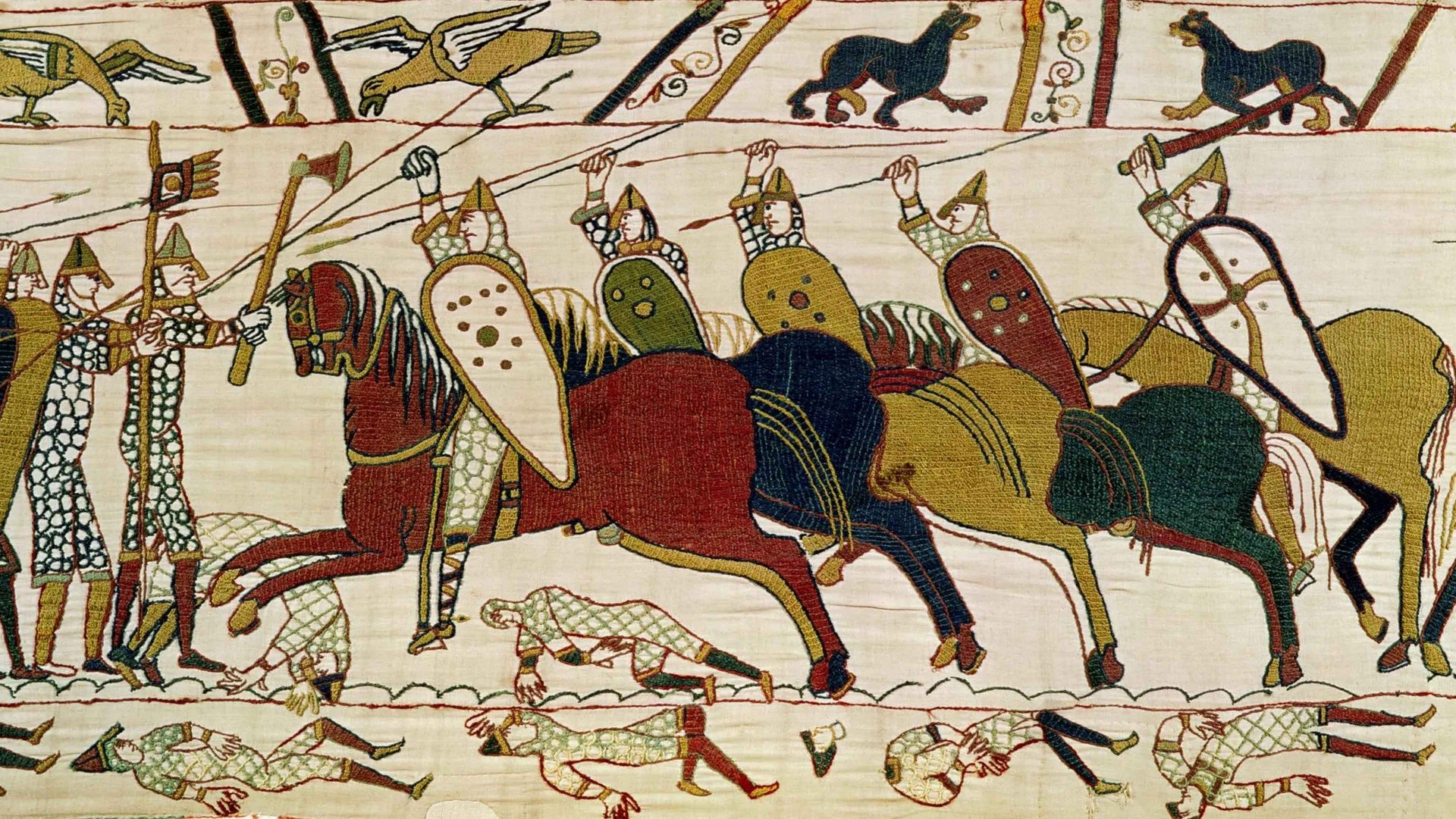
Women scarcely feature in the medieval embroidery (not, in fact, a woven tapestry). Only three appear in the main panels of the work, usually at moments of distress, and three naked figures cavort in the margins; this, compared to the 621 military men, courtiers and kings.
Lewis thinks that there might have been up to 20 seamstresses involved in the making, and it is likely they had witnessed the carnage that followed Duke William of Normandy’s arrival at Pevensey, crossing the English Channel with his fleet of ships, his army and his 5000 warhorses (these animals are highly masculinised in woollen thread, and naturally it is William’s horse that is the best endowed).
The destruction that the Normans wreaked is shown in scene 47, where two crop-headed soldiers are torching a house, from which a woman leads her son to safety. “I think it’s difficult for the English women not to have this in their minds when they were sewing… they would have been very emotionally attached to these events,” says Lewis.
For a work that narrates the story of perilous sea journeys, thrusting invasion and bloodthirsty battles, the stitched lines of The Bayeux Tapestry writhe with rhythm and life almost impossible to replicate (though many have tried).
Suggested Reading


The Bayeux Tapestry and the continuing allure of all that Norman wisdom
The first such attempt was by Elizabeth Wardle from Leek. Married to Thomas Wardle, an associate of William Morris and owner of the town’s dyeworks, Elizabeth had seen the original in Bayeux and decided that “England should have a copy of its own.” To this end, she recruited 35 women from the Leek Embroidery Society and in 1885 they began a 70-metre replica, which took a year to complete.
Britain’s Bayeux Tapestry, as it became known, toured nationally and internationally before being sold to a former mayor of Reading, Arthur Hill, for £300, who then gifted it to Reading Museum, where it is now on permanent display. Hung vertically, the copy gives a better sense of both the tapestry’s dimensions and its immersive quality, where you stand in a room surrounded by cloth, as opposed to the original at the British Museum, which is laid flat.
Although the facsimile is often described as ‘identical’ this is untrue, and it is the differences between original and copy (and between all the simulations that have followed) that is interesting. The most obvious deviation is the proud inclusion of the names of each embroiderer in the border beneath her section of work. The second concerns the genitalia.
The design for the Leek version was drawn from photographs of The Bayeux Tapestry supplied by the South Kensington Museum (later named the V&A). These pictures were doctored by the museum’s authorities to downplay the genitals of the warhorses and shield the men by putting them in pants, faithfully reproduced by the ladies of Leek, who had not seen the original and were not the prudish partners in this story.
Since then, there has been a veritable weave of Bayeux Tapestries popping up across the land, some issuing from community group projects (The Alderney Bayeux Tapestry Finale; The Norwich Friends’ Tapestry; The Hastings Embroidery) and some made by individuals (Mia Hansson in Cambridgeshire has taken 10 years to create hers; Ian Williams’ version in cross-stitch has just gone on show at Market Street Hall, Macduff, and there is also a well-regarded hanging by Jan Messent in Reading Museum, whose book The Bayeux Tapestry Embroiderers’ Story has proved an inspiration to many).
Suggested Reading

The curse of modern smartphone etiquette
Messent’s The Bayeux Tapestry Finale II (2019) reimagines the missing scene that some historians believe must have come at the end of the Bayeux narrative, namely the coronation of King William in Westminster Abbey on Christmas Day 1066. It is unknown where this section might be – but a fragment cut from the tapestry in 1816 by the historical draughtsman Charles Stothard is now owned by the Bayeux Tapestry Museum in France.
Stothard had been commissioned by the Society of Antiquarians to make a full set of drawings of the tapestry and used the opportunity to snip off a souvenir. Unfortunately, it was his wife, Eliza, who was blamed for the theft and it was only after a series of articles published in The Times in 1881 that Eliza, by then aged 91, was absolved of her husband’s crime.
Once considered a mere storytelling and propaganda tool, appreciation of The Bayeux Tapestry has evolved from the view that it was “rude and barbarous”, to the realisation of its importance as historical artefact to the recognition that it is a great medieval masterpiece – or “mistresspiece” – as the American feminist group Guerilla Girls would call it.
Before leaving the British Museum, I detour next door to The Parthenon Marbles, where I’m confronted by a frieze of processional figures carved in stone and swathed in draperies with rearing horses, so full of life. But what beguiles me more lies in the tapestry, where I have seen an artisan fixing a cockerel weathervane on the roof of the newly built Westminster Abbey, where mourners ring bells at King Edward’s funeral and where the French count, Guy of Ponthieu, travels on horseback with his captive Harold Godwinson, their luxury items – two hunting hawks – on full display.
And yes, there’s also that tiny man squatting in the border, who forgot to put his pants on…
The Bayeux Tapestry is at the British Museum until December 31
 Most popular


Emily Maitlis’s diary: Trump doesn’t fear the AI apocalypse – but he’s terrified about the midterms


A new film about Elon Musk reveals him as so awful it’s almost tragic. Almost

My day out with Danny Tommo
I was at Eton with Charles Spencer – this is how it explains his battle with the royals