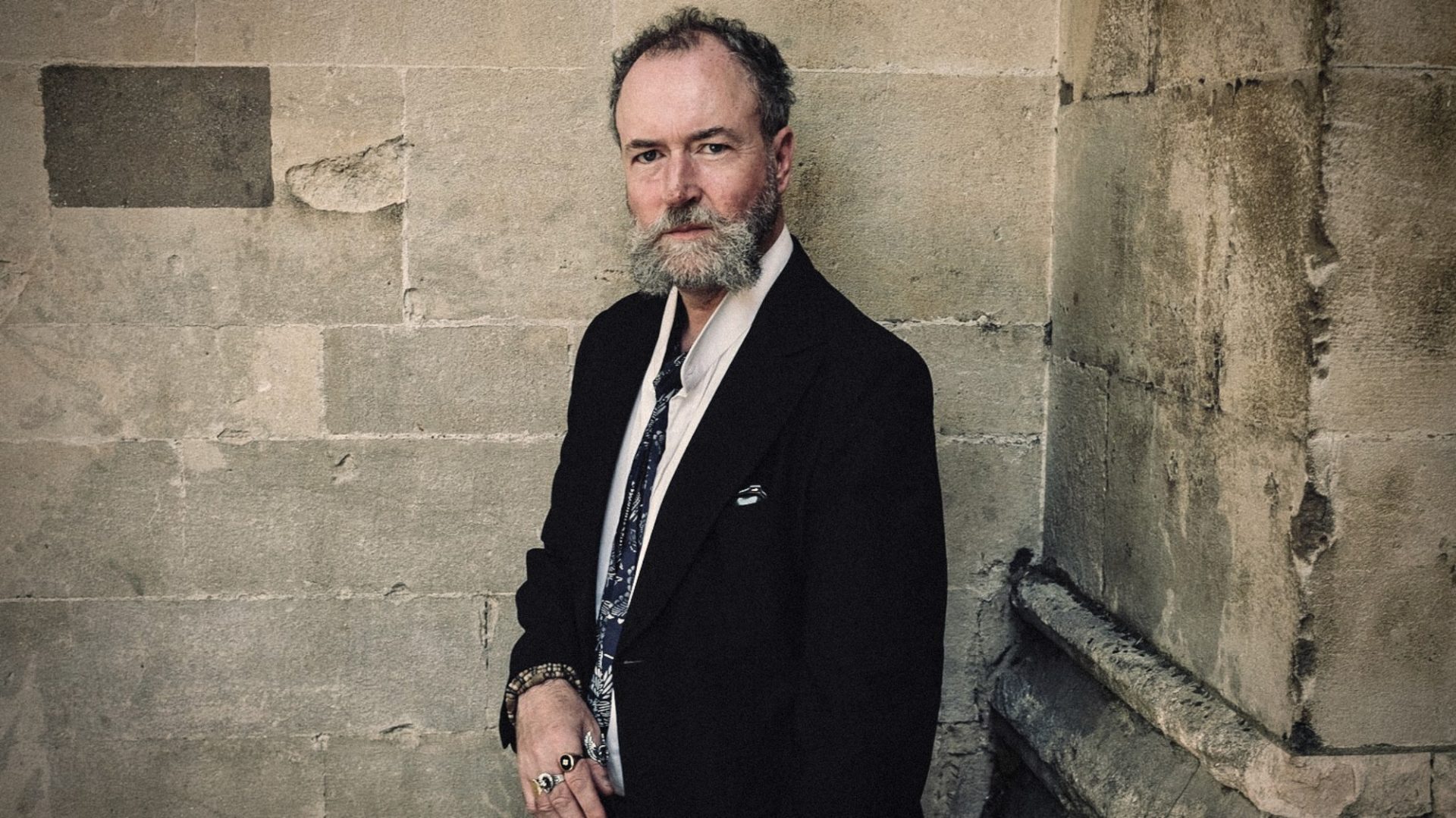
David Keenan doesn’t like to make things easy. Particularly for David Keenan.
“I don’t plan the books out in any way,” he tells me. “I start at the first sentence and I end at the last. And so there’s that element of surprise and a sort of unfolding revelation for me as well. And I never research. I always think that as a fiction writer, research is an excuse for not inventing.”
As many of his novels, including his latest, Boyhood, are densely plotted and riven with ideas concerning, among many other things, Magick, philosophy, architecture, angels, free jazz, lost civilisations, the Troubles, poetry, theology and demons, all this might come as something of a surprise to his readers. But he’s unrepentant.
“I’ve developed this quite deep faith that I can rely on the creative process,” Keenan explains. “The muse always seems to speak when I sit down and it’s been so fair and true to me that I have complete trust in the process.”
Keenan appears like a figure from the dark past, living out of time. More of a soothsayer or gnostic than a novelist. Plucking characters and ideas out of the air and assembling them on the page in a series of incantations.
His books are remarkable. After an apprentice as a music writer (a collection of his pieces, Volcanic Tongue, written mainly for The Wire, has just been released in paperback), he moved to novels, with his first, an invented history of a fake post-punk band in Airdrie, 2017’s This Is Memorial Device, shortlisted for the Gordon Burn prize.
The books that followed are audacious, unpredictable, often sexually graphic and lean towards the grotesquely violent. For the Good Times, his novel about low-level IRA operatives, has scenes that I’ll never be able to shake off. And the fate of one of the characters in Boyhood so derailed me in its cruelty, that I brought it up with the author, perhaps hoping for a rewrite and a better outcome.
“Believe me, Dale, I wanted more too,” he tells me. “I was hoping for a sort of positive resolution. And I was as shocked as anyone else.
“But then it occurs to me that that’s how violence happens. This is how endings take place. They’re not convenient. People are taken from us very suddenly and brutally and horrifyingly often, certainly in my experience. And so in a way that seemed very true to life. I’m very wary of overly interfering with what’s going to happen to characters.”
This approach, allowing your characters to dictate your work in some way, could feel a little risky. At one point during our conversation, Keenan says “we” when referring to the author of his work. I ask who this “we” was.
“These books seem slightly out of my control,” he explains. “I can’t force these characters to show up. And I think there wouldn’t be as much reality in it for me if I was able to be in control of it like that. These books really are almost spoken out of the air. And it’s genuinely a magical experience. And I like the glimpses. I like the glimpses.”
Suggested Reading
What if Thatcher had been assassinated?
Boyhood offers these glimpses over 246 bite-sized chapters, as the abduction of a child in 1970s Glasgow (the novel is a love letter to the city) kickstarts a story covering Nazi-occupied France, Troubles-torn Derry, ancient Mexico, vampires, remote-viewers, angels and burlesque dancers. It barrels along, refusing to focus on one aspect of the story for too long.
Some elements intersect, others drift away, only to suddenly reappear unexpectedly. A little like life.
“And to me, that’s how we think and experience,” he explains. “In these episodic updates. I love to jump in and out. Sudden visions here and there, jumping to one story, jumping to another story.
“I like that kind of uncanny feeling of revelation that that sort of provides, you know? I know my books reference lots of real-world things, but I’m not even sure if they take place in the real world.”
Keenan’s stories exist at the corner of the eye of reality. His six novels juggle the concrete (“Oh, there’s John O’Neill from The Undertones”) and the mirror-world (“Oh, John O’Neill is talking to someone who may or may not exist and may or may not be an angel”). Ah yes, angels. Keenan loves angels.
“One of the big questions the book asks is, are angels real? And I think, yes, I do believe that. I believe I’ve encountered angels myself.
“I had just finished Boyhood and I was sitting in the Euston Tap (a pub near the London station), and a guy came up to me and he said, ‘Just so you know, I’m an angel. I’m an Albanian gangster. I’ve done a lot of things wrong in my life, but I’m also an angel of God.’ I think if an angel is going to show up, it’s more likely to show up as an Albanian gangster than some sort of a Christmas card, you know?”
But being Keenan sounds fairly exhausting. As well as the fantasies of his fiction stepping into his own reality, the work it requires to get these things down on paper takes its toll. Alchemy is never easy. Ask any alchemist.
“Honestly, I don’t really have much say in the matter,” he admits. “This is what I’ve committed my life to. And I’ve accepted there’s been collateral damage. I have had to make sacrifices in my personal life and family life. But there’s really been no option.
“I don’t have a single doubt about my calling as a writer. It feels that this is what I came to this planet to do. And so I take it very seriously. That’s a very, very hard thing to get over. I absolutely honour that.”
But is it all worth it? Keenan says: “I would discourage most people from being writers.”
Boyhood by David Keenan is published by White Rabbit Books
Dale Shaw is a television and radio writer, journalist, fiction writer, performer and musician