The Italian sculptor Arnaldo Pomodoro, whose centenary is marked this year, constructed vast works that seemed designed to outlast civilisation itself. Yet even monuments have a habit of colliding with history, and the story of three important commissions illustrates how even the largest artwork can be as vulnerable as it is impressive.
In 1975, Iran’s then Empress Shahbanou Farah Pahlavi was involved in asking him to create a dialogue-sparking piece destined for Tehran’s Aryamehr sports and events stadium, a challenging location visited by people who were not necessarily art lovers. In his vision, 15-metre columns with contrasting surfaces were to tower over the visitors, friendly giants with a bird’s-eye view.
Design, casting and transport ate up the months, until an unwelcome letter arrived in November 1978, on the eve of the revolution that would overthrow the Iranian royal family. It came from Shahbanou’s cousin, the first director of the Tehran Museum of Contemporary Art.
“Unfortunately, because of the present political situation, we have been obliged to postpone your project for a while,” it read. “The present atmosphere is highly anti-art and western culture, and it will take some time for the situation to normalise.”
The columns were mothballed, and although a second Pomodoro work was successfully installed in the museum, the columns were raised instead in the PepsiCo Sculpture Garden in Westchester County, New York State.
Suggested Reading
How Giotto woke up art
In May 1989, four years after Mikhail Gorbachev unveiled perestroika, Pomodoro wrote to the Soviet leader in emotional terms about the advances in international relations he had made, offering a tangible sign of his admiration.
“We can say that a new era for the Soviet Union is now beginning. As a sculptor, I would like to make a contribution: I would be willing to work on the casting of a large-scale sculpture, the concept for which reflects your innovative ideas on both the international and domestic stages.”
As early as that December, the large circular piece, Disco Solare, was waiting for the Soviet delegation at Milan’s Castello Sforzesco. Its final destination was not within the sculptor’s remit, although he hoped for the Kremlin. In the event, it was placed outside the Youth Palace, where it was neglected, and is now in the Moscow Museum of Modern Art.
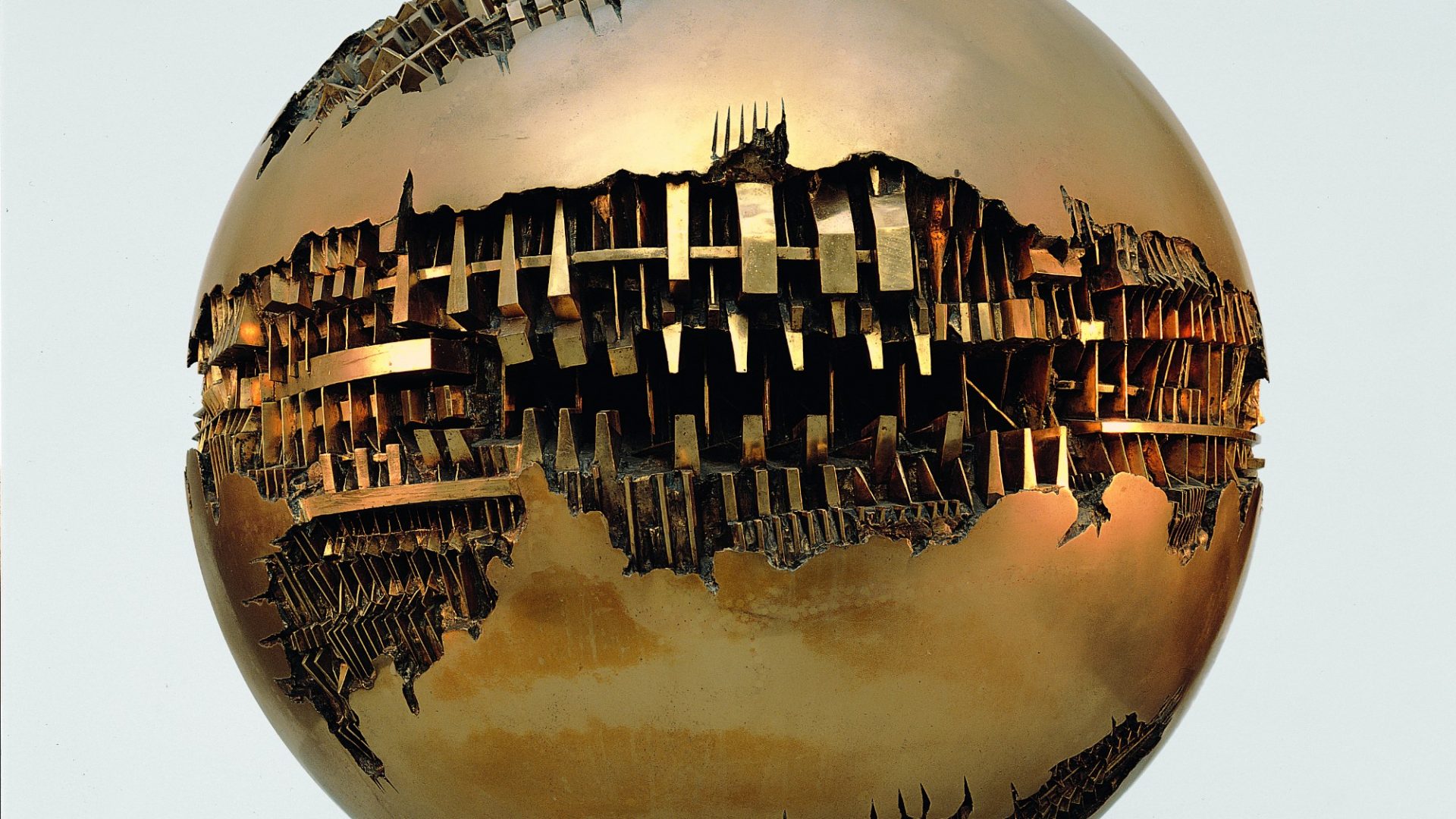
Pomodoro’s best-loved and most recognisable works are his vast, golden spheres, at once pristine and fractured, a flawless skin broken at intervals to reveal toothed or mechanical inner organs. One on the grandest scale was created for the United Nations building in New York, at the behest of the then secretary-general Boutros Boutros-Ghali.
Within the resulting commission, the 3.5-metre diameter Sfera con sfera reflected, the artist explained, “the shape of the ‘ideal city’, as it was conceived by the artists of the Italian Renaissance”. As a symbol of the UN, it “appears solid, yet is already cracked from within; a complex machine that nevertheless continues to promise order; a whole that reveals itself only by exposing its own wound”, says curator Luca Massimo Barbera in the volume that accompanies a huge retrospective of Pomodoro’s work in Milan.
Entitled simply Pomodoro, the exhibition at the Gallerie d’Italia retraces the prolific artist’s evolving style, from early abstract paintings to the great public artworks now visible all over the world. Born into a poor family in Morciano di Romagna, near Rimini, in 1926, Arnaldo Pomodoro had artistic ambitions as a young man but qualified as a surveyor, working in civil engineering in Pesaro on the east coast and in Milan.
Yet during his time off, in a goldsmith’s studio, he studied the intricate art of working cuttlefish bone into moulds for molten metal. By his late 20s, taking from his civil engineering experience an understanding of materials, techniques such as welding and drilling, and a fearlessness about working at scale, he was attracting the attention of the leading artists of the day, and influential gallerists too. From here, his career moved rapidly, with a solo room at the Venice Biennale and exhibitions in Rome and New York.
Silken and textured, radiant and penetrating, Pomodoro’s sculptures stand out a mile – on the seafront in Pesaro, outside the German postal headquarters in Darmstadt, and above all in Milan, at the Fondazione Arnaldo Pomodoro. They are powerful reminders of what Tehran and the Kremlin missed.
Pomodoro runs at Gallerie d’Italia, Piazza della Scala 6, Milan, until October 18