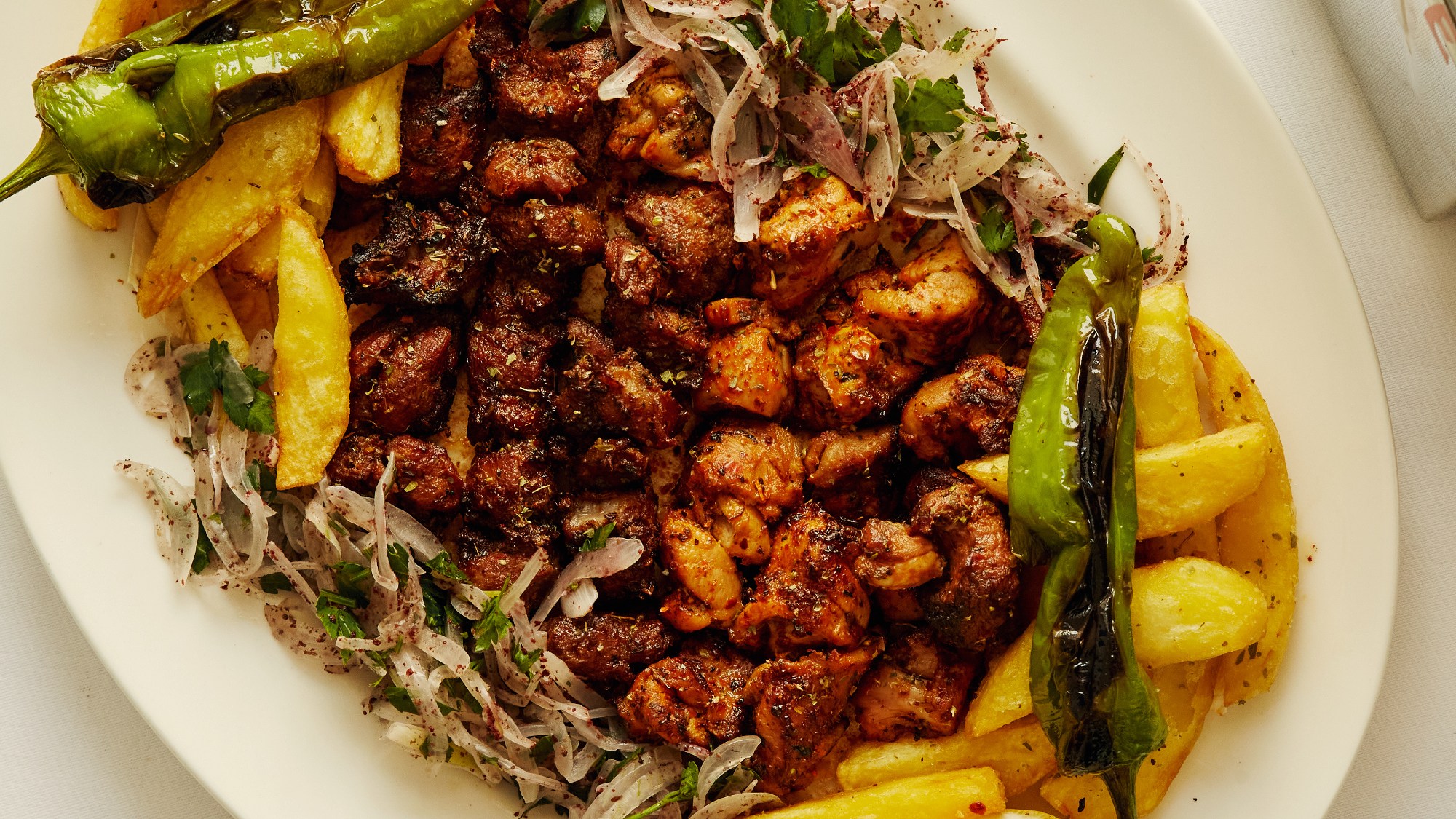
“The doner kebab is sacred,” says Keiran Mustafa, the chef behind one of Britain’s hottest new Turkish restaurants, Kismet in London. “It’s an art form. A true kebab is not this heavily processed meat we’ve become accustomed to here. We’re seeing truer, better-quality versions now, beyond post-pub doner and chips, and that’s pretty cool to see.”
Kismet is inspired by Turkish-Cypriot meyhanes, or “taverns”, and specialises in spreads of meze and meats cooked over charcoal, these best enjoyed with a beer, rakı or Turkish wine. There are no rotating, stand-up kebabs – the traditional doner.
Mustafa’s restaurant is part of a wider trend, one in which Turkish cooking, and by extension, culture, is being presented in a more modern, higher-end way. The cuisine has never been more amplified in Britain, nor recognised to such a degree.
“Growing up, kebabs were only really thought of as greasy meals you had after a night out,” says Mustafa. “That’s fine – they have their place. They were an entry point. But there’s a disparity between those and a true kebab.
“I think perceptions around our food are changing. For me, kebabs were more of a Sunday dinner, ceremonial and ritualistic, not just something you eat when you’re pissed. I love that more people in Britain are appreciating everything more.”
There have been pockets of real Turkish, Turkish-Cypriot and Kurdish food in Britain for decades. North and north-east London have long been home to restaurants such as Umut 2000, Antepliler and Durak Tantuni. Many of these places were established after the first wave of immigration from the region occurred in the 1960s – they came about as much to feed an incoming population of economic migrants filling textile jobs and similar.
Kebab vans and neon-lit shops, the sort found in provincial towns and cities, parked expectantly outside pubs and along thoroughfares lined with nightclubs, opened later. They were partly a product of political asylum seekers, and the food they brought with them was already intertwined with a growing diaspora in Germany.
With limited options, a route to enterprise, else a means of survival, is almost always through catering, and so doner meat was thrust into pita and served with salad and pickles, covered in garlic sauce and chilli; a delicious takeaway to soak up beer. I remember my orders fondly: Nuro in Guildford; Kebab Kid in Oxford; Gemüse in Berlin, a showstopper.
There are eye-catching doner kebabs in Britain now. One is found at Londoner by Best Mangal in Hammersmith, where quality veal is cooked over a wood-fired spit, served traditionally on a large white plate with lavash bread and salad, and drenched in hot, bubbling butter.
Londoner didn’t take long to capture the hearts and minds of diners in the capital, who rushed en masse to sample a “proper” doner kebab. Queues snaked round the block for days after the social media crowd shared videos of the restaurant’s “flavourful” veal and fresh lavash.
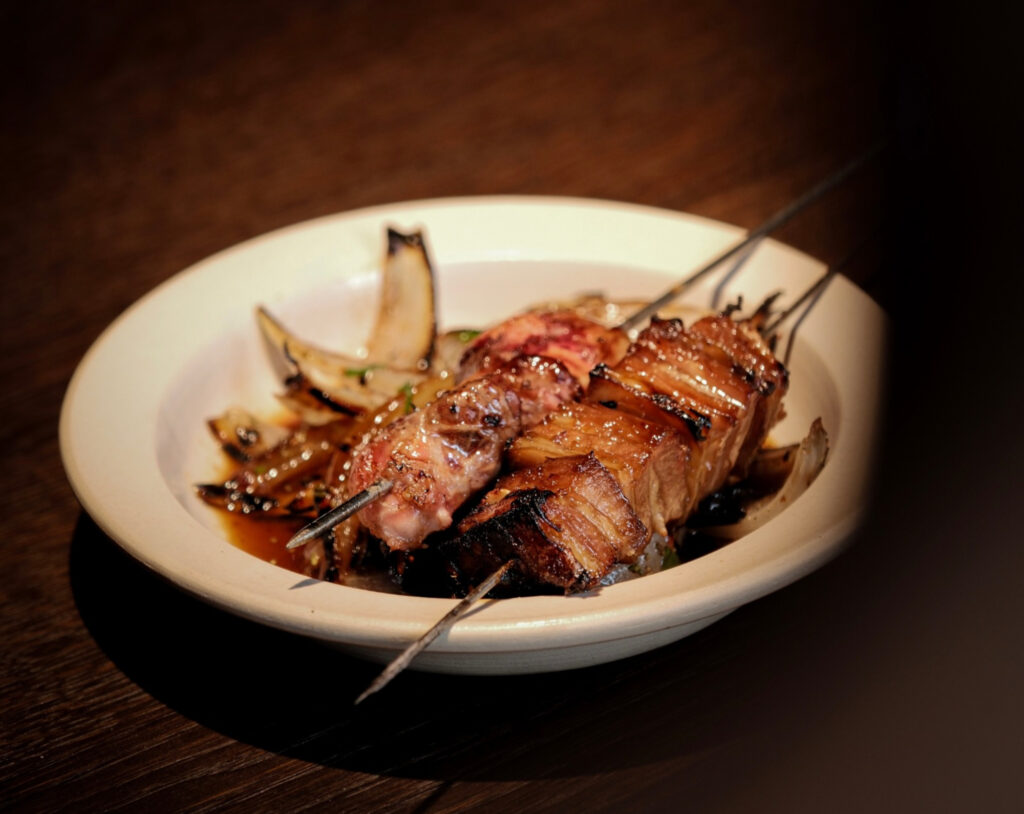
Kid has earned rave reviews in its first few months
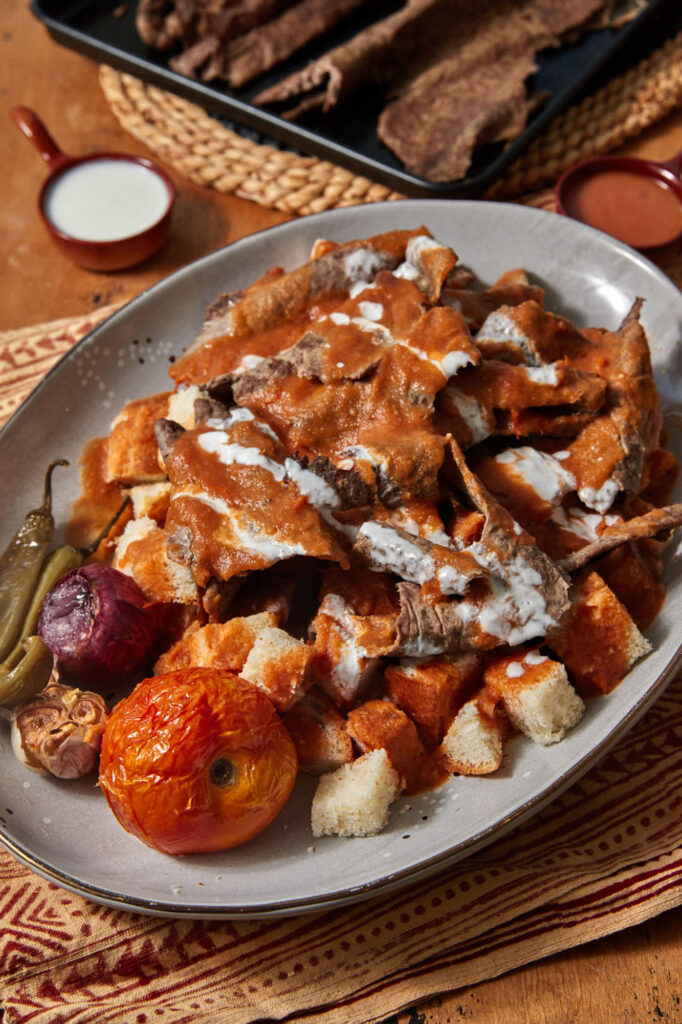
Then in September came İskender, a kebab specialist dating back to 1867, when İskender Efendi transformed the way meat is cooked for ever. He flipped the traditional horizontal rotisserie to become vertical, and paired thin slivers of carved meat with pillowy pita, tomato sauce, and cool, sheep’s milk yoghurt.
It’s a marvel to witness minced lamb being prepared on a vertical metal spit, before it’s cooked slowly beside flames, sliced into thin ribbons, then showered in hot butter. Charcoal-roasted tomatoes and peppers followed; chilli was never really a necessary component, but a popular addition.
İskender Efendi opened his first shop in Kayhan Bazaar. Today, the same family still operates a restaurant in Bursa, and another in Istanbul, in a European quarter replete with lively bars and street food stalls selling mussels filled with rice. The city’s branch of Soho House isn’t far away – the original kebabs might not be designed as hangover cures, but for many, they are anyway.
The patriarch today, İskenderoğlu, is proud that his grandfather was the first chef to layer minced lamb on a vertical metal spit. For so long, the family knowledge remained the preserve of Anatolia, despite his studying economics at a university in Birmingham.
He relented two years ago when his sons Oğuzhan and Kayhan convinced him to take the brand to Britain. This year, the family bought a four-storey townhouse in Knightsbridge, catapulting history and heritage into London. There have been queues since the opening in September.
“I always wanted to open here,” İskenderoğlu told me recently. “It was never the time, nobody was ready. Now, it is perfect.”
It would be remiss not to mention Kid, in Soho, which also opened last month to fanfare. Like Kismet, getting a Friday night table is almost impossible.
Head chef Sertaç Dirik made his name at Mangal II, his father’s old-school ocakbaşı, which opened in 1994. Dirik, with his brother Ferhat, changed the game in 2020 when they modernised the menu, adding dishes lesser-known in Britain such as mantı (filled pasta), roasted fish over beans, and imam bayıldı, where whole aubergines are stuffed with garlic, onions and tomatoes. This happened after the Turkish chef Selin Kiazim, now based in Amsterdam, launched Oklava, another pioneering restaurant as far as “modern Turkish” is defined.
“Turkish food in Britain is a huge topic at the moment,” Dirik tells The New World. “There was a time when Kiazim was the only one showing our country’s food in a new way, and so many people followed. It was early days – we felt switching from a traditional ocakbaşı was a huge risk back then.
“The community asked, ‘Why do this? What’s the point? You’re surrounded by traditional restaurants in Dalston, this is what we do here’. It confused a lot of people, but we did it, and it worked.”
Dirik is continuing to celebrate Turkish food at Kid, which has earned rave reviews in its first few months. “We approached the idea respectfully. We have happy diners, happy Turkish guests. It’s a celebration. It’s old Turkish through a 2026 lens. We’re influenced by London as much as Turkish cuisine, although I call my dad most days to ask questions. The little details are so important – you can’t fool a Turk.”
Dirik says he’s pleased to see Turkish food be given a greater space in the spotlight, to be “allowed to move beyond a point of ‘discovery’”. Each wave of immigration has meant that understanding of and adoration for the cuisine has progressed. “You can trace its path,” says the chef. “The world is small. I often find that people want to learn, to say, ‘oh, there’s more to this than what we’ve seen’.” In other words, there’s more to Turkish food than doner kebabs, however wonderful they are.
Dirik adds: “I’m not a food snob. Kebab vans paved the way in a mad way. My dad had a crack at one in Wood Green. You know, a classic doner, emulsified lamb press drenched in garlic yoghurt and chilli sauce. Good ones are spicy, sour, sweet, tender. But then Britain is so multicultural, why wouldn’t we want to amalgamate, to push things forward and see what’s behind the curtain.”
The kebab plate at Kid features no doner. Instead, find chicken wings, lamb sashlik and adana. Meat is cooked over fire. Roasted tomatoes arrive soft, to be crushed, their juices flowing into kebabs’ bread bedding, already soft with fat.
Suggested Reading

Is this the best sandwich in Europe?
Kid is a serious Soho restaurant – upscale, full of fashionable people with big budgets, cocktails and wine. It’s New York-esque. And yet it doesn’t feel too serious. The buzz is a welcoming one, much the same as Londoner, İskender, Kismet, or pretty much any Turkish restaurant in Britain. The nation does hospitality incredibly well.
“Well, it’s still just food,” says Dirik. “It’s supposed to be fun. You don’t need to come in and think about anything, be nuanced. If you want to just come in for a bottle of wine and a kebab, you can. Then you can go out in Soho and get fucked up. It’s fine. All power to you.”
But there is education for those who want it. And I wonder if, now Turkish food has – for want of a better description – “hit the mainstream”, a rip-off chain will follow?
Dirik says: “Let them do it. A Turkish Wagamama? Turks have been on the outskirts of London culture for too long. You’ve got huge Thai chains, but we’ve still got Singburi. Gateways are good. They help. Maybe someone goes to Giggling Squid, then goes to Thailand, then comes back and goes to Kiln.
“We’re having a good time. It’s exciting. There are Turks here, and they want to feed everyone.”