As the Strait of Hormuz remains shut, and pretty much every driver on the planet feels the effect in their bank account, electric cars have suddenly begun to look even more attractive. And that’s great. We love clean air.
But it seems we’ve moved very quickly from the simple, environmentally friendly vehicle consisting of a couple of batteries, an electric motor and some wheels, to something bordering on the dystopian. New electric vehicles are now fully computerised and connected surveillance machines that create and collect data at a disturbing rate.
We are told that it’s all for our own good – that it’s all about safety. Whether it is the £20,000 Citroën Ë-C3, that you will see in many urban areas, or the £200,000 Maserati GranTurismo Folgore, that you will see perhaps less often, EVs are almost all equipped with the latest sensors. They are also equipped with the latest DMS technology – that stands for “driver monitoring system”.
Sensors are nothing new. In the 90s, your car would already beep at you to let you know that you were backing into a wall, that a door had been left open, or that someone didn’t have their seatbelt on. It wouldn’t tell you exactly which one of these three options it was, which somehow kept it fun. It just beeped until someone, usually the driver, started yelling, and then it would magically stop.
What has changed recently is the sheer number of these sensors. You would be forgiven for mistaking some of the new electric vehicles’ specs for the description of an average submarine. Take the Chinese tech giant Xiaomi’s latest flagship EV, the SU7, for example. It has one LiDAR sensor (Light Detection and Ranging), 11 high-definition cameras, 3 millimetre-wave radars, and 12 ultrasonic radars. I’m pretty sure all we really need are bigger parking spaces.
But the most significant shift isn’t how many sensors are pointed outward for parking assist or collision avoidance. It’s the ones pointed inward.
As of 7 July 2026, driver monitoring systems (DMSs) are mandatory in all new cars sold in the EU and the UK. DMS is a safety feature using sensors and algorithms to keep tabs on a driver, to make sure they’re paying attention.
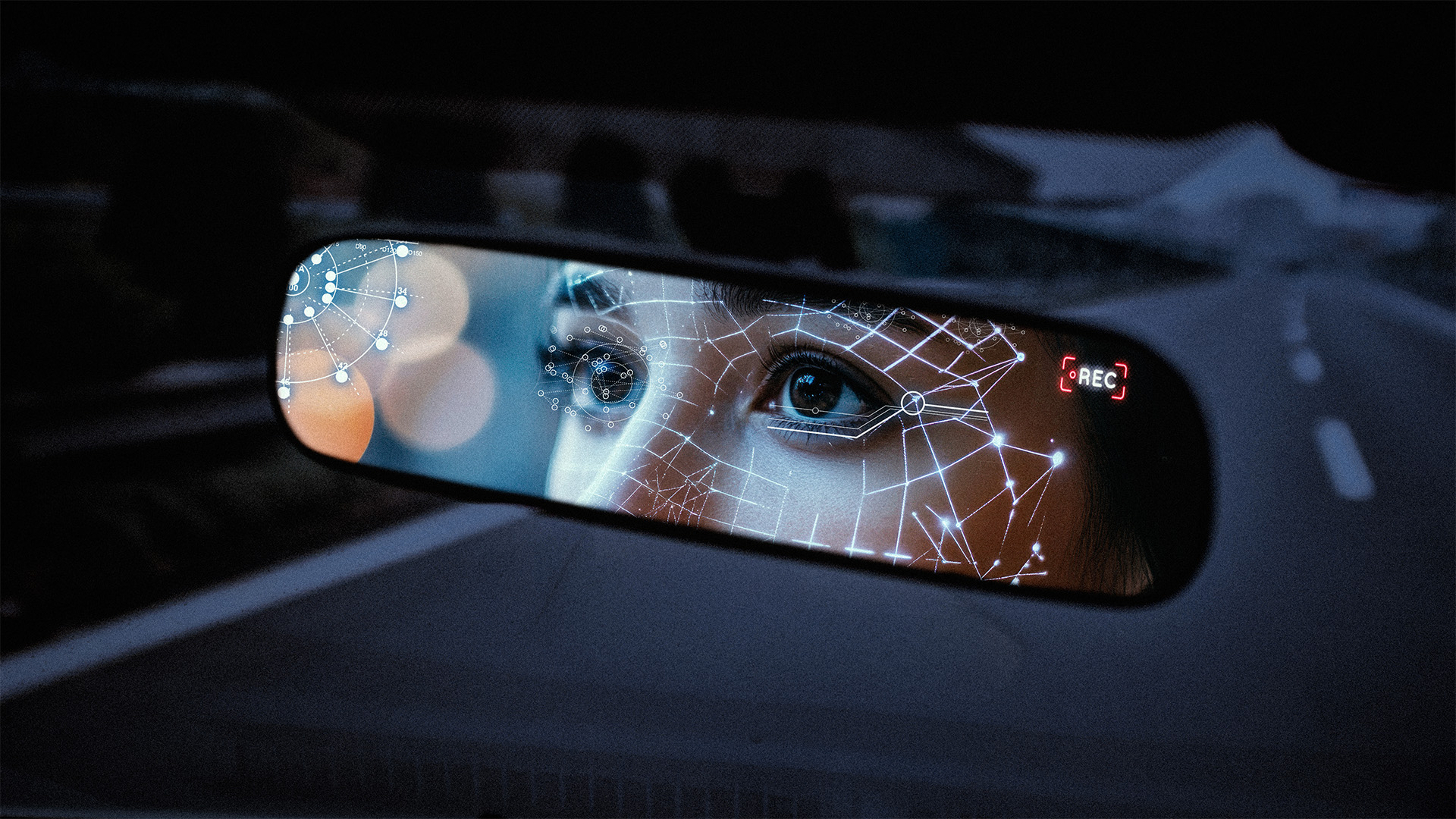
Some of these systems can be quite minimal, for example in the Citroën Ë-C3 mentioned above, which just monitors the vehicle’s trajectory in order to detect fatigue. But many EVs now use cameras to film the driver and assess, among other things, their eye movements for signs of fatigue or distraction.
In the Polestar 3 for example, a vehicle released this year, you will find two infrared cameras that track the driver’s eyes, and an additional four motion-sensing radars that are scanning the car’s interior. Fine, except that the manufacturer has partnered with a fellow Swedish company, an AI-focused outfit called Smart Eye, to regularly update its monitoring system. Its vision for the near future? Facial expression analysis, which would allow the car to know how everybody inside it feels at any given time.
Smart Eye has a subsidiary named Affectiva, which develops emotion-recognition AI systems. It does this using machine learning and data acquisition to “understand” and “predict” human behaviour. These all feel very far away from being simple safety features.
Suggested Reading

Your next car will be Chinese
Which brings us to the Tesla Model Y and Model 3 (2026) which both already monitor the whole car interior and all of its occupants. Tesla says that footage captured inside the vehicle cannot leave the car unless data sharing is enabled. Which means, there is a way to get those video clips out.
But it’s not only about being watched by your car, it’s also about being listened to. In a bid to make voice commands better and EVs “smarter”, in the past year several car manufacturers have unveiled their brilliant idea of integrating AI platforms into their infotainment systems. God forbid one could go more than five minutes without talking to a chatbot.
You will recognise a lot of the usual players here. Volvo and Polestar, among others, partnered with Google to include Android Automotive and its Gemini AI directly in their latest models. Audi, in its Q6 e-tron, uses a combination of Cerence AI for the car functions and ChatGPT to answer general questions. And, of course, Tesla has Grok, the AI tool used by both SpaceX, and teenagers who want to undress celebrities on X.
How this new data is processed is very much dependent on the service provider. And you will have to check the privacy settings of the system your car uses (and each of its subsequent updates) to know what will happen to your “car-versations”.
When it comes to Google’s in-car option, Android Automotive is quite clear that it saves all of your data to “give you more personalised experiences across all Google apps and services”. Meaning that where you go, and what you say in your car to your fellow passengers, or to the car itself, will affect what you see on your computer later.
As some EVs morph into smartphones, it raises the question of what happens to all the data that our new cars create. EU regulations specify that DMS data shall immediately be deleted after processing. The rules also prohibit car manufacturers from selling DMS data to third parties.
Suggested Reading


Will we all end up as Chinese AI death clones?
But what about everything else? Because what does your EV really know now? Only who is driving, how many people are in the car, where they are going, at what time, how often, at what speed, where they are recharging, what they use the car’s AI assistant for and how often they use it.
You will find a version of “Your privacy is very important to us” on all car manufacturers’ websites. It’s not like collected driver data could be sold without consent…
Except that on the 8th of May 2026, General Motors has agreed to pay a settlement of $12.75m in a California lawsuit after it was revealed that the company had in effect collected geolocation and driver behaviour data through its OnStar vehicle programme (a subscription service for safety and connectivity of its fleet) which ended up being bought by insurance companies.
Some drivers subsequently paid more for their insurance if they had been flagged for driving late at night or using the brakes too hard. Manufacturers who are suspected to have also sold their customers’ data include Toyota, Lexus, Mazda, and Stellantis, Chrysler, Dodge, Fiat, Jeep, Maserati and Ram.
So while manufacturers double down on creating hyper-connected vehicles that could be vulnerable to all types of security and data breaches, let’s put some barriers up straight away.
Suggested Reading


Artificial intelligence and the end of capitalism
How about no automatic opt-in for data collection and sharing of any sort, and no software update that buries the lede in terms of data. Because really, who actually reads the terms and conditions of an update, as long as Les Misérables, written in size 8 font that suddenly appears on your dashboard just before a Monday morning commute?
Also, bring back buttons, and stop the over-automation of everything. If it rains, I can switch on the windscreen wipers myself, thank you very much.
EVs are objectively one of the best new technologies that we have that can help us to mitigate the rise of carbon emissions, and curb our dependency on fossil fuels. But we should be able to move away from our gas guzzlers without having to sacrifice our privacy.