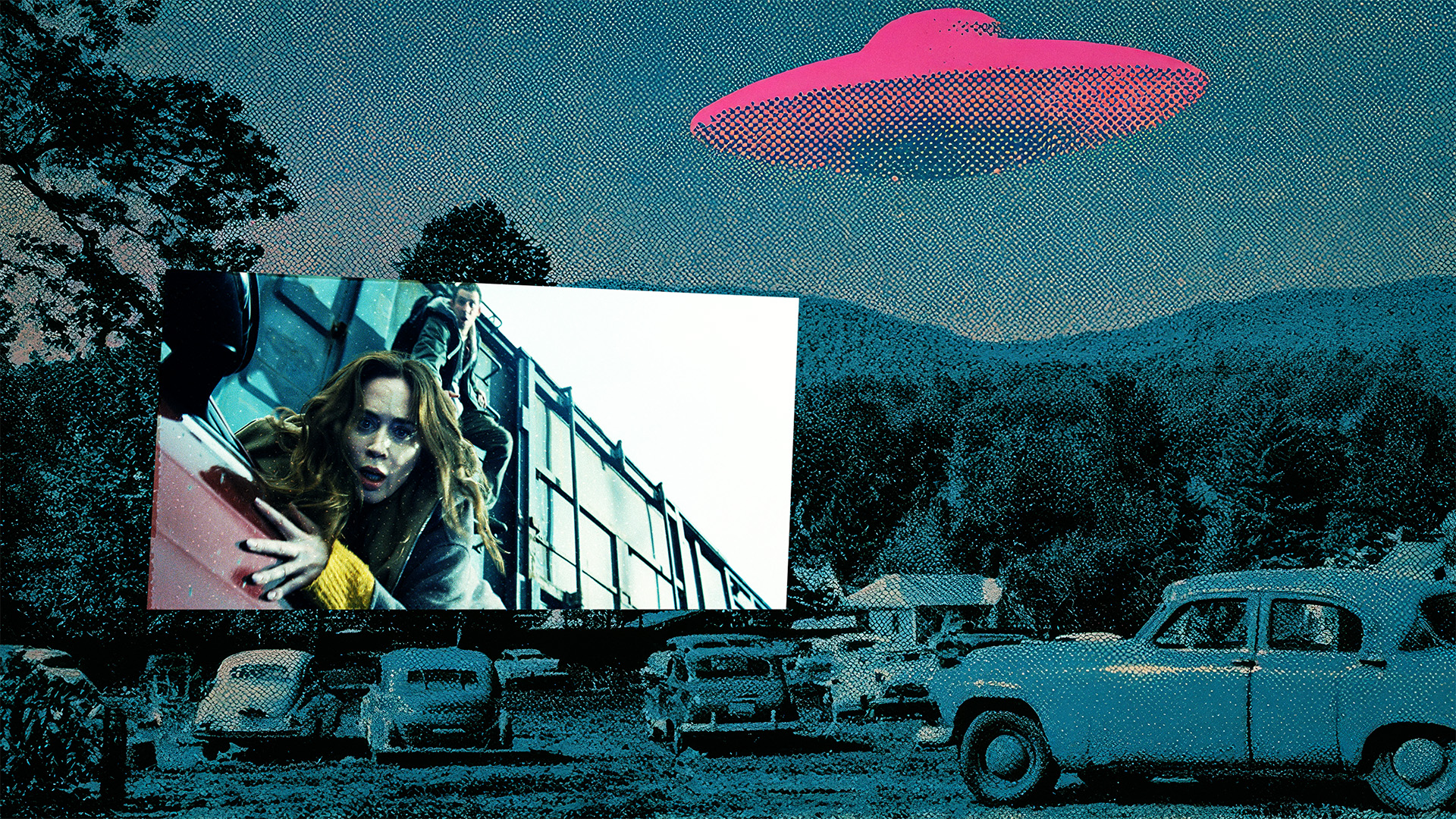
Steven Spielberg could not have timed it better.
When it was announced in April 2024 that the director of Close Encounters (1977), ET (1982) and War of the Worlds (2005) would return to the subject of UFOs and aliens with his next film, Donald Trump was still mired in court proceedings, his re-election looking about as likely as a visitation from little green men.
More than two years on, the chaotic return of the Trump show means the movie is being released at a time of congressional hearings into “flying saucers”, vice-president JD Vance babbling that extraterrestrials might be biblical demons in disguise, the Pentagon releasing unconvincing videos of supposed UFO sightings and the president himself posting on social media an AI-generated photo of him meeting a silver alien with an elongated head at a military base.
Trump may be deep underwater in the polls, but just as with his UFC event on the White House lawn, he understands the advantage to be gained by connecting with certain of America’s outlier tribes. In this case, he is addressing the so-called ‘disclosure movement’ that demands governments come clean about contact with other lifeforms, the topic of Spielberg’s Disclosure Day.
Suggested Reading

There’s nothing clever about comparing Trump to Idiocracy
Trump, who is deeply invested in American paranoia about all kinds of aliens, was a year old at the time of the country’s first great UFO flap, inspired by both US pilot Kenneth Arnold’s encounter with “flying discs” and then the so-called Roswell crash, both in 1947. High above Washington state’s Mount Rainier on June 24, 1947, Arnold reported seeing nine unknown objects, which he described as “crescent-shaped”, their movement “like a saucer [skipping] across water”. A wave of sightings followed through July, with the press soon dubbing them “flying saucers”.
The manoeuvrability and speed of these objects – Arnold estimated they were larger than one of 49-seat DC-4 passenger planes of the time, and that they were capable of flying over 1200 miles per hour – led many to decide that they could not be from this Earth.
Yet in the Chicago Times, Arnold hoped the craft actually were of American origin. “If our government knows anything about these devices, the people should be told at once,” he said. “A lot of people… are very much disturbed. Some think these things may be from another planet.”
The ‘planet’ some feared the craft may have come from was Russia. The cold war was underway, and Americans lived in fear of Soviet scientific advantage, especially in the nuclear weapon race. Could the unidentified flying craft be Russian vehicles, superior to anything America had at the time?
CIA memos of the era suggest American intelligence used the UFO flaps as psychological warfare. This had two purposes – it confused Russia and disguised America’s own advanced experimental aircraft.
Just as the first wave of saucer hysteria faded, a rancher discovered debris in a field near Roswell, New Mexico. Bizarrely, the US Army Air Force announced they were in possession of a crashed “flying disc”. A hasty press conference then explained away the debris as coming from a “crashed weather balloon” instead.
In the absence of further detail, science fiction stepped in to fill the blanks. Saucer mania hastened the heyday of movies like The Day the Earth Stood Still (1951), It Came From Outer Space (1953), and Earth vs. the Flying Saucers (1956). Sightings continued, but with no immediate answers, interest in flying saucers and alien invaders declined.
But the space race and Star Trek kept the fire burning, then in 1968, Erich Von Däniken’s book and subsequent documentary Chariots of the Gods? – a huge influence on Spielberg’s Close Encounters – relaunched the fad for all things extraterrestrial and conspiratorial.
Swiss-born Von Däniken’s big idea was “ancient astronauts”, the concept that the wonders achieved by ancient men were beyond their technology and thus had obviously been the gift of space beings from across time. It presented ancient artefacts and monuments as evidence for alien intervention
Suggested Reading

UFOs over the White House
Several publishers had initially rejected Chariots of the Gods?, dismissing the hypothesis as nonsense. To enhance its appeal, Von Däniken enlisted Wilhelm Utermann to rewrite it in a more popular idiom. Unfortunately Utermann came with baggage – he’d once been editor of the Nazi Party newspaper, Völkischer Beobachter.
Chariots of the Gods? unexpectedly became a runaway best-seller, and the 1973 US cut of the documentary was nominated for an Oscar. Despite its hokey nature and serious criticism from archeologists, historians, and astronomers, it took $25 million at the US box office.
Just as the nation conquered the Moon, there was something irresistible to Americans about the supposedly hidden knowledge exposed by Von Däniken, later exposed as a serial fraudster and forger with two prison sentences to his name. How could supposedly ‘primitive’ societies build such wonders as the pyramids, the Easter Island stone heads, Stonehenge, and many more ancient artefacts, without outside help? Chariots also ‘revealed’ that ancient art was littered with images that to the modern eye looked technologically advanced, like space vehicles, computers, and telephones.
It opened the floodgates, unleashing a saucerload of ancient astronaut lore, together with the idea that shadowy groups – perhaps from inside the government, perhaps alien themselves – might be covering things up. In particular, a trio of documentaries captured the alien zeitgeist: In Search of Ancient Astronauts (1973, a TV repackaging of Chariots), In Search of Ancient Mysteries (1974), and The Outer Space Connection (1975) – all narrated by The Twilight Zone’s Rod Serling, lending them gravitas. “The evidence is clear,” he declared.
That ‘evidence’ led to a spin-off television series titled In Search Of… (1977-82), fronted by Star Trek’s Mr Spock, Leonard Nimoy – and who wouldn’t believe Spock? Across six seasons, it tackled every weird subject under the sun, but repeatedly returned to flying saucers and supposed long-buried secrets.
Meanwhile aliens dominated 1970s pop culture, from comedy (Mork & Mindy, Kinvig) to kid’s shows (Dr Who, The Tomorrow People) to mainstream drama (Quatermass, Project UFO) to a movie blockbuster, Star Wars, that combined them all. Even the charts weren’t safe, with The Carpenters’ very silly Calling Occupants of Interplanetary Craft (1977) and Jeff Wayne’s high-concept rock opera version of HG Wells’s The War of the Worlds (1978).
David Bowie played an alienated alien in 1976’s The Man Who Fell to Earth but the ultimate expression of American alien paranoia was Spielberg’s Close Encounters, released in late 1977. Spielberg explored UFO conspiracies, governmental agency cover-ups and the impact that ‘first contact’ could have on humanity, culminating in the spectacular arrival of an alien mothership at Devil’s Tower in Wyoming.
The film was drenched in the idea that those in charge were not to be trusted – the recent scandals of Watergate and the Pentagon Papers had made that clear. A paranoid era led to a paranoid culture, expressed in films like The Parallax View (1974), The Conversation (1974), and Three Days of the Condor (1975). Conspiracies were everywhere, and the enemy wasn’t ‘out there’, he was in here, with us.
Suggested Reading

Making Pluto Great Again
Nearly 50 years on, those paranoid feelings are reverberating around the US once again. Where there was war in Vietnam, there is now conflict in Iran. There was the energy shock of the 1973 oil crisis, now there’s the blockade of the strait of Hormuz. One disgraced Republican president resigned – following Watergate, Nixon quit to avoid impeachment. The double-impeached Trump has proved more difficult to shift but now has a popularity rating equal to Nixon’s in his last days in office.
In the 1970s, the uncertainty and fear created by these events corresponded with a rash of interest in flying saucer sightings. The same seems to be happening now, and the active ‘disclosure movement’ has been boosted by the release of information about unexplained ‘Tic-Tac-Toe’ sightings by US Navy pilots in 2004, with official footage released in the first months of Trump’s first term. Those led to the May 2022 Congressional hearings on UFOs, the first for 50 years, followed by the recent documentary The Age of Disclosure – the new Chariots of the Gods?
Conspiracy theories have been mainstream since the assassination of President Kennedy in 1963, but it is only in the age of social media that they have spread so far and wide that they dominate our politics. It helps that Trump’s White House is awash with conspiracy, with FBI boss Kash Patel, health secretary Robert F Kennedy Jr and Devin Nunes of the President’s Intelligence Advisory Board all subscribing to deeply weird beliefs. The president himself, of course, propagates untruths about elites conspiring against him to steal elections.
Now here comes Spielberg’s Disclosure Day, a film the director says is required because “it’s just become overwhelming to me that we’re not alone in the universe.” Perhaps more overwhelming still, though – and the real reason America is obsessed with UFOs and aliens all over again – is our belief that some hidden secret might explain the chaos around us. And that some otherworldly force may soon intervene to save us all.
Disclosure Day is released on June 12
 Most popular


Emily Maitlis’s diary: As I was saying to George Clooney just the other day…


History says Polanski is going to win the St Pancras by-election


The uncomfortable truth about Ariana Grande

BORN IN THE FIRES OF 9/11