
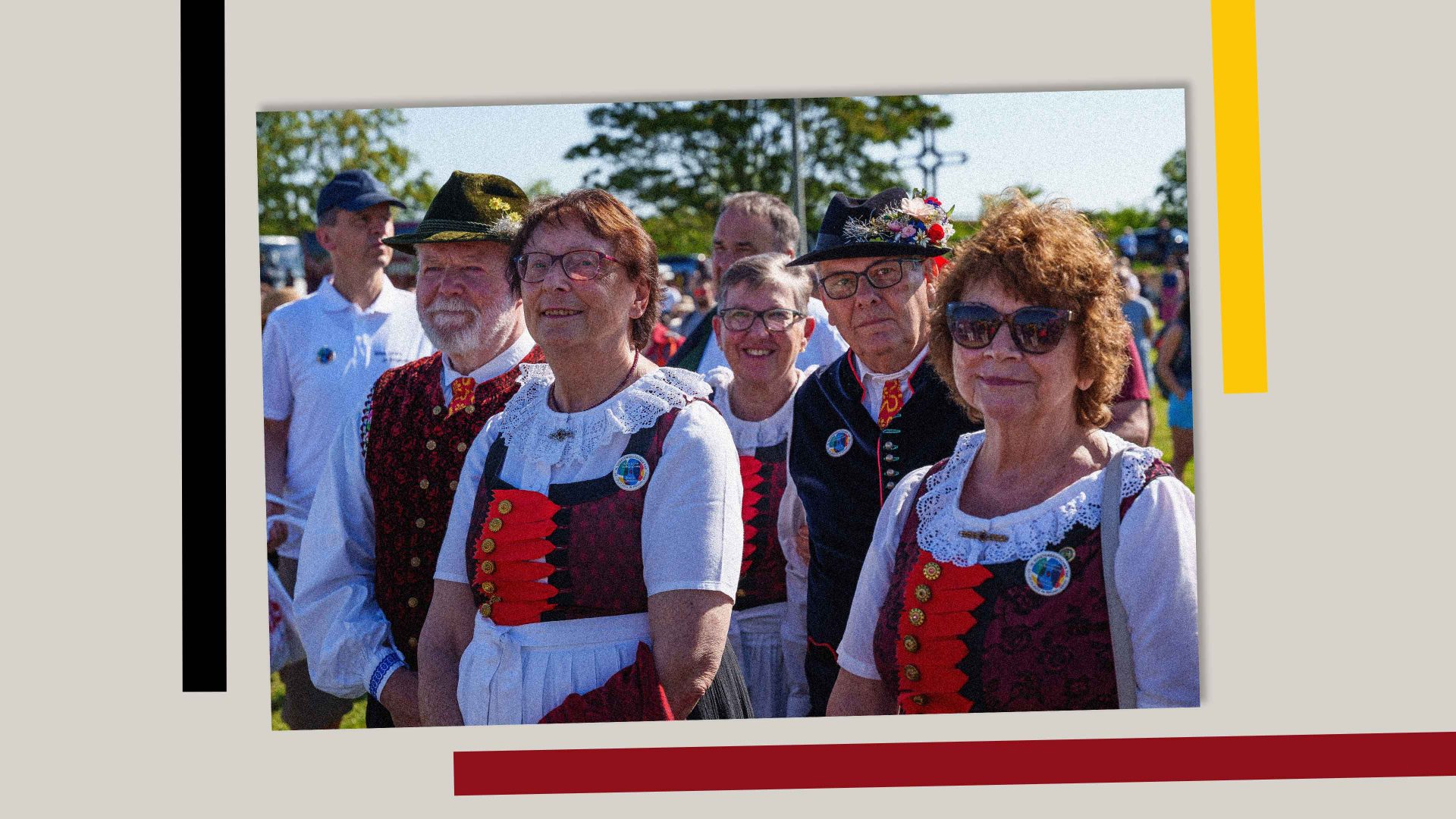
The Germans are coming – news that rarely causes exaltation anywhere in Europe. In the Czech Republic, however, the debate was particularly heated.
Because the Germans in question weren’t just any Germans, but Sudetendeutsche, who gathered in Brno for the 76th Sudeten German Congress last month.
In West Germany, for the first decades after the second world war, the Sudetendeutscher Tag was a fixture of political life. Especially in Bavaria, where many of the roughly three million ethnic Germans settled after their expulsion from neighbouring Czechoslovakia.
Over time, however, influence waned, not because people objected to folk costumes, traditional songs and embroidered banners. The uneasiness grew because their association, the Sudetendeutsche Landsmannschaft, kept the objectives of “regaining our homeland” and also the “restitution or equivalent compensation” for confiscated property.
There was no history of forcible expulsion in many West German households, and sympathy fatigue set in. Bottom line: would you have preferred life under the Commies? Get on with it. This rationalisation never did justice to individual suffering. Historical grievance has a way of outlasting the political conditions that produced it.
Speaking of suffering: the German occupation of Czechoslovakia was brutal. Reinhard Heydrich ruled as deputy “Reich Protector” over the occupied part, Bohemia and Moravia. After his assassination by Czech resistance fighters in Prague, Nazi reprisals culminated in massacres among the civilian population.
Suggested Reading

The washed up revolutionaries’ favourite side-hustle? Armed robbery
The backlash followed in the chaotic months at the end of the war. Thousands of Germans died during forced marches, internment or violence. One of the most notorious episodes was the so-called Brünn Death March in May 1945, when tens of thousands of Germans – mostly women, children and the elderly – were driven from the city towards the border. Many never arrived. Under communism, this story was largely absent from public discussion.
The Czech name for Brünn is Brno, and it was the “Meeting Brno” dialogue festival that had invited the Sudeten Germans to meet in the old Heimat.
Federal minister of the interior Alexander Dobrindt (CSU), who attended, called it a “historic event”. Bernd Posselt, spokesperson for the Sudeten German ethnic group, said: “We are not here to demand anything; we are here to give something.”
But by then, the gathering had already turned into a wedge issue. Czech nationalists denounced the event. Ministers in the government led by the right wing populist Andrej Babiš did not attend. Billionaire Babiš himself described it as an unfortunate affair. Parliament passed a resolution expressing opposition to the country hosting the annual event. Around 2,500 protesters marched through Brno carrying banners bearing the message: “You’re not welcome”.
But Brno’s mayor, Markéta Vaňková, personally welcomed the guests as “dear neighbours” and expressed her regret over the expulsion following the war. “Injustice cannot be rectified by further injustice,” the 48-year-old politician said.
None of this would have been possible without a decisive shift inside the Sudeten German Association itself. In 2015, delegates abandoned their version of a “right to return”, as well as demands for their homeland and restitution.
Suggested Reading

Angela Merkel – Germany’s back seat driver
On the weekend of the gathering, one of the most moving moments was a reconciliation march from Pohořelice back to Brno, retracing part of the 1945 expulsion route. What began years ago as a local initiative has evolved into something remarkable: a shared act of remembrance involving both Czechs and Germans. There weren’t just elderly descendants of expellees, but hundreds of younger Czechs. Many seemed motivated precisely by the nationalist outrage. Apparently nothing attracts a Czech liberal quite like being told not to attend something by a populist politician – around 1,500 Czechs had registered for the German meeting.
Another quietly powerful moment came when representatives of the Sudeten Germans and Czech civil society jointly laid wreaths at the Kaunitz student residence, a former Gestapo prison where hundreds of Czechs were executed. After 1945, it became an internment site for Germans. That act contained an idea much of the world still struggles with: remembering one suffering does not require forgetting another.