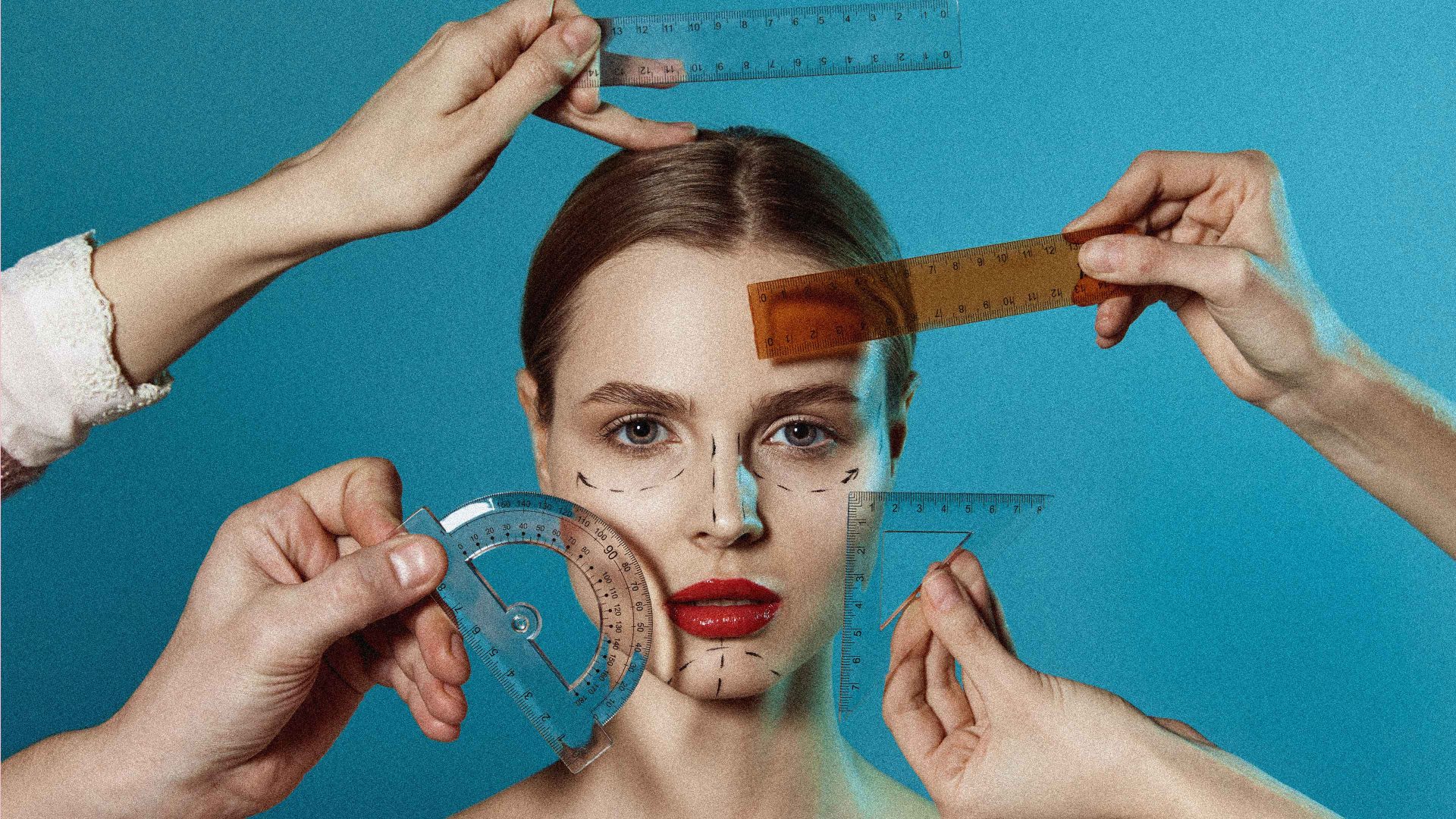
I’m in an industry where plastic surgery and cosmetic enhancements are completely normalised, openly discussed and are often an investment, done to guarantee more earnings or to stand out in a competitive market. At some brothels I’ve worked at, there have even been flyers for clinics in the girls’ room, with discounts offered if you mentioned where you’d seen it.
I’ve worked with many women who are saving for surgeries; some women put almost all of their income into such expenditure. I am usually the odd one out, never having had any work besides having two moles (of many) removed and laser hair removal. A friend says it’s time to get Botox, but I am reluctant, not because I am against it, but because I am curious to see how I age without any work. It almost feels like an experiment or performance art in the sex industry and, funnily enough, it sets me apart in the market.
I also have a different perspective as a lesbian; I like how age shows on an older woman’s face. I find it attractive, and so I believe there must be people who find it so on me. I have, too, elements of a second-wave feminist’s distrust of the beauty industry. I am concerned by the fact it is an industry that deliberately targets women and encourages and preys on their insecurities.
Women have less of an expendable income than men and are more likely to live in poverty in older age. The beauty industry encourages them to spend their money on something ephemeral, money that will very likely be needed later on. On top of that, I don’t like the fact that some plastic surgery is used to homogenise people’s faces, so that it becomes instantly recognisable as a particular style, such as LA influencer face, or Mar-a-Lago face.
Those are my reasons for abstaining, though I understand women who do not, especially if they rely on their looks for stability or survival: sex workers, trans women and many wives who fall into the grey area of marriage and sex work, such as gold diggers and trophy wives.
Suggested Reading


What does the global economic downturn mean for sex work?
Trans women of course have to consider the way they are perceived even when they are not sex workers or adjacent to sex work, as “passing” (as a cis woman) may be the difference between safety and danger. These expectations of gender normality are displaced also on to cis women, especially those who aren’t white, as we’ve seen in the case of Algerian boxer Imane Khelif, harassed globally because to some people she doesn’t visually fit into the category of “woman”, which shifts according to race and class and location.
In Disclosure, the 2020 documentary, American writer Jen Richards talks about how celebrities such as Kim Kardashian have been inadvertently inspired by trans women, and specifically trans women sex workers. The gay men who style them have been influenced by the “street queens that they know from the clubs”.
Blac Chyna, the American stripper who converted her renown into an empire and whose aesthetic has influenced many rappers today, also acknowledged this. In a 2016 interview with i-D, she said that the community of trans women in Washington DC had given her the idea to augment her butt 10 years earlier. “You had to be cool with the trans queens; they wouldn’t give just any girl their plug.”
Suggested Reading

How do we kill off the cool girl?
Both sex workers and trans women have to perform a hyper-femininity that makes sense of this flow between them; Canadian artist Nina Arsenault points out that cis women sex workers often have constructed or “artificial” bodies in the same way some trans women do.
I find it fascinating how so many people who get cosmetic work done today have no idea that the trends they are following began with women from the fringes, women they would look down on. Clavicular, the infamous looksmaxxer, takes many of his ideas from the playbook of trans women. In one of his streams, three trans women approach him and point out that they are the original looksmaxxers and he is following their programme.
Clavicular could be labelled as transitioning from “male-to-male”, as much of what he does is gender affirmation, a striving towards hypermasculinity, in the hope of becoming visually the ultimate man, even if that means he isn’t fully functional – he has said multiple times he would rather have a full head of hair and not be able to get an erection than the other way around.
Outwardly heterosexual, he is intensely homosocial, existing to compete with and impress other men, and has other shared traits with the gay guy world, such as his penchant for the club drug GHB. An excellent Playboy article poses him as a radical submissive, submitting to the algorithm, in direct contrast to the image he wishes to assert.
There is so much interchange between queer culture and sex worker culture, because many women in sex work are trans or queer or both. Cosmetic work is an aspect and reality of both cultures, and I will always be in support of it, even while I may personally and consciously resist it. I also think it’s important for people to see women age without it, both in the public eye and in the sex industry.
Tilly Lawless is a Sydney-based sex worker. She is the author of two novels: Nothing But My Body (2021) and Thora (2024)