
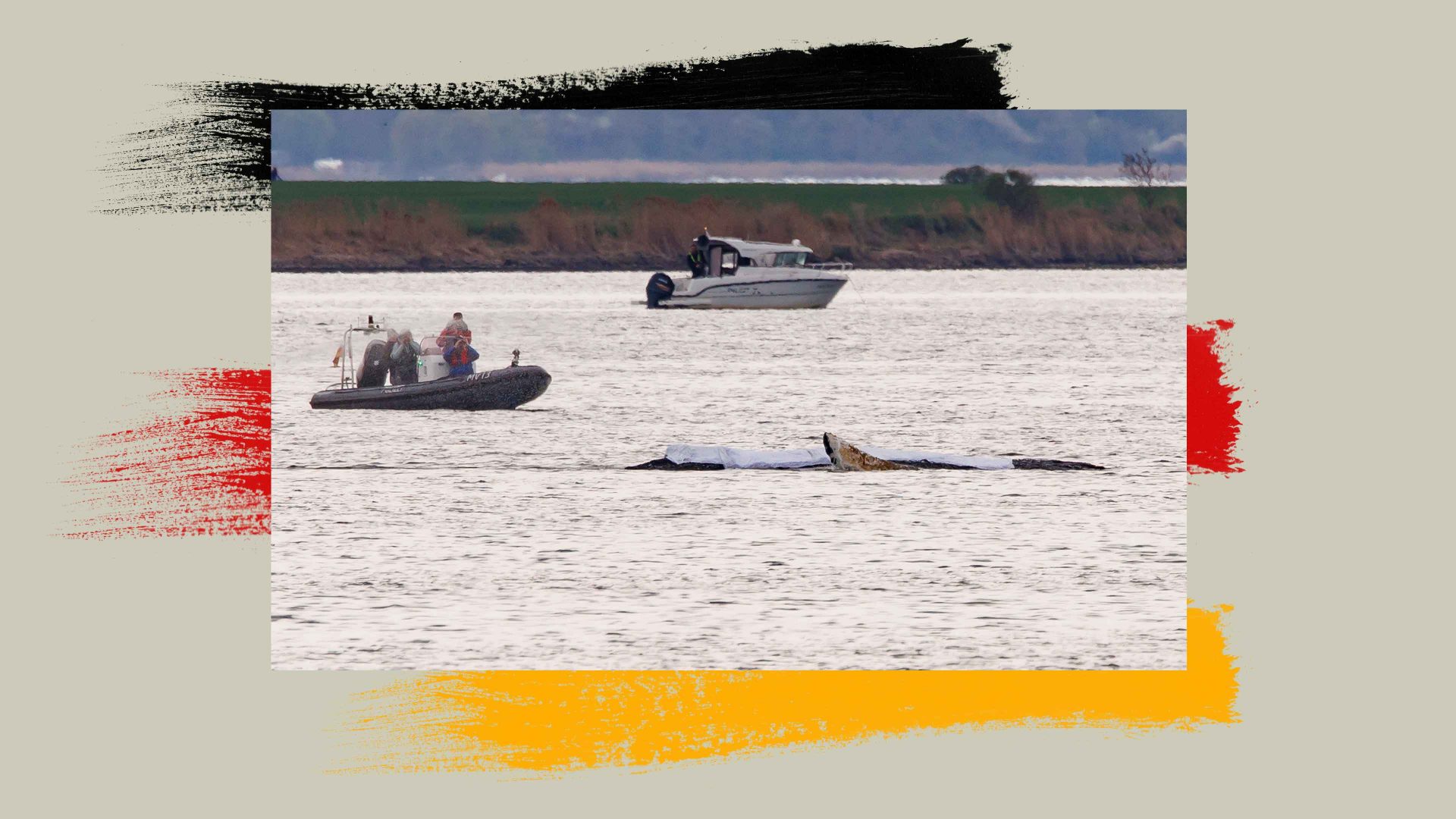
There is a humpback whale beached in the Baltic Sea – the Ostsee, as Germans call it – which marine biologists will tell you is precisely the wrong sea for a humpback whale. Too shallow, not salty enough, and too empty of the krill-adjacent snacks the majestic mammals require.
Because the internet exists, we have followed him around the clock for three days. We’ve also called him Timmy, because the first time he became stranded was on a sandbank off Timmendorfer Strand in Lübeck Bay.
A dredger dug a channel through the seabed silt and the animal swam away – but, for reasons unknown, in several directions. Just not the right one.
He stranded twice more after that. Hopes rose with the tides, and once more the whale swam on briefly during the night. But since March 31, he has been lodged in Kirchsee Bay, next to the island of Poel.
As we have all become oceanologists by now, why Timmy came to the Baltic Sea in the first place has been a matter for public debate. What everyone agrees on, however, is that he is suffering. He tangled himself in fishing nets, acquired skin lesions, and apparently has water in his lungs. A friend who spent a weekend at the coast told me she couldn’t sleep because of Timmy’s harrowing cries.
When he became stranded for the third time, the question arose whether he had done it on purpose. Sick whales apparently sometimes beach themselves deliberately, to stay close to the surface and breathe. Whether intentional or not, scientists were blunt: Timmy was dying, they said, and there was no meaningful way to help him. The kindest thing was to let him go in peace.
Peace is the one thing Timmy isn’t getting. People waded into restricted areas, leapt from excursion boats to reach the whale, and filed court injunctions demanding rescue attempts. There were activists, real experts, false experts – and a big whale show. Every flick of his fins generated new headlines. And, of course, someone received death threats.
Suggested Reading


The German state where the far right could soon rule
Enter Walter Gunz. The founder of the MediaMarktSaturn, Germany’s temple of consumer electronics, was asked by friends whether he couldn’t do something. He decided – that’s German entrepreneurship for you – to fund an ambitious plan: lift the critically ill whale on to a platform suspended between two pontoons and tow it 500-plus kilometres to the Atlantic.
Cost? “People always think too much about money,” Gunz said. “Money is a form of energy, and you have to handle it with care.”
Asked about the chances of success, he simply replied: “He cannot die more than once.” Gunz has a point. Left stranded, Timmy would certainly not survive. If the rescue attempt also kills him, the death toll remains at one whale. There is a certain pragmatic nobility to the position.
What’s harder to defend is some suggestions – lurking in the frenzied public response – that experts recommending a peaceful death are callous, or uninformed, or secretly motivated by a pro-whale-death agenda.
While I am writing this, Timmy is once again swimming, not however on pontoons and cushions prepared for him. Boats are attempting to steer him towards the open sea. In vain, so far, either because the whale is too weak, too disorientated or… if only we knew.
According to Greenpeace, all of this is “a massive source of stress” for him.
But there is something rather wonderful about the fact that, in a world seemingly getting colder, convulsed by wars and economic disarray, thousands of people are worrying about a humpback whale off Poel Island.
Empathy is not a finite resource. The fact that Timmy’s predicament moves people is not evidence of misplaced priorities. But next to his fate – which may still be undecided by the time you read this – the tragedy is that the passion being poured into Timmy’s wellbeing is so rarely directed at the conditions that may have caused his troubles: overfishing, ocean noise, drifting gear, habitat destruction. The nets that injured Timmy did not appear from nowhere.
His cousins, the harbour porpoises – actual Baltic Sea residents – are critically endangered. Between 2016 and 2022 alone, their number in the western Baltic Sea shrank from 42,000 to 14,000.
More marine protection zones, less industrial trawling, and acoustic devices on nets (or peals woven into them) to warn the whales’ sonic system: these would help not just one whale, but all of them.