I never really liked Easter when living in the UK. While I could have easily eaten myself into a diabetic coma before the big day (no thanks to the chocolate eggs stacked on supermarket shelves the day after Valentine’s Day), there was never the same excitement around the event as Christmas.
That all changed when I moved to Italy. Oddly enough, although the Vatican sits in the centre of the country’s capital, Italy itself isn’t constitutionally religious. Nor do you see many of the younger generation attending church. I was even naive enough to think of Good Friday as a national holiday. But no.
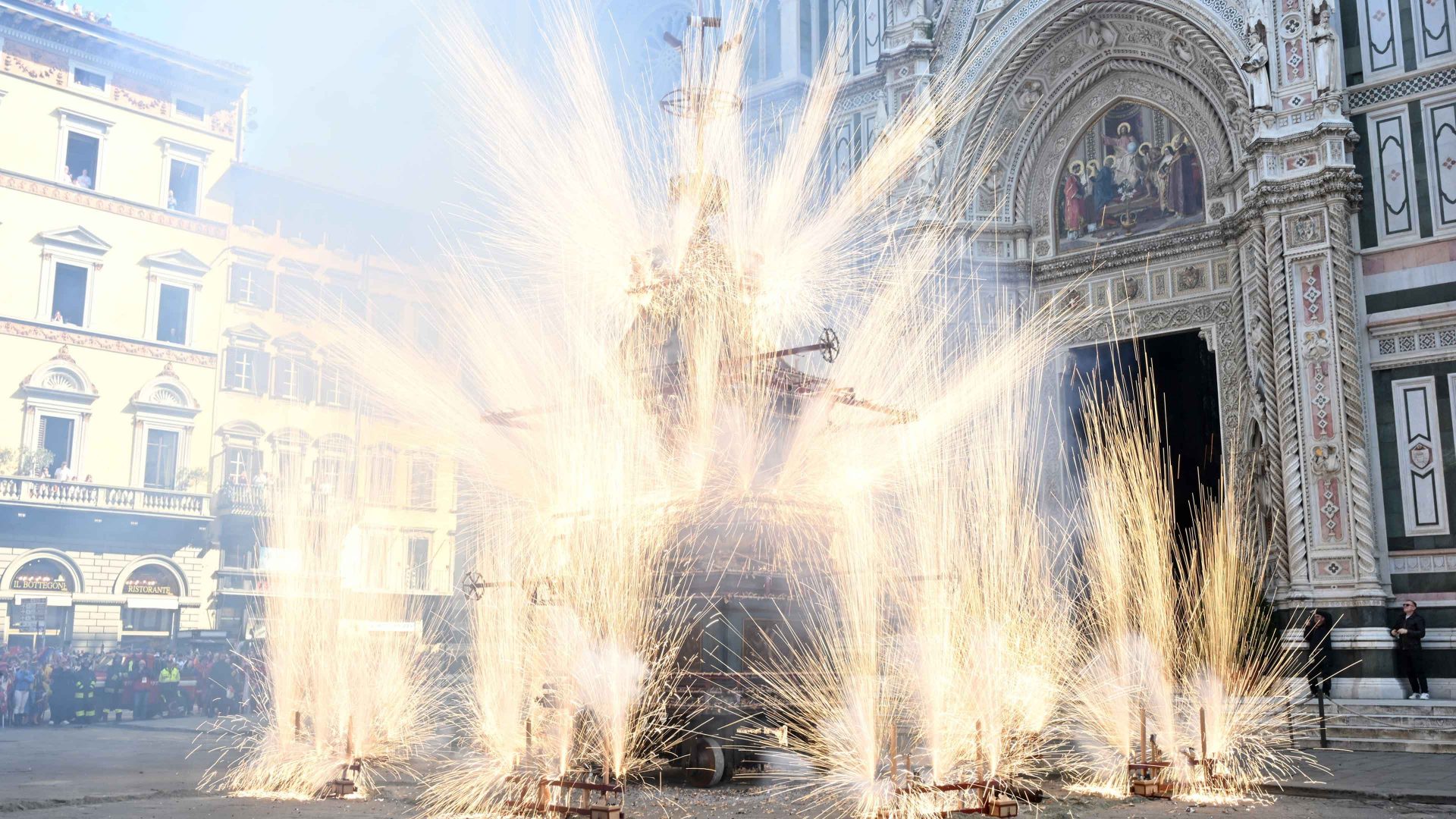
Italy may lack a four-day Easter weekend, but it more than makes up for it. And it’s in Tuscany where you’ll find the real showstopper – the Scoppio del Carro (or the Explosion of the Cart) in Florence. The tradition dates back to the 11th century, when a Florentine noble returned from the First Crusade with flints from Jerusalem to light an Easter fire, a ritual that evolved into today’s firework-laden spectacle.
I remember watching it on the news when I first moved here. The 17th-century cart, or Brindellone, was escorted through the streets of Florence by 150 armed guards and flag bearers from Piazza del Prato all the way to Piazza del Duomo, just outside the doors of the cathedral, Santa Maria del Fiore.
Not resembling a cart at all, but rather a decorated, three-storey, turreted wooden tower, at first glance the cart seemed a mere vestibule for the thousands of fireworks ignited by what on screen appeared to be some kind of flying dove.
“If you’re not from these parts, it’s hard to explain how much this celebration unites us,” said Fulvio Soldi, one of the four masterminds behind the pyrotechnic display. “Saying that, it’s a pleasure and a satisfaction to do it because it’s something everyone knows and many tourists around Italy come specifically to see because of its uniqueness.”
Fulvio’s family started their business, Pirotecnica Soldi, back in 1869 when his ancestor Francesco set up shop in a small town near Florence. While the family business is over 150 years old, for the last three decades, Francesco’s descendants have held the prestigious position of exploders-in-chief.
“We study fireworks that have high luminosity to contrast with the sunlight so they can be seen by the spectators. From there, a very important part is the sound effects, where you create various types of explosions of different tones so that it’s as varied as possible.
Suggested Reading

The art treasures Italy won’t let you see
“Preparation begins the November before Easter when we start thinking about some of the fireworks, but in reality, we make most of them a week or two before the show.”
They put on a highly explosive show. The cart itself is weighed down with 1,499 firecrackers, six pinwheels, 106 star volcanoes, 480 tracers, and 144 Roman candles.
But it’s the star of the show, the little dove (or columbina) that gets the audience engaged, Soldi says. The dove, he explains, is a gunpowder-filled rocket, disguised in papier-mâché and ignited by the archbishop using three ancient flints during the hymn Gloria in excelsis Deo. It shoots along a steel cable from the high altar into the cart, igniting the fireworks before returning to the altar using a double-ended exhaust.
If it returns, Florentines believe the year will be auspicious. And if it doesn’t? Well in 1966 it didn’t and the Arno River flooded, killing 35 people. This dove means business.
I decided to head to Florence to see the display for myself. Stepping out of Santa Maria Novella train station I waltzed down to Piazza del Duomo, to be met by thousands of other spectators eager to see if the dove would bring good luck.
“We need good luck more than ever this year,” one woman said.
As the clock struck 11am, the crowd’s murmuring came to a standstill. A crack echoed across the square. Out flew the colombina setting off the fireworks. First came the sparks surrounding the cart. Then came the rockets whooshing out. Bright white, they streamed out high above the Duomo.
The crowd gasped. The dove had flown back to the altar, and applause broke out – the year would be fortunate, according to Florentine lore.
When the whole show was over, I traipsed over to a bar to get a panino. As I was eating, I couldn’t help but think we Brits really need to up our Easter game.
Jessica Lionnel is a freelance journalist based in Rome, specialising in politics, environmental matters and culture