Last Saturday, laden with shopping and navigating a car-sharing vehicle back to my flat, I found that the only available parking spot was only half available. The other half had been colonised by a cargo bike.
For context: you cannot get more urban-green-matcha-latte cliche than a Lastenfahrrad.
The thing was fully loaded. So there I sat, suppressing my inner Wutbürger – a phrase that describes a petit-bourgeois citizen in a rage spiral – and scanning the cafe opposite for the culprit.
A woman caught my eye and called over magnanimously: “I can move it somewhere else if you like.”
I thought: “Yes, for instance 15 metres down the road, where the Green-SPD-run borough has recently installed purpose-built cargo-bike parking bays while relieving local motorists of yet more of what little space they had.”
What I actually said was a passive-aggressive: “Well, yes, you do see the lack of parking spaces here, don’t you?”
We parted in peace. But my confirmation bias – despite the fact that I don’t own a car in Berlin and cycle frequently – celebrated yet another piece of evidence that public policy has been relentlessly squeezing the car out of urban life for decades.
Suggested Reading


When the Sudeten Germans went to Brno
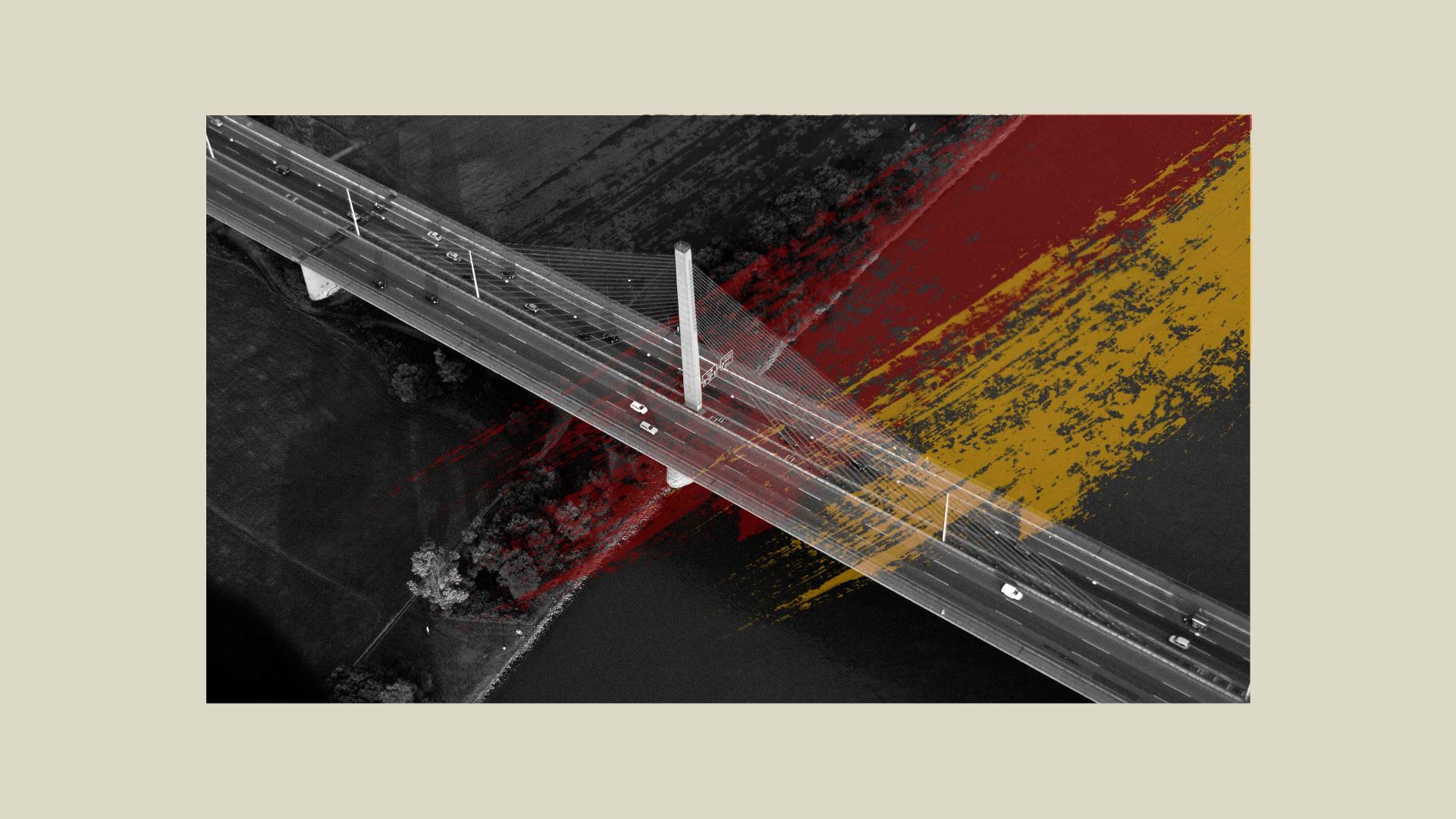
The same feeling has been simmering for some time in my hometown of Bonn, where currently many residents are struggling to suppress their own inner Wutbürger, because last week – with no warning – a bridge was closed indefinitely. Not just any bridge, either, but an Autobahnbrücke across the Rhine, carrying around 100,000 vehicles a day.
Motorways are the responsibility of the federal government. And here we arrive at the heart of Germany’s infrastructure problem: for three decades, far too little has been invested to keep the country running – on roads, railways and energy networks alike.
The results were predictably biblical. Cars mounted pavements and drove the wrong way down one-way streets simply to escape the chaos. Buses arrived up to 250 minutes late. Tradesmen and plumbers did not arrive at all.
It is far more than a local inconvenience. The bridge is a key east-west artery feeding the wider motorway network. More importantly, the saga serves as a neat little parable about modern Germany.
The Friedrich-Ebert-Brücke, named after the first Reichspräsident of the Weimar Republic, opened in 1967, after a brisk three-year build. For four decades, it quietly did its job. In 2007, however, inspectors concluded that a major overhaul was required.
And then something very German happened: nothing.
The renovation was postponed. Several times. Faith in structural integrity appeared unshakable until 2018, when the diagnosis was upgraded to demolition and replacement. Construction was scheduled for 2028. Then 2034. Along the way, a dispute between Greens and Conservatives over whether the new bridge should be wider consumed time nobody had to spare.
This February, matters became really serious: the bridge was closed to vehicles over 7.5 tonnes after the approach section on the left bank was found to lack what engineers delicately termed “adequate load reserves”.
Heavy lorries continued rumbling across regardless. Police enforcement? There wasn’t any.
Suggested Reading
Angela Merkel – Germany’s back seat driver
Those checks are now, of course, unnecessary. As a police spokesman dryly informed the local paper: “Traffic that has come to a standstill no longer needs to be managed.”
It has come to a standstill because cracks, corrosion and assorted structural deficiencies have deteriorated to the point where the emergency brake had to be pulled.
For two weeks, engineers will assess whether a limited number of cars and cyclists might be allowed across while a replacement is built. Outcome: unclear. On the bright side: there’s money.
Germany’s decision to loosen its constitutional debt brake was partly motivated by exactly this problem: decades of neglect have left roads, railways and energy infrastructure facing an investment gap estimated at €465bn (just over £400bn). Hence the creation of a €500bn special fund.
Even better, North Rhine-Westphalia faces state elections in 2027, which tends to sharpen political urgency in miraculous ways. The head of the state chancellery, Nathanael Liminski, offered me a sobering outlook: public trust in democratic government was at stake, he warned, “because the Nordbrücke will not be the last bridge that has to be closed”.