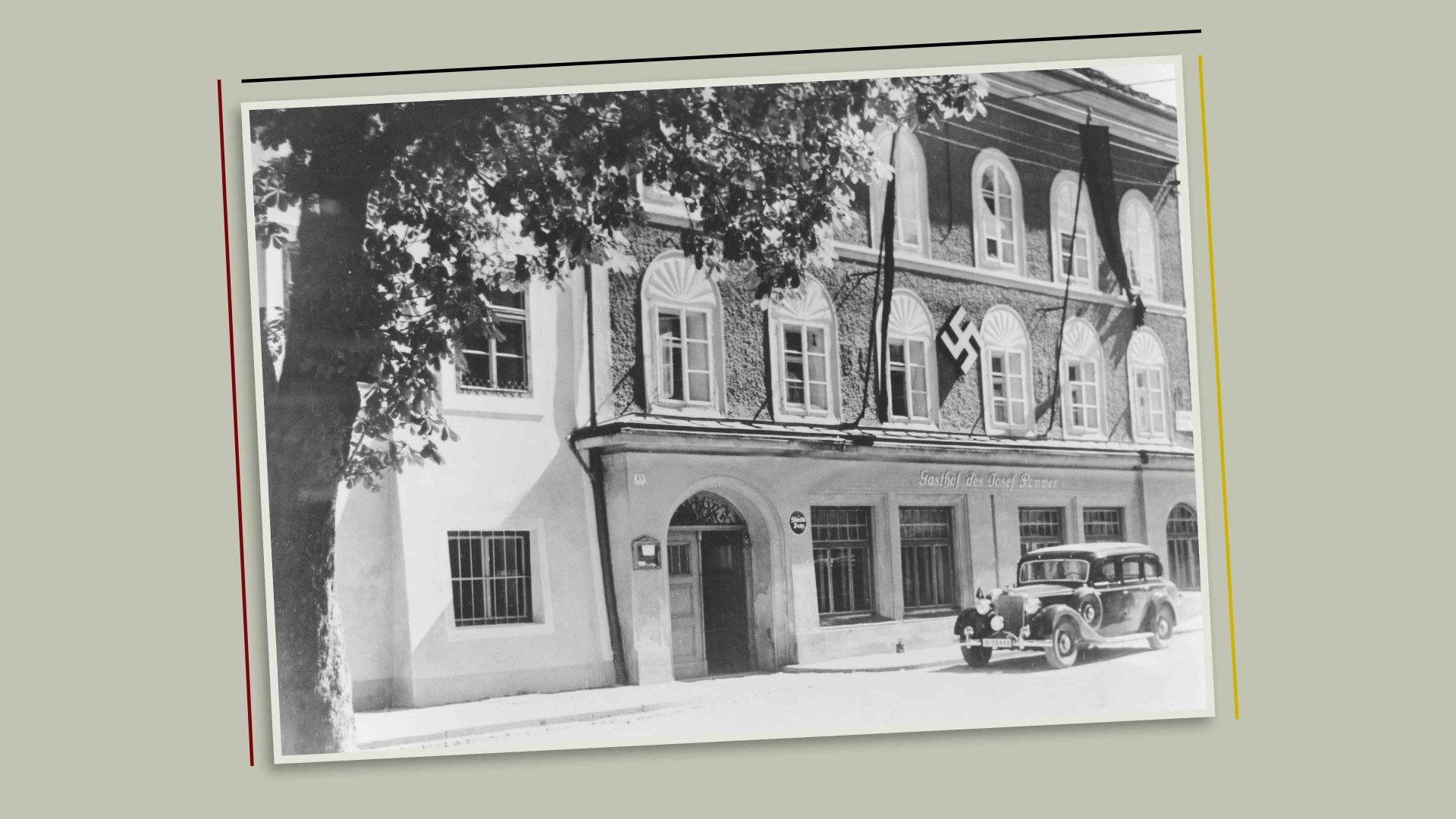
Adolf Hitler lived in the house he was born in for only a few weeks before his family moved. Austria has spent considerably longer than that deciding what to do with it. The one priority everyone could agree on: to deny neo-Nazis their five-star Tripadvisor place of attraction.
The Führer’s Geburtshaus stands in Braunau am Inn – literally, Brown Meadow on the Inn, on the German border. Unhelpfully, braun has been political shorthand for Nazism ever since Hitler’s Brownshirts, and is to this day. If your hometown already sounds like a far right branding exercise, you don’t need a Hitler landmark on top.
Ironically, Braunau has confronted its past more honestly than Austria, with the long-kept Lebenslüge – the lie one lives by – that it had been Hitler’s “first victim”, rather than acknowledging how enthusiastically many Austrians had welcomed the Nazi regime.
Nazi pilgrimage never was a theoretical risk. Just 130 miles away, in Bavaria, you could watch what it looked like: in the Protestant cemetery of Wunsiedel, Rudolf Hess was buried in his parents’ family grave after his suicide in Berlin’s Spandau war criminals’ prison in August 1987.
From that moment, on the anniversary of his death, the grave became Europe’s annual neo-Nazi reunion site. They would lay wreaths and perform the Hitler salute for his deputy, to honour the man whose gravestone proclaimed: Ich hab’s gewagt – “I dared.”
Only after Germany tightened assembly laws in 2005 could the marches be banned. Today, they no longer exist. At the request of the parish and with Hess’s family’s consent, the grave was removed in 2011. His remains were exhumed, cremated and scattered at sea.
Suggested Reading


Why Merz had to ditch surrogacy hypocrite Jens Spahn
No shrine, no more pilgrims – so no wonder many thought Braunau should simply bulldoze Hitler’s birthplace, which already served as a magnet for the wrong lot.
After all, other Hitler-related real estate is largely gone, save for a few underground remnants. The Neue Reichskanzlei was demolished by the Soviet and East Berlin authorities in 1949 and 1956. The Berghof, his Obersalzberg mountain retreat, was damaged by British bombs in 1945 and set alight by the SS. To prevent the ruins from becoming a Nazi tourist centre, the Bavarian government, pushed by the allies, had it blown up in 1952.
Braunau proved trickier: the house was privately owned.
From 1972, Austria rented it, using it, among other things, as a workshop for people with disabilities until 2011. But when renovations became necessary, the owner refused. A legal dispute later, she was compensated and the property – empty for years – was expropriated in 2017.
An expert commission rejected both demolition and turning it into a museum, favouring a redesign stripped of recognisable features. During construction, fearing collectors of Nazi memorabilia, the building site was kept under surveillance.
Suggested Reading

France, Germany, Britain: which one’s in the deepest shit?
The rubble was shredded on site and mixed with other material. It is stored at an undisclosed location – so somewhere in Austria, apparently, there is a classified pile of bricks. Raiders of the Lost Rubble, anyone?
Anyway: last week, finally, after a €20m renovation, the new tenants moved in: the police. Around 50 officers will be stationed here, prison cells and interrogation rooms all included.
Some critics complain that Hitler himself had wished for an “administrative use” of the building (thinking more of NSDAP offices, though).
But an added benefit, the local police commander observed, is that anyone lingering suspiciously outside the building will now be immediately stopped and questioned. Which should kill the mood of any neo-Nazi day-trip.