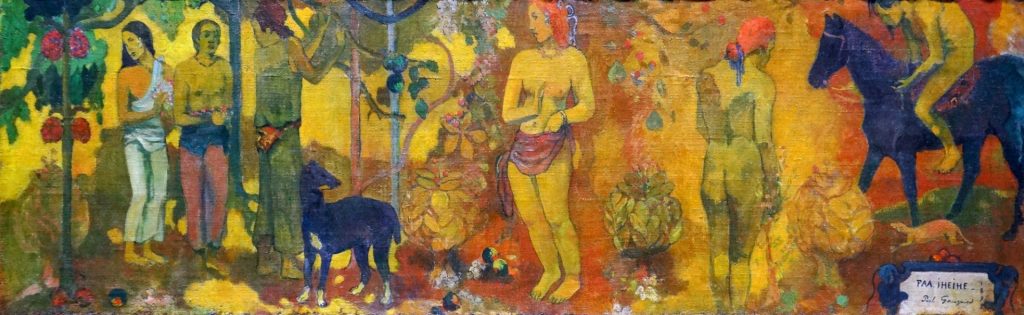
I had a gap between appointments so I dropped into the National Gallery for half an hour. There was a Vincent I’d completely forgotten, a green dream from Cézanne and a rather nice Gauguin. This one came with a health warning.
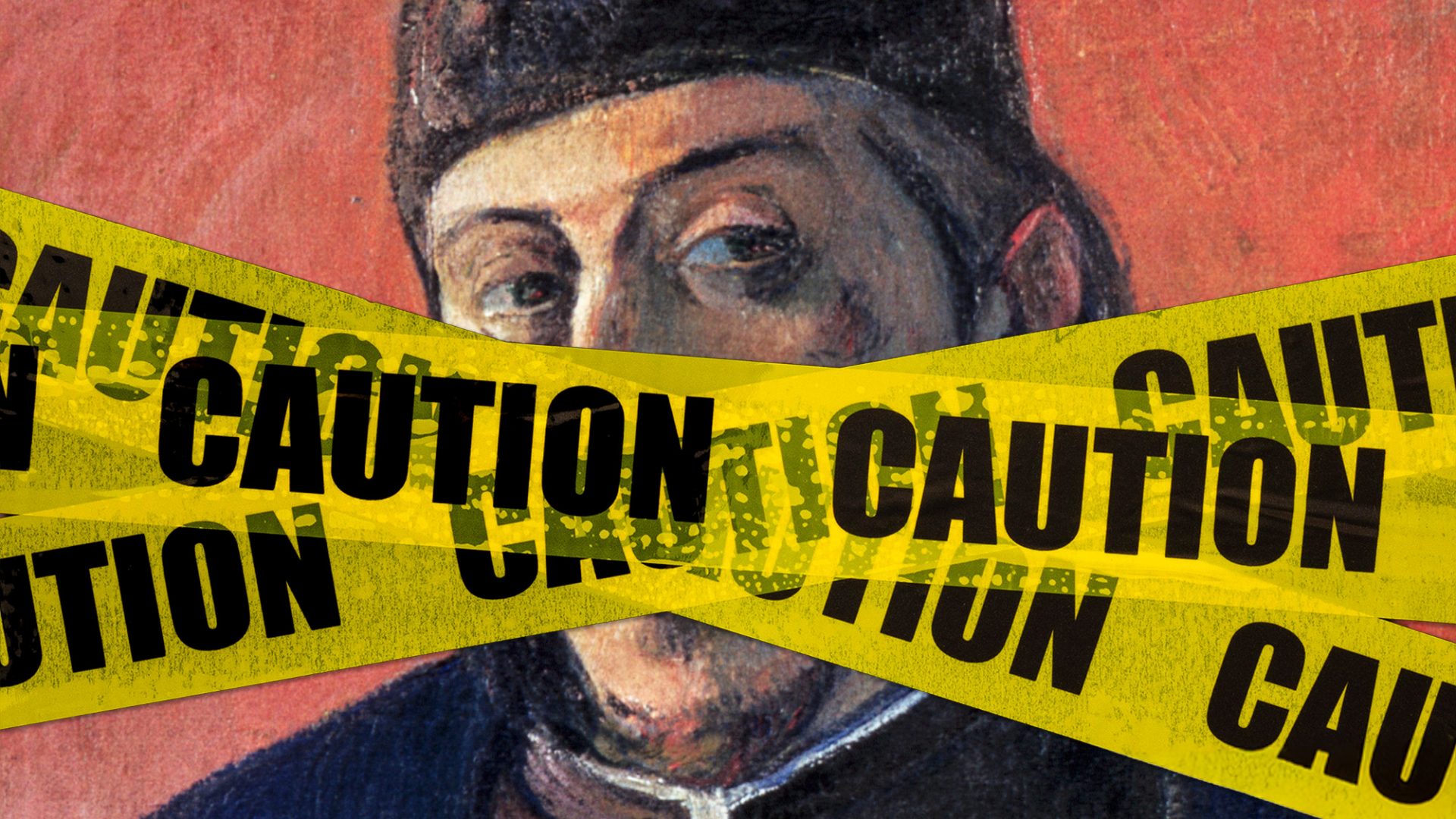
The painting is called Faa Iheihe and the label informs us that it was painted in 1898 by Paul Gauguin (1848-1903). Then it tells us to beware. “His works display his own perception of Tahitian culture, appropriating elements from the people’s art and religion… Gauguin took several young girls as ‘wives’, enacting the erotic fantasies often connected to colonialism.”
This seems to me to ask four important questions:
1. Is the artist’s life relevant to a work of art?
2. Should we judge long-dead people by
21st-century morality?
3. Are all those accusations sins?
4. Was Gauguin guilty of them?
Perhaps we should extend a little sympathy for the National Gallery. They have to deal not just with Gauguin’s life, but also with Gauguin’s myth: the depraved sex tourist spreading syphilis among the underage girls of Tahiti while ripping off their culture. The label on the wall is perhaps code for: “We know all about Gauguin’s reputation. Please throw your soup elsewhere.”
Never trust the artist. Trust the tale. That is DH Lawrence’s principle, and I pondered that austere view as I strolled over to Long Grass with Butterflies. Was my response to this painting influenced by the story of van Gogh, the tormented genius, those wonderful letters and the foolish wish that I could tell him how much his paintings are now loved?
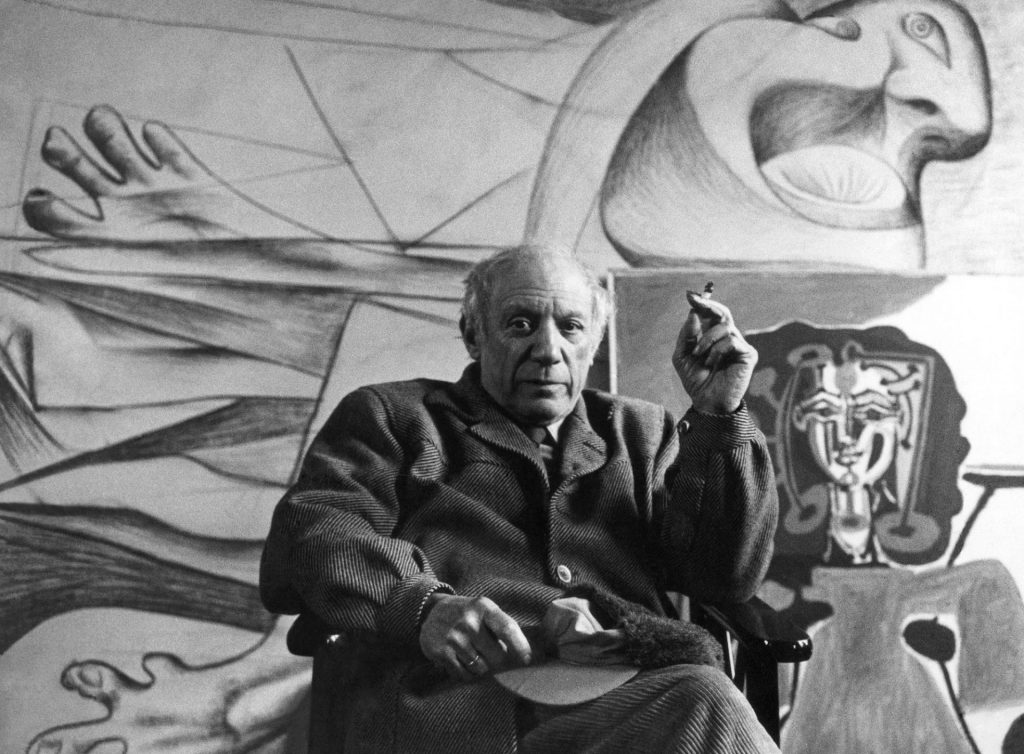
Picasso was a great cultivator of his own myth: the genius who makes his own rules about life, art, women and everything else. Perhaps that’s becoming counter-productive in the current century – is it OK to say you don’t like Guernica because its painter is only quite a nice chap? It’s your art, so you choose.
Was Ted Hughes a bad poet because some people say he drove his wife Sylvia Plath to suicide? Again, your call: their shared history is immensely complex, and they both wrote stuff worth reading.
There are suggestions that Bach, who fathered 20 children with two wives, stole the credit for his second wife Anna Magdalena’s masterpiece, the six cello suites. Bach scholars will tell you this is nonsense, but it’s the sort of thing some people like to believe. Does it invalidate his music?
Can we call Gauguin a monster for his taste for underage girls? One problem is that they weren’t (then) underage. The age of consent in France and its colonies was 13 when Gauguin was in Tahiti. Many other Frenchmen took on young Tahitian girls.
In the United States, the age of consent was then 10 or 12, depending on which state you were in. In most places, homosexuality was a criminal offence. Standards change: Gauguin was for a while a highly successful stockbroker and, like everyone else at that time, his basic method was what’s now called insider trading.
We live in an increasingly secular age. Most people merely ignore organised religion: some are actively hostile. “I am against religion because it teaches us to be satisfied with not understanding the world,” said Richard Dawkins.
Does 21st-century atheism invalidate Botticelli’s angels, The Divine Comedy and the Mass in B Minor? Should they be suppressed because, in Dawkins’s words, they might “implant [faith] in the vulnerable mind of a child”?
Richard Wagner held powerful antisemitic views. Does that make his work unacceptable? Stephen Fry, Jewish, adores Wagner. Me, I don’t listen to him, not for ideological reasons but because I can’t bear the din; I have many times been told that Wagner held vile views but made heavenly music and I’m missing out on the very best.
There’s a word on that Gauguin label that perplexes me: “appropriating”. In 1907, Picasso went to the Musée d’Ethnographie du Trocadéro. It was a visit that changed the history of visual art: the African objects in the museum inspired him to abandon realism and single-point perspective and create a new kind of art. The revolutionary painting Les Demoiselles d’Avignon shows five distorted, naked women, two of them wearing African masks.
This is now called cultural appropriation and is considered a very bad thing. I’m never quite sure where cultural appropriation begins. James Joyce was Irish: Ulysses is packed with references to Hamlet, The Divine Comedy and of course The Odyssey. Is that appropriation?
TS Eliot’s The Waste Land is full of Ovid, Shakespeare, Dante and Buddhist scriptures: “Immature poets imitate. Mature poets steal,” he famously said, adding something that’s usually left out: “Bad poets deface what they take and good poets make it into something better, or at least something different.”
Was George Harrison guilty of cultural appropriation when he introduced the sitar into the Beatles’ repertoire, starting with Norwegian Wood and Tomorrow Never Knows? He had us all listening to Indian classical music as a result: I’m not entirely convinced that was a bad thing – or that they were bad songs.

Gauguin believed that art was universal. He fell in love with the culture of another tradition and wanted to bring it to us all. The label implies that this is an immoral act.
And what of Gauguin the colonialist? The French colonists of both church and state tried to eradicate Tahitian culture – Gauguin wanted to preserve it and share it with the world. He was a regular contributor and later editor of a newspaper called Les Guêpes, noted for its scurrilous attacks on the governor and officialdom.
He campaigned for lower taxation of Tahitian people. The governor said he was: “A defender of native vices, a subverter of the rule of law and a dangerous anarchist.” His most recent biographer, Sue Prideaux, wrote: “The Polynesians loved him; the French hated him.”
She also demonstrates that he didn’t have syphilis. A cache of four of Gauguin’s teeth were found at his then-ruined house; DNA testing showed they were indeed his and further testing showed that he had never taken a cure for syphilis, so presumably never had it.
Perhaps the reason Gauguin is so awkward to fit into a modern-liberal view of art history is because he’s so damn good. Even if you hate his pictures on visceral or ideological grounds, you can’t help but be aware of their power.
Some people hate the pictures because they believe they represent bad values, both colonial and sexual. They see them as propaganda for sex with very young girls. We should note here that Shakespeare’s Juliet was 13 and, in the late 16th century, considered ripe for marriage.
Some would suggest that Gauguin’s pictures should be taken from the walls of the National Gallery: and better still, excised from the history of art. We can all make our own minds up on these issues: and maybe allow everyone else the same freedom.
Gauguin wrote: “All the joys, animal and human, of a free life are mine. I have escaped everything that is artificial, conventional, customary. I am entering into the truth, into nature.” That was how he wanted to live, and that was unquestionably what he painted.
He gave us a series of unforgettable half-glimpses of a forever elusive paradise. These days they come with a health warning.
Simon Barnes’s latest book is How to Fly: Taking Wing with Birds, Bats, Insects and Humans (Bloomsbury)