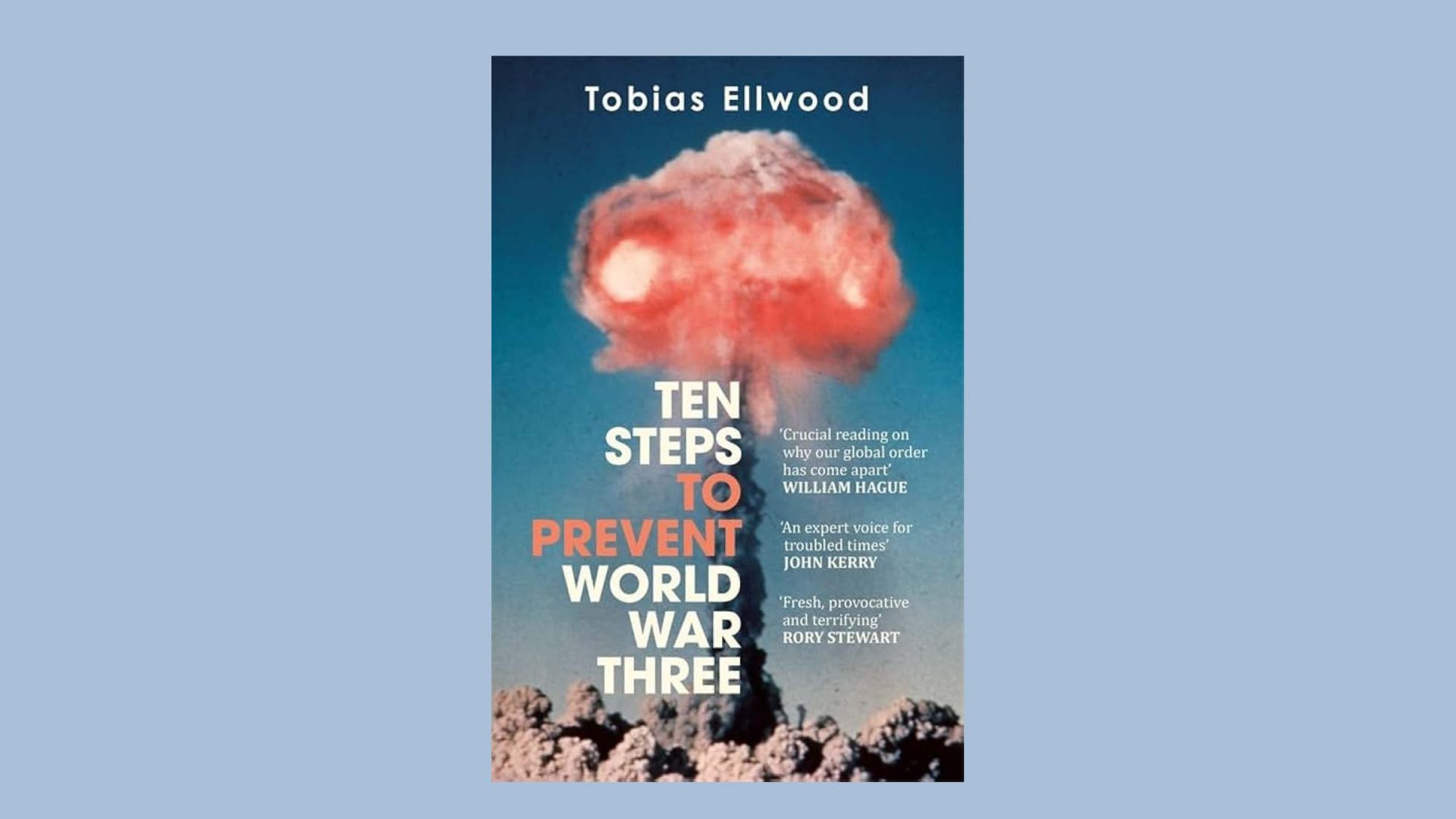
It is traditional for authors to thank their editors in the acknowledgements, and Tobias Ellwood duly does so. But in truth they have done him no favours. What could have been a timely, snappy call to arms by one of Britain’s more interesting ex-ministers is a bloated mess. Shoehorned into a listicle format and with summaries of major and minor wars that would leave a GCSE history examiner unimpressed, Ten Steps to Prevent World War Three is a missed opportunity.
Ellwood is not a gifted writer. That is not his fault. He is a former army officer turned MP who deals in the PowerPoints of the world of defence consultancy.
His prose has a machine-gun-like quality, and any narrative structure has long since been wiped out on the battlefield. But in the hands of a good editor who could have extracted what Ellwood really knew about and wanted to say, that would have mattered less.
Instead, he has produced a necessarily lightweight account of every conflict in which Britain has ever been involved, accompanied by some fascinating but buried insights into how the military works and what “globalisation” really means for our security. Oh, and how to fix it all.
For instance, Ellwood explains how crucial GPS is to British defence and why we have no sovereign back-up for it, despite the likelihood that China and Russia would seek to take out the system during a hot war. His explanation of what defence kit
the army, navy and RAF actually possess (and why) is useful, particularly in the context of the defence review, which came just too late for this book and reshapes the navy in ways that are controversial among defence experts.
He conveys the importance of rare earth minerals and how much we depend on China for them. Usefully, he sets out why America – and Britain – are distrusted by many of the countries where we have tried to bring about “democracy”, often to promote our own trading interests. None of these topics are well understood by the public.
Ellwood’s brother was killed in the 2002 Bali terrorist bombings, and he tried to save the life of the police officer who died in the 2017 attack on Parliament. These experiences, and his military career, give him a perspective that is unusual among politicians, and it is a pity he touches on them so briefly.
Other sections are flimsy. Drone warfare and AI pose moral and ethical questions that Ellwood does not grapple with. He suggests the Transport for London hack was a foreign op, but the teenagers responsible lived in Walsall and east London and had no reported links with foreign powers.
He is a firm advocate of national service, which appeared in Rishi Sunak’s 2024 election manifesto and was widely ridiculed. It should not have been – modern-day national service would look nothing like its 1950s predecessor, and other European countries are re-adopting it in some form – but Ellwood devotes just two pages to the idea.
That is not enough to convince a sceptical public, and certainly not a 16-year-old who, if the social media ban goes ahead, has only just been allowed to log on to Instagram, let alone learn civil defence techniques or how to fire a gun. He complains that the policy has been rejected out of hand. In that case, it deserves more of his attention and a fully thought-out rationale.
And if we are going to hear about the Malayan emergency, the account should convey some of the subtleties of what Britain did in the jungle, not just the conclusion that it worked out better than Vietnam.
Some of the graphics contain basic errors and the referencing is almost non-existent, which suggest Ten Steps to Prevent World War Three was thrown together in a hurry. If the next major conflict really is only five years away, as Ellwood suggests, that is understandable. But it should have led to a shorter book.
The Conservatives have drifted rightwards since they lost the election. Ellwood has not followed them. He still regrets Brexit, and does not want to leave the European Convention on Human Rights. He clearly deplores Trump. But the defence establishment knows how closely British weapons and surveillance systems are tied up with the US, and Ellwood falters on this difficulty.
Suggested Reading


Why did Britain forget how to build railways?
He wants Britain and like-minded countries such as Canada, France, Germany, Australia and possibly India to form a “Stability Alliance” that would step into the gap left by the UN and the World Trade Organisation, while presumably being tolerated by authoritarian states like Russia as less of a military threat than Nato. Members would cooperate on energy and supply chains and step in to offer “diplomatic, economic and humanitarian action” in “places such as Sudan, the Red Sea or the Sahel”.
The alliance would be an alternative to Trump’s risible Board of Peace and extensive Chinese influence in Africa. The plan is commendable, but if it is to have more agency than, say, the Commonwealth, Ellwood needs to imagine how it would handle a crisis in a part of the world where authoritarian states push back.
For all its flaws, the book is a reminder of how little the British public now think about defence. “War is the human default. Peace is the exception,” he writes, pointing to the constant “grey zone” attacks on UK infrastructure whose origins often go unreported.
As the rows over defence spending show, there is a growing divide between figures who warn that outright war is coming and those who argue that we must fix our domestic problems and fend off populism before spending large sums on the military. Ellwood, who had to resign as chair of the defence select committee in 2023 after praising aspects of the Taliban’s rule in Afghanistan, is a big-picture guy and a passionate advocate for defence.
But a shorter and better-argued work would have served his cause better.
Ten Steps to Prevent World War Three is published by Blink