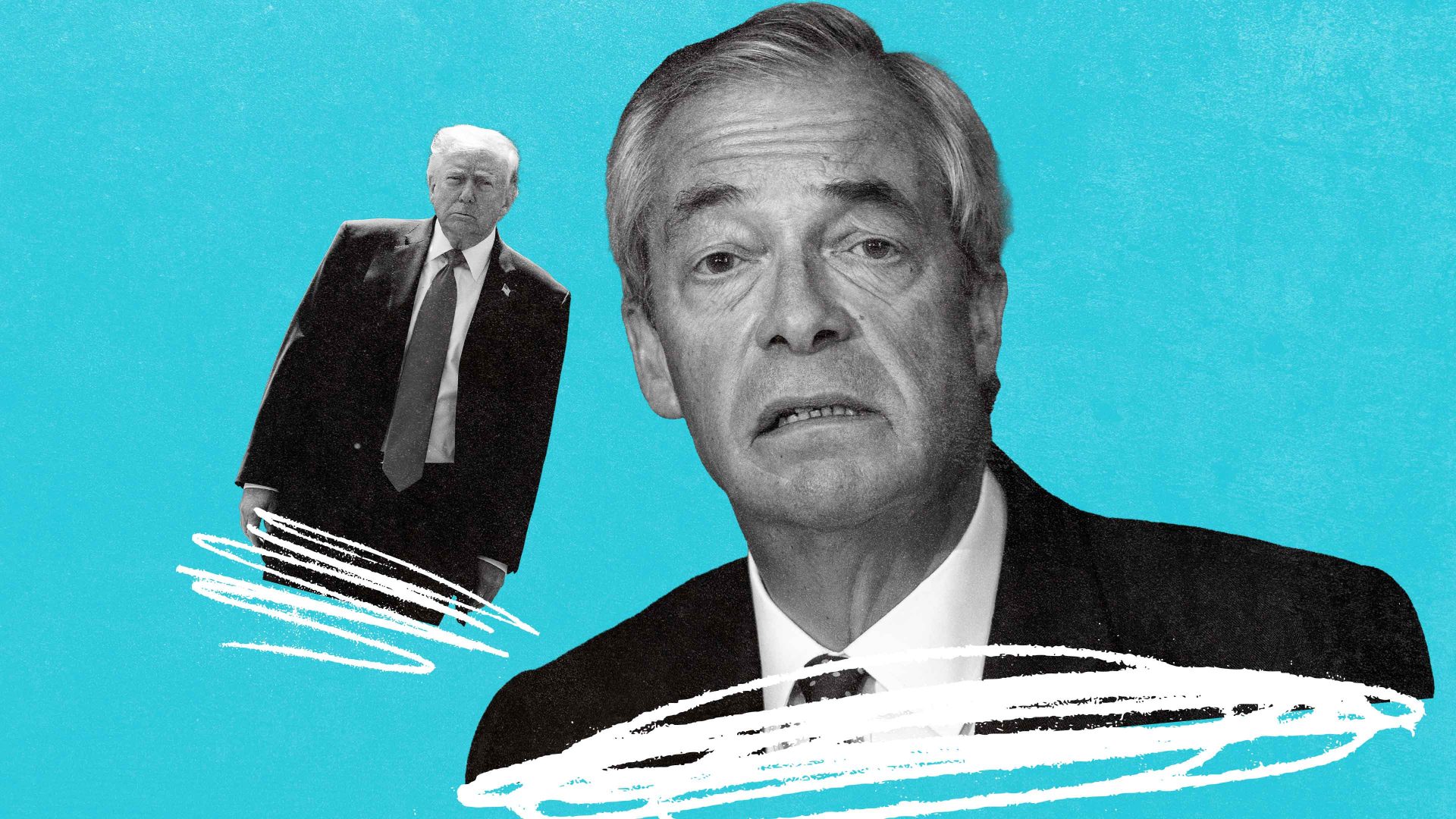
Reform’s poll ratings are not as high as they were in the autumn. Yet with the local elections a couple of weeks away, around a quarter of Britons still say they want it to form the next government, and the party will undoubtedly win many new councillors. Nigel Farage’s signature achievement has made us poorer. Even Brexiteers struggle to point to any concrete benefits. And his rush to associate himself with Trump, a man who has thrown the world into chaos, now looks like a grievous mis-step. Has Farage lost his touch?
In his immensely self-satisfied memoir, The Purple Revolution, Farage explains how UKIP did so well in the 2014 European elections. The then-leader of UKIP relished his performance against Nick Clegg in debates and was briefly buoyed by his surge in the polls. Yet he could not enjoy it. “Being in the lead… is a very vulnerable place to be,” he wrote. “It is far more exciting being the horse that comes up on the inside to win than having to keep that pace for three weeks.”
The Purple Revolution came out a year before Farage’s victory in the EU referendum. That was a much more thrilling ride. Remain’s horse started out as the firm favourite, only to falter, surge again in the final polls and then stumble at the last hurdle. It was classic Farage: the unlikely victor, proving the experts wrong and then grinding their faces in the mud.
“Farage occupies this extraordinary position in the British political system on a five-year cycle,” says Seth Thévoz, a political historian. “He comes out of nowhere, does far better than anyone thought he’d ever do, scares the hell out of whoever’s in power – and then falls out with all his own allies, and his support base utterly collapses back to ground zero – only for him to start all over again. He’s been doing this since 1999. It used to be the rhythm of European Parliament elections that kept him going, with the oxygen of publicity around that.”
These breakthroughs are the rhythm Farage is accustomed to – one that allows him to carry on barracking from the sidelines, safe from any genuine responsibility for what might ensue. The whole point of being re-elected to the European Parliament was to bring about its demise. That attitude served him well as a City trader, when a good day left him unsatisfied, and a bad one could be forgotten over a PFL (Farage-speak for a “Proper Fucking Lunch”).
“When you are sitting on a massive loss – when a trading position just gets worse and worse and you just keep losing more money – it is an enormous relief when you just think, ‘Right, to hell with it. I’m getting out of this’ and you cut your losses, get out and go for lunch. It’s very clean,” he wrote in The Purple Revolution.
Clean, exciting, untrammelled by personal responsibility or unpleasant consequences: that’s the Farage way. Negotiations and compromises never sully the joy of victory. He has to be in charge. Political parties – UKIP, the Brexit Party and now Reform – are a vehicle for his ambitions, but he decides the itinerary and drives the car. Or pilots the plane, of course: his near-death escape after a crash is part of the Farage legend. He claims he last took public transport in 2013.
This strategy has proved more successful than almost anyone imagined. His biographer, Michael Crick, predicted he would never win a seat in the Commons. It will eventually run out of road. But Farage loves the race too much to abandon it.


Right from the earliest days of UKIP, when he was jostling for prominence in the party, Farage had one star quality: his patter. As a schoolboy, he avoided being punished for drinking by disarming his teachers with repartee. As a commodities trader in the City, he bought and sold by shouting and gesticulating in “open outcry” trading. He secured early converts to the Eurosceptic cause by winning people over in village halls.
Farage has never been keen on writing speeches, preferring to improvise. This spontaneity has served him well among people not disposed to trust careful politicians who struggle to come up with ready answers, aware that they may get the facts or the tone wrong. When the left despairs of Keir Starmer’s communication skills, this is the thing that they envy.
At the same time, he knows exactly what he can get away with. “He’s very good at articulating a position that’s provocative, but not too provocative,” says Rob Ford, a professor of political science at the University of Manchester and an expert on the far right. “That’s down to the exact kinds of words he uses, and the sensitivity it shows for where the hidden landmines are in a very landmine-heavy terrain.” Not many politicians are comfortable talking off the cuff about immigration. Farage has been doing it for decades.
The video he made during the August 2024 riots shows how adeptly he walks the line between distaste for violence and excusing its cause. “I understand the anger that is felt by huge numbers of people, but we do not support, I do not support, street protest, violence or thuggery in any way.” But then he added the kicker: “Do we want to deal with the symptom that we’re seeing today? Or solve the problem?”
“He has very good antennae for the normative limit of what can be said,” says Ford, noting that Farage always takes care to distance himself from the far-right loutish offender Stephen Yaxley-Lennon, better known as Tommy Robinson. Kemi Badenoch and Robert Jenrick can be “clumsy and clownish” as they deplore the immigration regime they helped run. Farage has had plenty of practice.
He likes to have the stage to himself. While he gives the impression of relishing a fight, Farage does not willingly put himself in a position where he might be bested. During the 2014 campaign he regretted having agreed to be interviewed by James O’Brien of LBC. “Patrick [O’Flynn] and I were normally very selective about who we talked to,” he explains. Before debating Clegg, he was so nervous he stopped boozing for a few days and took some exercise.
How does that square with the man who wrote in his autobiography, Flying Free, that “Freedom of speech… is absolute or it is nothing”? It reveals a man with a justifiable confidence in his ability to win over a crowd, but no taste for Oxford Union-style debating, that forum where so many successful politicians first test their arguments and rhetoric.
Farage never went to university. He is not interested in the Socratic to-and-fro or in honing his beliefs through challenge. It makes him a notably shameless politician and gives him a style that lends itself to TikTok. Why try to impress a snotty elite when you can seduce the ordinary man? They all vote only once.
Crucially, Farage is a man at ease with his origins and his class. But whereas Jacob Rees-Mogg has been foolish enough to turn himself into a caricature, Farage hasn’t gone so far. Yes, he went to public school. Yes, he likes golf and First World War battlefields. Plenty of British politicians try to play down their origins, or have travelled too far from their upbringing to be confident about where they belong. Voters can sense it, and often despise it.
Farage loves the British class system, understands it and is unapologetic about it: he delighted in the way Dulwich College rewarded his shameless contrarianism. He drinks beer, but also champagne. He has deliberately cultivated this persona, partly to reassure his nationalist supporters that, despite marrying a German and commuting to the European Parliament for many years, he remains wholly British. (Farage’s current girlfriend is French.)
What he despises most of all is homogeneity and conformity. This is not to say he is a libertarian. Farage’s schtick might better be described as bloody-mindedness. Flying Free is very keen on “diversity”, as long as you have to travel to find it. One of his principal criticisms of the European Union – and one of the least convincing – is that it imposes a relentless uniformity on its members.
This aversion to compromise is the reason why Reform would be very little without Nigel Farage. Political parties exist to work out what their members believe and want and how to deliver it. But Farage has never had to deliver on his policies and his instincts have never been checked or challenged. Reform councils are only just realising what governing means, and are finding the reality of office much harder than barracking from the sidelines. People who fall out with Farage either leave his party or, like Zia Yusuf, issue a feeble yelp of dissent before crawling back shortly afterwards.
This inability to work with others has often been a boon for Farage. It means that he – and only he – sets the tone of Reform. Since the party owes its popularity to him, new entrants must submit to his will. Tory defectors have prostrated themselves before their new leader – Nadhim Zahawi, an ex-chancellor, was not even allowed to answer a question about vaccines as he was paraded before the press.
Farage apes authoritarian strongmen like Trump and the now-deposed Viktor Orbán, who believe their instincts both follow and shape the thoughts of ordinary people. The paradox, of course, is that Farage cultivates an anti-authoritarian image, saying “I hate being told what to do on a personal basis” – unless the lawbreakers are immigrants.
This pro-Trump position is becoming a problem. After the US declared war on Iran, the deputy Reform leader Richard Tice told LBC Radio that Farage had changed his mind on war in the Middle East. In 2013 Farage told the Jewish Chronicle he supported a “non-intervention policy” and that sanctions against Iran had been a mistake. He told the paper that “a more intelligent approach would have been to love-bomb Iran and give everyone free access to the internet.”
It was all very different now, Tice explained. “‘In a sense, actually, that’s what the president of the US is doing, by love-bombing the good Persian people, trying to get rid of the regime.” Even Farage would not have come out with this kind of nonsense. But surrounding yourself with pliant mediocrities has a downside.
More broadly, his slavish devotion to Trump undermined his instinct for what most of the British public want from their defence policy – which is, broadly, a quiet life and no more “wars of choice” that promised painless regime change and ended up running into the sand.
“I do believe that Starmer’s actions don’t just threaten the special relationship, but that probably he has posed a major threat to NATO,” Farage pontificated, sounding like a man way out of his geopolitical depth. And even before the Iran debacle, Farage had been struggling to articulate a position that supports Ukraine without annoying Trump. He recently appointed two advisers with very different views on who bears responsibility for Ukraine’s invasion. Iran would have offered a respite from that tricky dilemma.
But the war is going badly, and Farage has now turned again – even admitting he is not sure what Trump’s war aims are. Now Orbán’s defeat has removed an ally in Europe. Farage is hoping to ally himself with Giorgia Meloni of Italy, who has quietly distanced herself from Trump. The more worried Britons become about Iran, the more irrelevant and powerless Farage looks.
When will the British public tire of him? Many already have. The qualities that make him so appealing to around a quarter to a third of voters – his energy, his bloodymindedness, his refusal to water down his demands – would also make it immensely hard for him to govern. Brexit is done. Once he has destroyed the Conservative party, what remains? His talents lie in selling simple solutions to complex problems, not reconciling the needs and wants of 70 million people. He won the race. The thrill is over. Shit. Time to go for a PFL.
 Most popular
His dad tried to overthrow Putin – now Pavel Prigozhin runs an African country

Liz Truss’s new mini-book is every bit as bad as her mini-budget
I was at Eton with Charles Spencer – this is how it explains his battle with the royals
18 things that will absolutely, definitely happen if Trump gets whopped in the midterms