
Why do we keep worrying away at the second world war? It is by far the richest source of material for historical fiction: modern enough to evoke, far enough away to invent.
Perhaps it was indeed Britain’s finest hour, but that does not fully explain it. With the war itself passing out of living memory, we understand it as an exceptional time when everyone took some part in a moral struggle between good and evil. Things that were ordinarily impossible were permissible, especially for women. The stakes were higher; life was more intense even as parts of it became dreary, at least in Britain.
What we see less often – because the war itself tends to provide enough excitement – is the fusion of magic realism with a wartime setting. That makes Nonesuch unusual.
Francis Spufford has touched on the occult (Cahokia Jazz) and written about the war (Light Perpetual) before. Here they come together with something you suspect he has been longing to tackle in fiction: Christianity.
It makes sense. Spufford has also published a short book called Unapologetic: Why Despite Everything Christianity Can Still Make Surprising Emotional Sense, possibly the most British work of theology ever written and which a more astute Church of England would distribute for free.
His chosen medium is the angel. They are a familiar way of showing the ways of God to humanity, but in Nonesuch one of them appears to a woman who is definitely not a virgin, most memorably while she is having sex with her boyfriend. The bathos here (she calls the angel “Bluey”) is just about bearable. In the earlier chapters, Spufford is more deft, brilliantly evoking the terror of being pursued by a malicious, supernatural being through blacked-out London. Few writers have done such a magnificent job of describing a city made strange by the darkness, or the awful knowledge that tonight the bombs may come for you.
Like the Virgin Mary, Iris is reluctant to discover that only she can prevent an even greater disaster befalling humanity (the war has already begun). The trope of going back into the past to meddle with history is familiar to anyone who has watched Doctor Who or read Kate Atkinson’s Life After Life, but Spufford gives the journey a Christian resonance. When Iris traces her way through London in search of Nonesuch through strange, luminous tunnels, she is attacked by malevolent statues and burnt on her back by incendiaries. It looks remarkably like the pictures of Jesus’s final walk in countless Stations of the Cross.
Spufford makes Iris a sensual, flawed, rather greedy individual, driven by a history we do not fully understand until the end of the book. Her boyfriend Geoff is a little too tame, but then so was Joseph. His aptitude for physics proves very useful until it isn’t, and forces beyond his understanding take over.
Occasionally, Spufford gently reminds us that the things we find supernatural now may well be possible in the future. Travelling through time and space, Iris wonders at a glimpse of what must be a plastic pipe. The good angel tries to explain something and then remembers that humans have not yet discovered it. Fair enough: could a Victorian have believed in the possibility of wifi?
Atheists may find the rousing scene at Midnight Mass a bit too forced. Spufford plays around with the rhythms of James Joyce’s short story The Dead, in which snow falls on Ireland, and tries to imbue it with joyous life rather than melancholy. But like Iris, unbelievers are welcome in his moral universe. He insists on the possibility of redemption after sin, and that suffering makes us who we are.
When so much of modern politics and culture is devoted to resolving suffering or, failing that, pushing it away to where it cannot be seen, it remains a radical assertion. Ultimately, Spufford wonders if it is more important to change the whole course of history for the better or atone for your own misdeeds. He does not offer an answer: as the trolley problem shows, our uncertainty about it is what makes us human.
Suggested Reading


Claudia Winkleman’s chat show is afraid of Claudia Winkleman
And perhaps we return to the second world war for good reasons. With fascism rising again in Europe and America, a novel about fighting the far right resonates. In the character of Lady Lalage, Nonesuch offers a glimpse into the lasting appeal of an ordered, hierarchical world in which no one bothers worrying about morality any more.
None of this stuff stops Nonesuch from being a thoroughgoing romp, with plenty of sex, a beautiful Nazi and the heroine clinging desperately to the flames at the top of the Monument in the City. Indeed, rarely has a novel admitted the possibility of erotic rapture so early on in the story. But it is as well to get it out of the way. Spufford has much more profound themes to tackle.
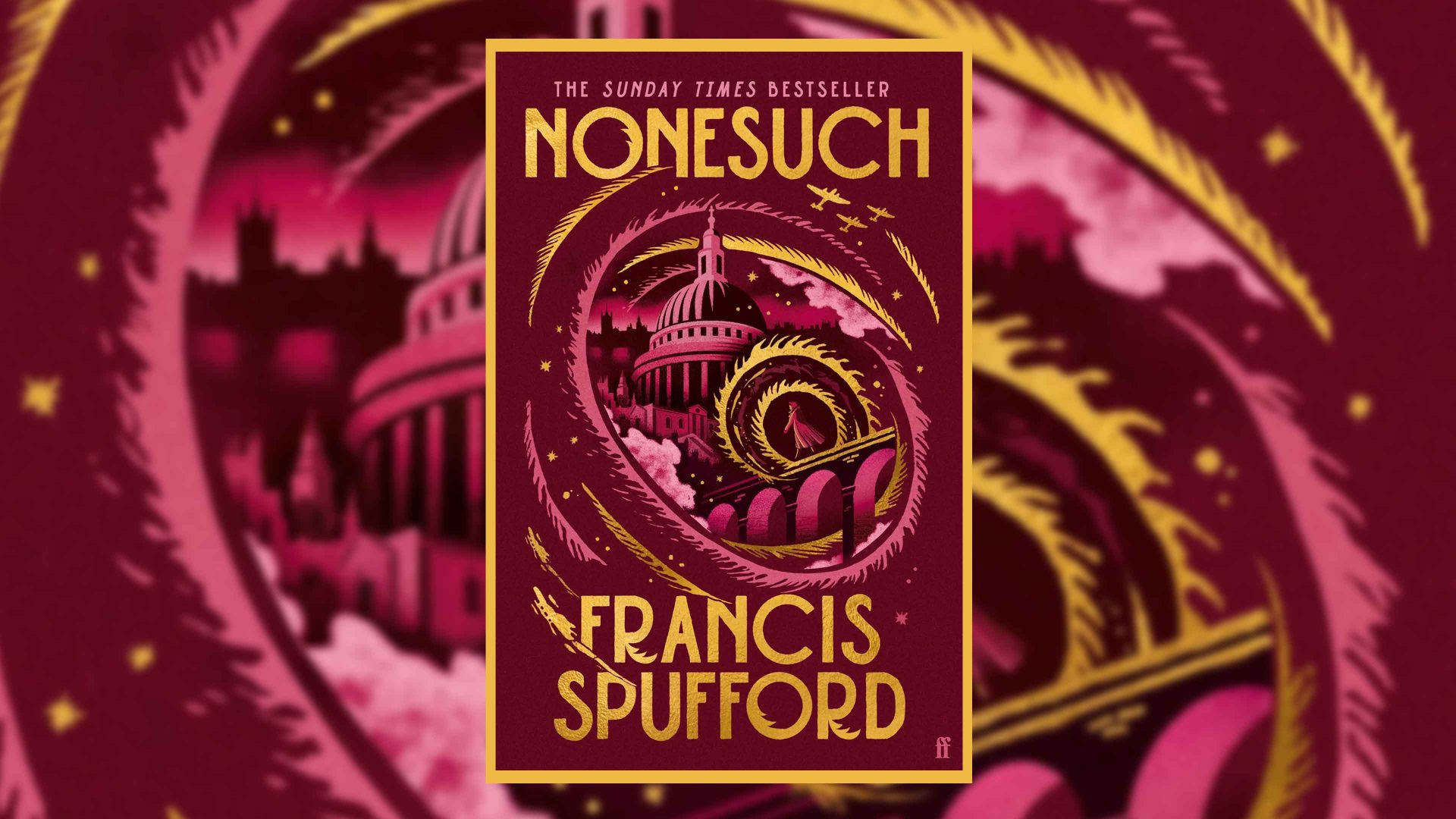
Nonesuch by Francis Spufford is published by Faber
Ros Taylor hosts the More Jam Tomorrow and Oh God, What Now? podcasts