
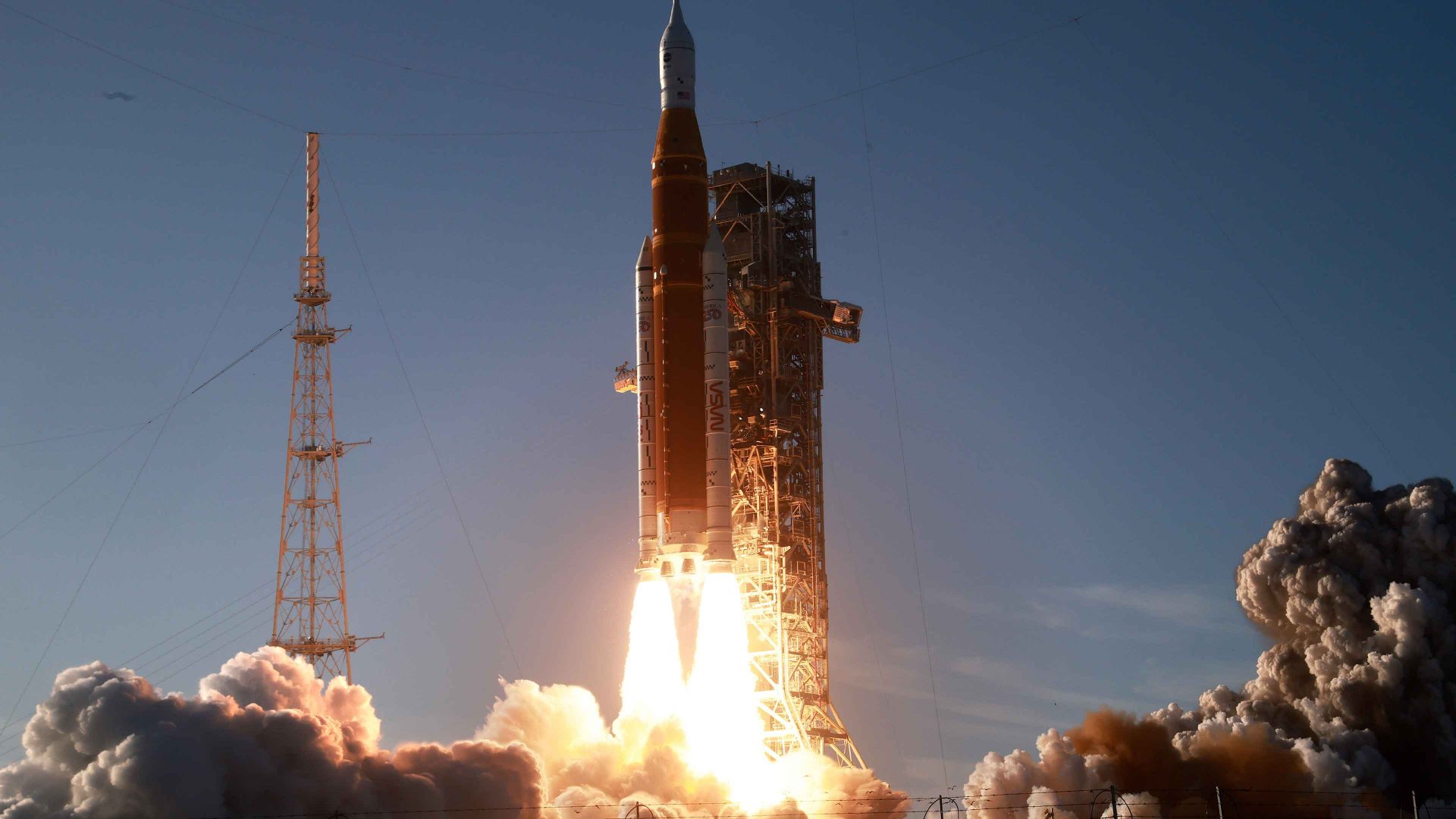
The Artemis II moon mission launched by Nasa on April 1 wasn’t without controversy. Few people in the US consider human spaceflight a priority for Nasa, and some scientists feel it distracts (and steals funding) from space science that can be done more cheaply, and indeed ambitiously, using robots.
Donald Trump’s focus on ostentatious crewed missions, first to the moon and then to Mars, look more concerned with grandstanding than with learning about the cosmos. Trump has proposed pouring money into lunar and Martian missions while cutting Nasa’s 2025 budget by almost a quarter, sacrificing climate-monitoring instruments and a robotic Mars mission.
Even the fact that the astronauts included a woman and a person of colour feels of less consequence in the face of Trumpian attacks on diversity in Nasa.
But the Artemis programme did have some scientific goals, and all the crew had some scientific training. The Artemis II craft orbited the Earth for a day (24 hours – there are no real days in space) before the Orion module housing the crew headed on a three-day journey to and around the moon.
The main goal was simply to establish the feasibility of this means of reaching the moon, in particular to test out how well the tiny Orion capsule would protect the four crew members against the harsh radiation environment in space, where there is no geomagnetic field to deflect pervasive streams of high-energy cosmic particles.
In this respect it was comparable to the Apollo 8 mission that transited the moon in 1968 before the landings the following year.
Sensors inside the capsule measured the radiation exposure during the flight. And, now they are back on Earth, the astronauts’ own cells will be studied for damage caused by radiation or the absence of gravity. Before the flight, the crew had the precursors of bone-marrow cells extracted from blood samples; some of these were placed on tiny plastic chips taken on board the spacecraft, while others have been kept on Earth.
The space samples will now be compared with the Earth-based ones, looking for signs of deterioration such as DNA mutations (some of which can potentially trigger cancer) or changes to the DNA segments called telomeres at the ends of chromosomes that get eroded away in the ageing process.
By personalising these experiments, it might become possible to predict in advance which astronauts have better resistance to space hazards. Another of the projects aimed to measure how being in deep space affects the crew members’ wellbeing, sleep patterns and activity in the face of such extreme confinement and isolation, not to mention a potential combination of high stress and monotony.
Suggested Reading

The slow death of American science
During the six-hour period that the capsule swung around the dark side of the moon, the crew observed the part of the lunar surface which is never visible from Earth. It has been scanned extensively already by automated instruments such as those on Nasa’s Lunar Reconnaissance Orbiter, launched in 2009.
But, unlikely though it might seem, planetary scientists say that the human visual system can still pick up information that it’s hard for robotic instruments to detect, such as subtle differences in colour of the lunar surface that could signify differences in geochemical composition.
It would be very surprising if any big revelations had been uncovered this way, but arguably it offered a way to test whether human exploration of other worlds can really do more, faster, than robotic missions can.
The Artemis mission is a key stepping stone towards the planned establishment of a permanent moon base, where a crew could potentially conduct observations of the stars and find out more about the moon’s geology and origins.
But the politics of human spaceflight have always been complicated. It can yield a scientific bounty – but enough to justify the cost, especially when much of the science is about the effects of space on humans in the first place? It can inspire – but public support is hardly overwhelming.
These days, “we choose to go to the moon”, in JFK’s famous phrase, for many reasons. But the rhetoric from Jared Isaacman, Trump’s appointee as Nasa administrator, about the “economic potential” of the moon and of putting “the Stars and Stripes on Mars” can sound like tub-thumping nationalism.