Poor old Vladimir Vladimirovich. How could he have known what a laughing stock he would become when he launched his hubristic “special military operation” on February 24, 2022?
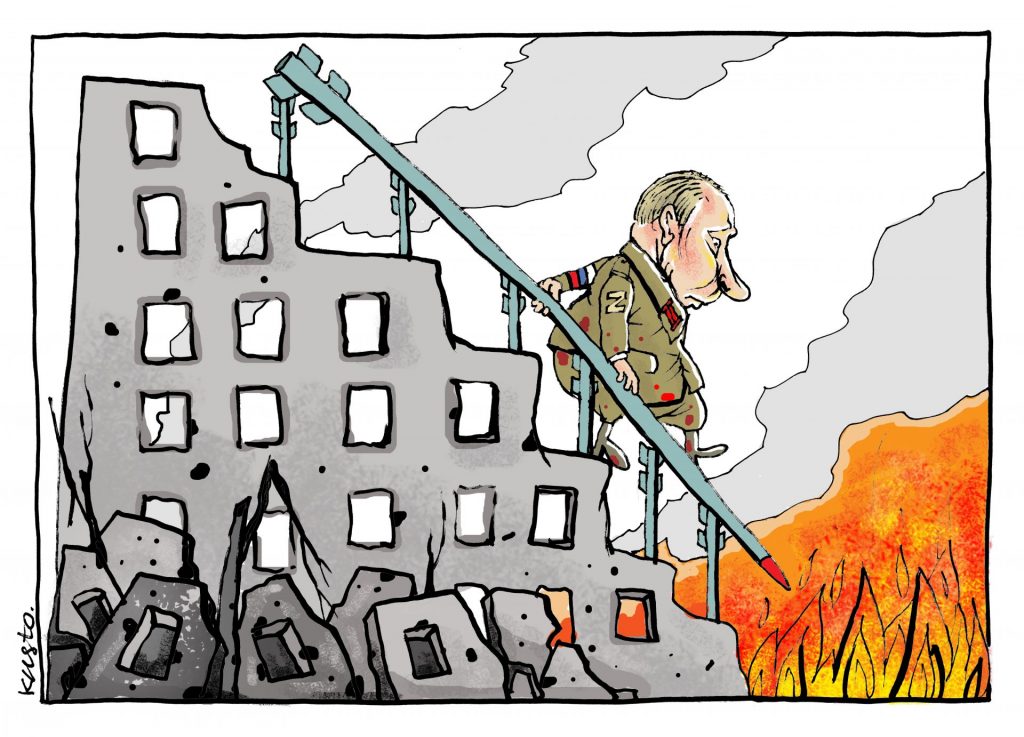
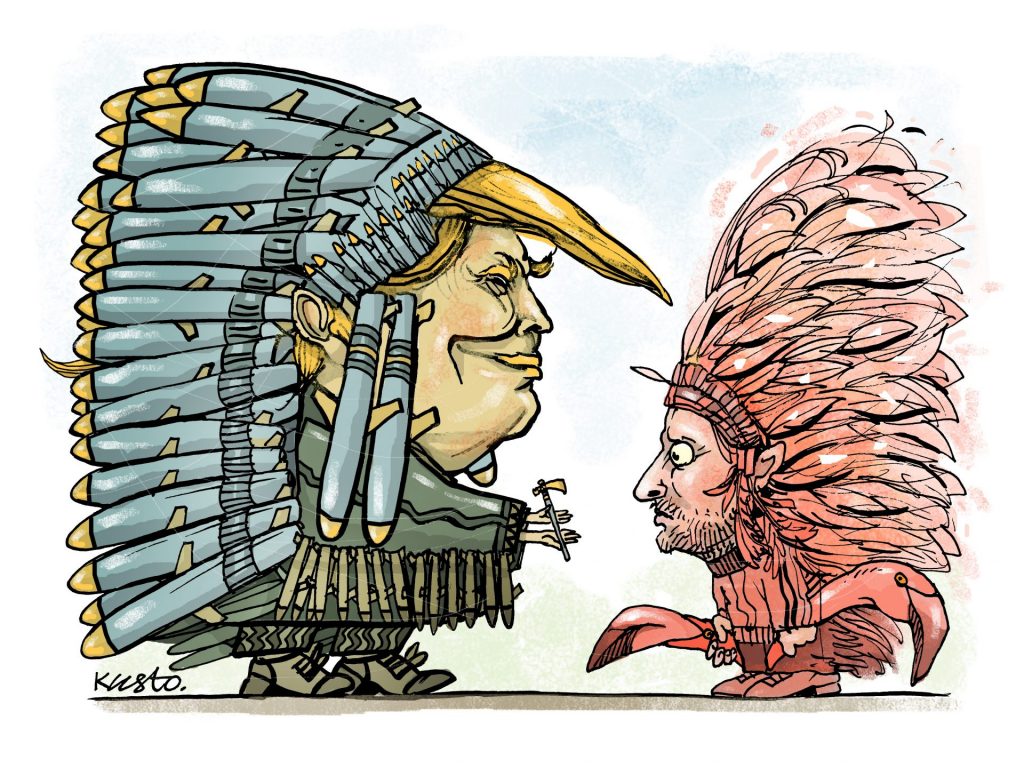
Putin, the dictator, the war criminal, is now the object of mockery and scorn, reduced to a caricature of failure, by an army of Ukraine’s cartoonists. They are following in the subversive traditions of the graffiti artists of ancient Rome, the ridicule heaped on Napoleon Bonaparte as the posturing “Little Boney” by James Gillray, the invective of Philip Zec and his fellow second world war cartoonists who drew Hitler & Co as snakes, vultures, toads, and monkeys.
In Ukraine, as the bombs rain down, art fights back with a steady flow of anger and contempt, exploiting the freedoms of social media and the wider online world to get their message across.
Oleksiy Kustovsky is one of them, an inveterate poster on Facebook. A self-taught artist and trained agronomist, he had his first cartoon published in 1998 and has worked for the newspaper of Ukraine’s parliament since 2004. He is reluctant to give interviews, and happily admits that there is little about him online to satisfy the inquisitive enquirer.
“I’m glad you couldn’t find too much about me,” he writes. “I’ve always believed that the drawings should speak louder than the artist. I simply make drawings to express ideas. I’m not an illustrator, not exactly a cartoonist, not a poster artist, and not a book illustrator either.”
His style is reminiscent of the schoolboy comics of the 1950s combined with the wild imaginings of surrealism, but contrasting with simpler, direct imagery such as Scorched Cherry Blossom, which he dedicated to his hometown of Vyshneve after a Russian attack had destroyed nearly 100 homes.
Suggested Reading
Ukraine is showing Europe what it needs to become
“People lost their lives,” he writes. “War leaves scars not only on the land. It leaves them on the cherry blossom as well.”
Kustovsky, who admits to suffering from impostor syndrome, tells me: “My process is very personal. I carry notebooks everywhere and make tiny thumbnail sketches with a pencil or a pen. When an idea feels right, I scan the drawing and finish the colour digitally in Photoshop.
“My drawings don’t contain words. I love philosophical cartoons – ones that are deep in meaning and rich in layers. The truth is that I’ve never thought of myself as a political cartoonist. Political satire is only a temporary chapter because of the war. Before that, and hopefully after the war, I was and will be interested in other things.”
Inevitably though, his subject today is the war and Russia’s “grotesque and ridiculous” president.
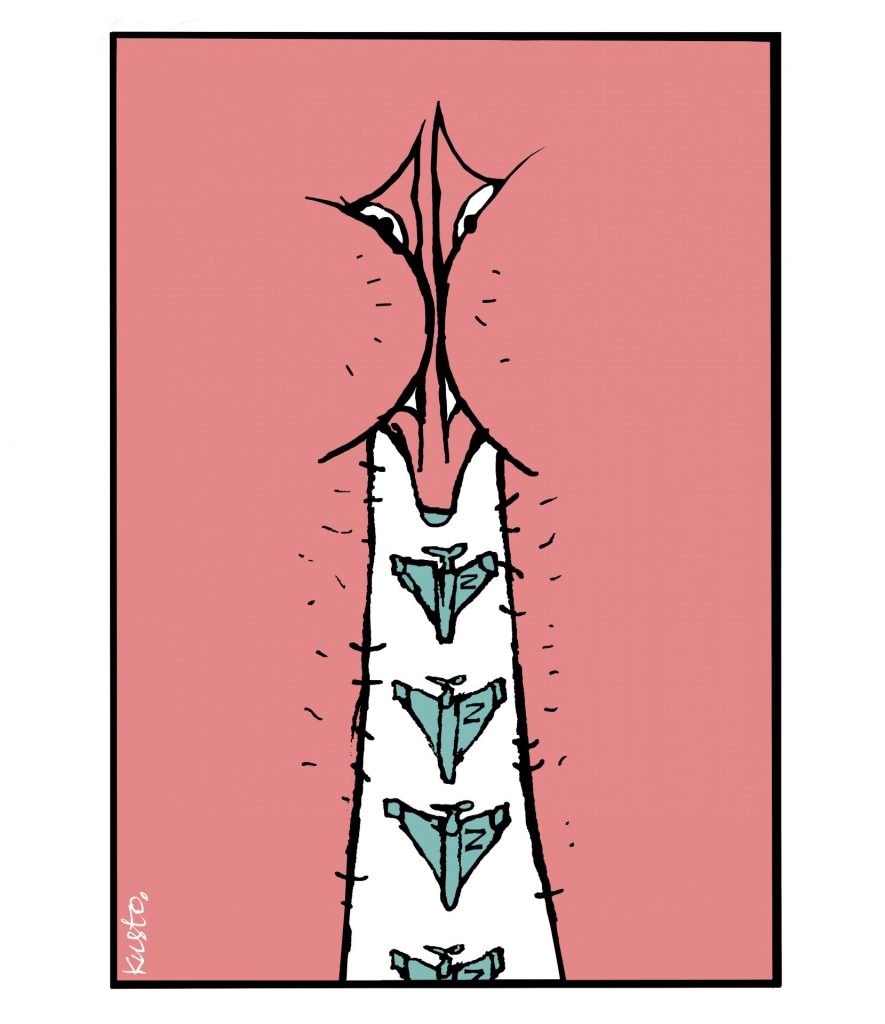
One of the most savage of his cartoons has a dragon, its belly hollowed out to reveal Putin as a cannibal surrounded by bones, on the creature’s head is balanced a chessboard on which a rather bemused Ukrainian soldier decides how best to fight back. Which move will be the most effective?
In The Price of Obsession, a sweating Putin wielding a skull is confronted by the ruins of his army while being cheered on by the ghosts of Hitler and Stalin. Death as an auctioneer has a framed map of Ukraine under the hammer, waiting for the highest bid.
The cartoonist avenges himself on the aggressor by placing him at the heart of the violence he has instigated; a pall of smoke in the shape of the dictator’s head billows above a sinking Russian ship, a piggy Putin with huge tusks is attacked from above by drones shooting spears.
Sometimes he is grimly amusing. Putin, the great commander on a tank, binoculars to hand, surveys the battleground, indifferent to the skeletons scattered around. Behind his back, a huge queue lines up to siphon petrol from the tank.
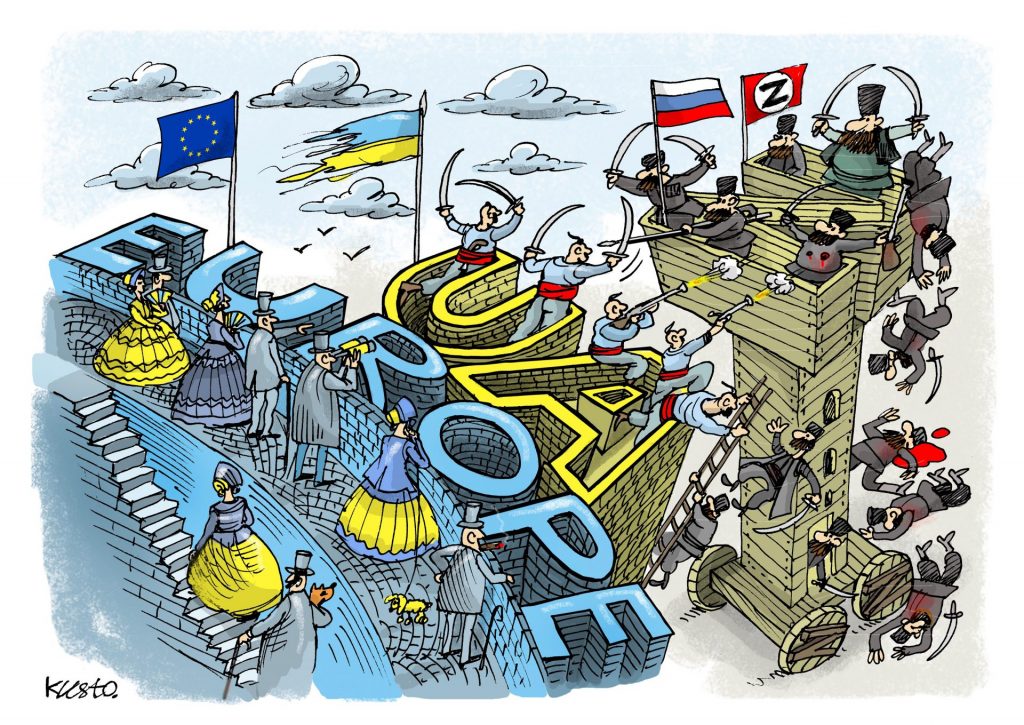
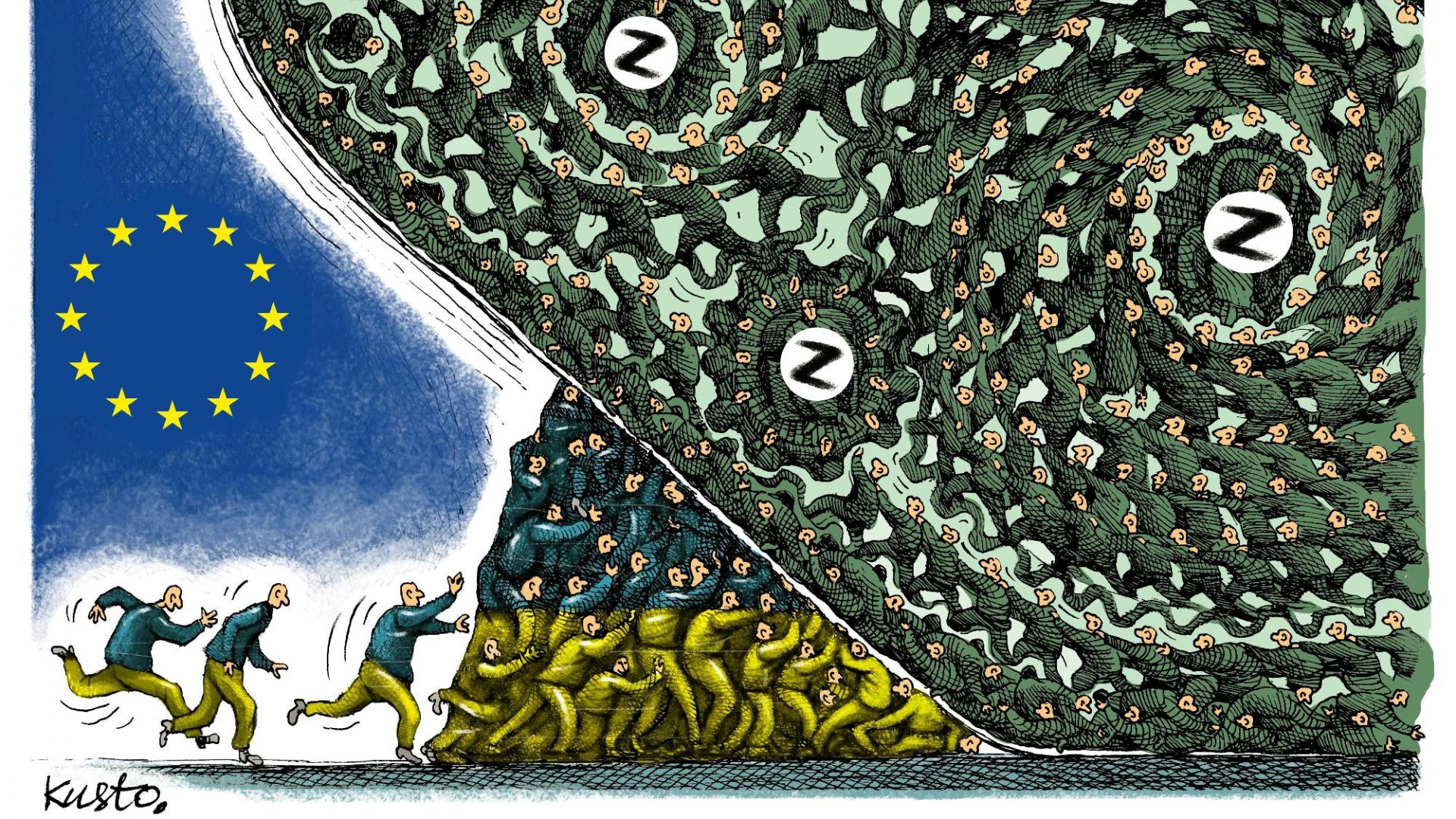
In one telling scene, he depicts Europe as onlookers in top hats and elegant frocks cheering on the Ukrainian army from the safety of their battlements while the Russians attack on their medieval siege engines.
Does he feel the west has let Ukraine down? “Yes, it hurts a little. But at the same time, the west has helped Ukraine enormously – with financial support, humanitarian aid and weapons. We understand that and we are grateful. Perhaps this is simply our fate: to be Europe’s frontier.”
Does he consider himself to be an activist? “I’m not sure. I don’t think so. An artist actively documenting and responding to the war in Ukraine? Yes.”
A satirist? “I’m not certain about that either. Humour is a very complex substance. For the past 28 years, I’ve been trying to understand what a cartoon really is. Sometimes the result is witty, sometimes funny, and sometimes not quite either.”
Sometimes too, he has been censored. “My political cartoons about the Russian dictator are sometimes removed from social media. Censors claim my drawings contain nudity. But it’s not my fault that the dictator’s face looks like a pair of buttocks. Pure buttocks.”
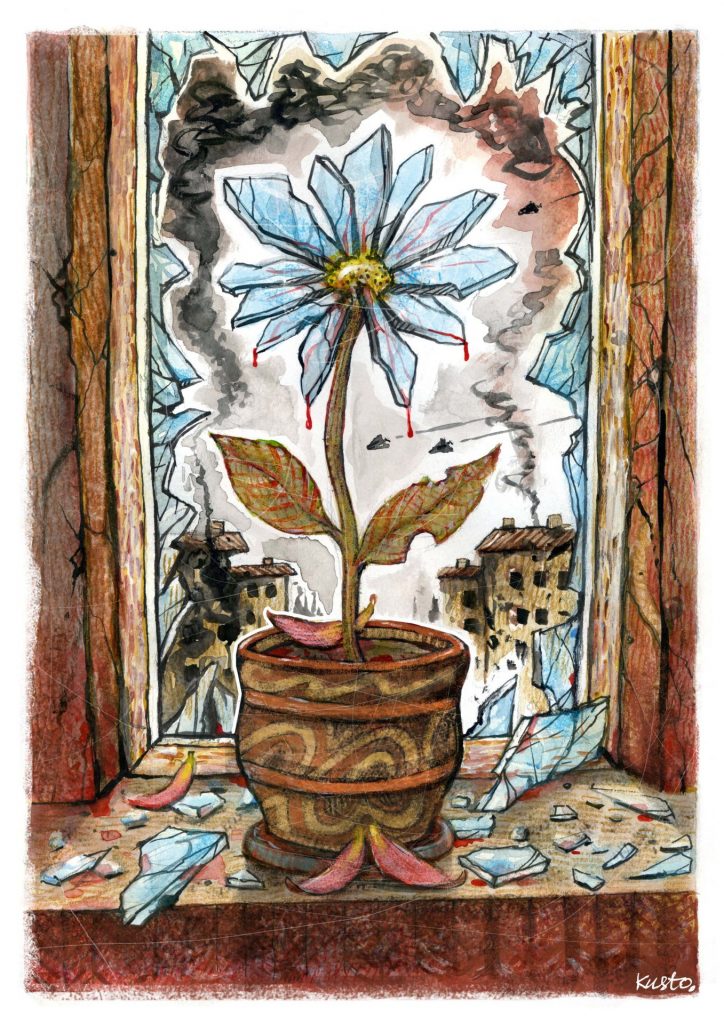
But just as effective in his mockery of the man, and his despair at the war, are deceptively simple pictures like After the Shelling – a flower on a windowsill whose petals are shards of shattered glass. Blood drips from the petals.
Suggested Reading
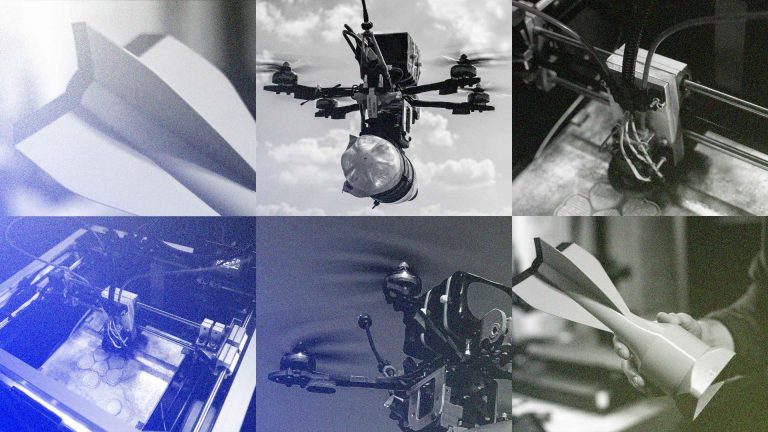
Ukraine is 3D-printing its way to victory
“That drawing still hurts,” he reflects. So does Ukrainian Window, in which a mother and son (and cat) peer sadly through a window where the space left by shattered glass is transformed into silhouettes of Trump and Putin.
“Kyiv is beginning to resemble a frontline city. People inside their own homes have become like targets in a shooting range,” he says. “That is a very sad conclusion.”
Yet, he writes: “I dream of the day when I no longer have to draw destruction, war or politicians.”