Summer vanished this week in Istanbul the way a candle goes out, in one breath and with no warning. As I stood on the shores of the Bosphorus the rain drove sideways, greying out the far shore. The handful of fishermen on the wall beneath Rumeli Hisarı had stopped pretending the weather would improve. They stood hunched over their rods, cigarettes cupped against the wet, watching lines that didn’t move.
Across the water the old wooden mansions on the Asian shore sat with their feet in the current, shutters closed. Behind me rose the towers that Mehmed II put up in 1452. Opposite, squat and older, was Anadolu Hisarı, built by his great-grandfather Bayezid, half a century earlier. The strait here is barely 700 metres wide.
Mehmed built his fortress in about four months, the year before he took Constantinople. The Ottomans called it Boğazkesen, meaning “cutter of the strait”, or of the throat. Every ship passing between the Black Sea and the Mediterranean had to stop and pay. That November a Venetian captain, Antonio Rizzo, refused. The castle’s guns sank his ship and Rizzo was impaled beside the road, where passing sailors could learn from him.
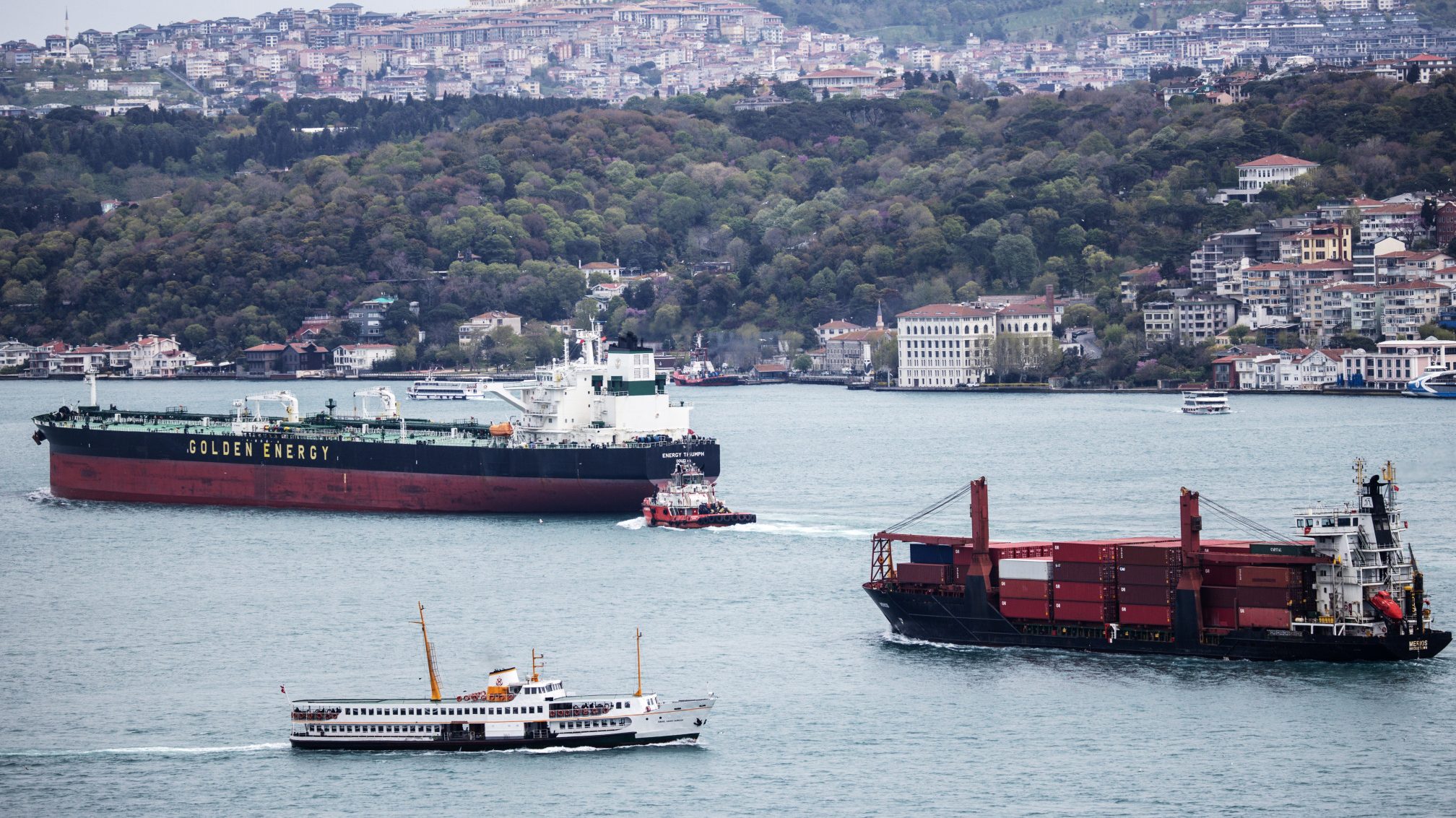
Nearly six centuries later, the ships still come, around a hundred a day and every one still passes beneath these walls. When the cloud broke, one slid past shockingly enormous. Black hull above, red below, she was riding high and on her bow, in clean white letters: DENALI SOVEREIGN.
Suggested Reading

Should we all start calling Turkey Türkiye?
The name was barely a month old. Until September she was the Maisha, a 24-year-old crude tanker now flagged to Equatorial Guinea and sanctioned by Britain, the EU and five other governments for carrying Russian oil with its tracking signal switched off. Empty and northbound, she was most likely going to load Russian crude.
Despite the sanctions, the 1936 Montreux Convention guarantees merchant ships free passage through the straits in peacetime and Turkey doesn’t enforce western sanctions. There is no Boğazkesen now, only a pilot, a radio channel and a request for insurance papers. The fishermen didn’t look up, these tankers have become part of the scenery. But the rest of the world is only now being reminded how much of its oil depends on narrow straits, just like this one.
In the Persian Gulf, before the war started, more than 21 million barrels of oil and petroleum products passed through the Strait of Hormuz each day. By the second quarter of this year, that had fallen by almost 77%.
When Hormuz turned dangerous, Saudi Arabia pumped crude west along its 745 mile pipeline on the Red Sea. Traffic through Bab el-Mandeb, the 18 mile “gate of tears” between Yemen and the Horn of Africa, rose by 50% between late last year and the middle of this year. Then the Houthis swept down Yemen’s coast, took ground around the strait and Perim Island inside it, disrupted the pipeline and fired missiles and drones towards Saudi.
Suggested Reading
Excuse me Odyssey fans, but Troy is in Turkey, not Greece
Neither the Houthis nor Iran needs to stop shipping altogether. They need only make the journey dangerous enough that insurance costs soar, crews become reluctant to sail and owners decide the risk is no longer worth it. The price of controlling these narrow passages is no longer extracted with cannon from a fortress, but in higher freight costs, longer journeys and, eventually, the price of diesel at a British forecourt.
Back on the Bosphorus, the fishermen barely glanced up as another tanker slipped past the fortress and continued north towards the Black Sea. Nearly six centuries after Mehmed built Rumeli Hisarı to control the ships passing below, many things about global trade have changed. And yet the geography on which it depends has not.