
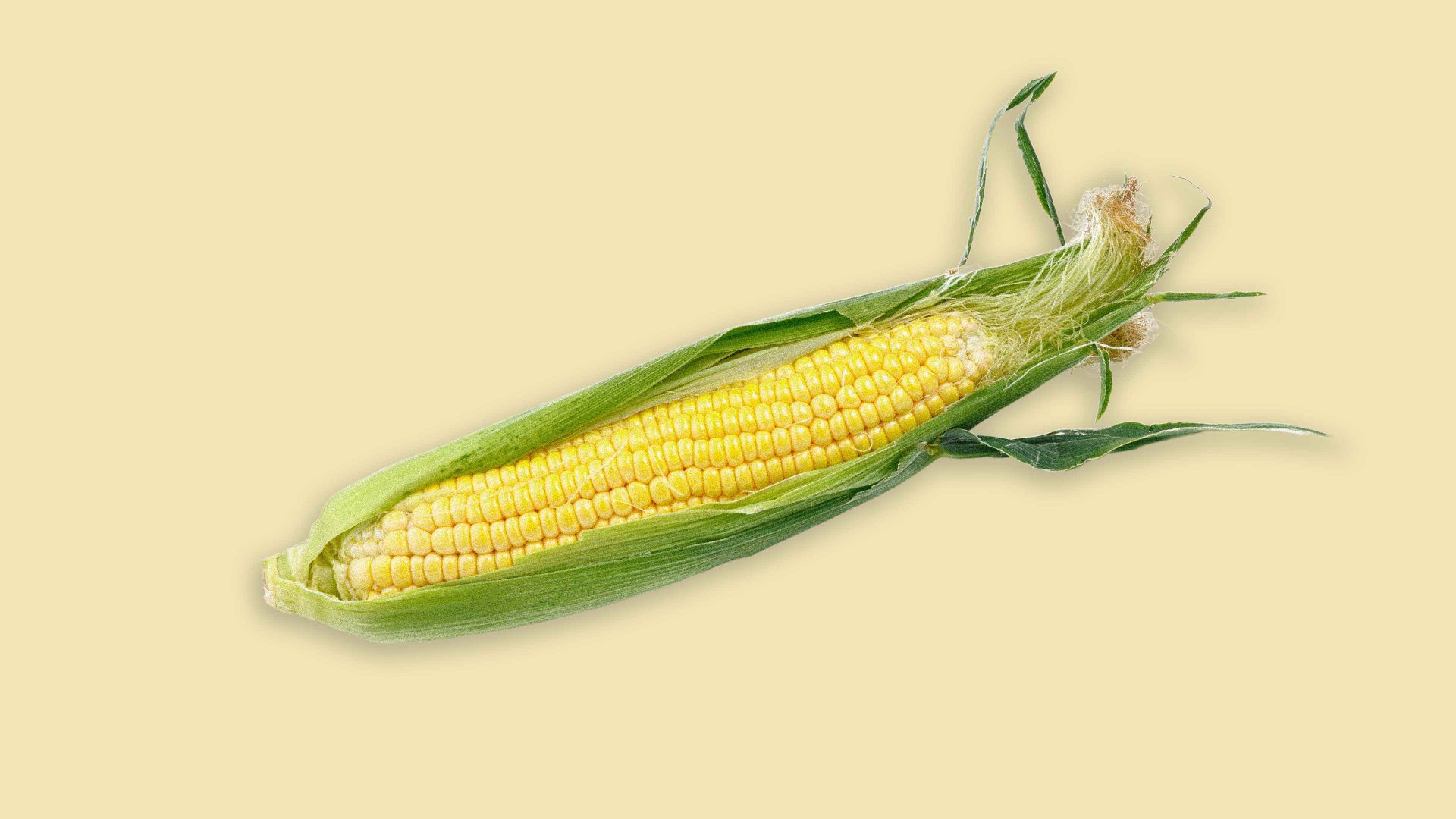
It seems obvious why an ear of corn goes by that name: the top of a stalk of wheat does bear a resemblance to an ear, if not necessarily a human one, then perhaps that of a small furry animal such as a mouse or rabbit. But this is in fact an incorrect inference. Etymology tells us that there is no linguistic connection between the English word for an ear of grain and any mammalian organ of hearing.
Ear, referring to corn, came down into English from the Ancient Germanic form *akhuz, originally from the Indo-European root –ak “to be sharp, rise (out) to a point, pierce”, while ear referring to the organ of hearing is from Ancient Germanic *auzon, from Indo-European *ous “ear”.
(Linguists use asterisks in this way to signal that, although we have no written evidence for the particular form in question, it has nevertheless been confidently reconstructed by philologists by comparing forms from later language stages for which we do have evidence.)
Similarly, the English word font also has two entirely different meanings – or perhaps the right way to look at it is that English has two different words, font, which happen to be pronounced and spelt in the same way.
The most common meanings of font today are: first, the receptacle in a church for the water used in christenings, and metaphorically the origin, cause, or “fountainhead” of particular ideas and principles; secondly, a set of type of a particular size, weight, and style forming part of a printing type family.
The different meanings of font derive, unsurprisingly, from distinct sources. For the senses involving water, it is the Classical Latin word fons (genitive fontis) meaning “spring, well, source of a river, source, origin”. The printing term font, which traditionally was fount in Britain, comes from the Latin verb fundere, meant “to melt, cast, or pour out”; in the early days of the printing press, letters were cast from molten metal.
In a converse sort of way, the etymological approach also tells us that the two English words mettle and metal, which look like entirely different words and certainly have distinct meanings, are really one and the same – or, to be more precise, they were formerly the same word, as they share a common etymology. The Anglo-Norman and Old French word metal was derived from the Classical Latin form metallum “mine, quarry, substance obtained by mining”, from Greek metallon, and has given us both metal and mettle.
These two different spellings of the word were used interchangeably in earlier stages of English, including in the writings of Shakespeare. They were used both in the literal sense “a hard, shiny, malleable material of the kind originally represented by gold, silver, copper, etc. especially as used in the manufacture of objects, artefacts, and utensils”, as well as in the figurative sense of “a person’s character, disposition, or temperament; the ‘stuff’ of which one is made, regarded as an indication of one’s character’’.
The meanings started diverging in the early 1700s, with mettle gradually being used for the figurative sense, and metal for the literal sense. We now mostly consider them to be two entirely different words, meriting separate dictionary entries.
Nowadays, mettle is most commonly used in phrases such as “show your mettle”, meaning to prove your courage, strength, or determination, especially in difficult or challenging situations.

Copper
The word copper comes from late Old English coper, which descended from Proto-Germanic *kupar via Late Latin cuprum, which is a contraction of the Latin Cyprium via Greek Kyprios “Cyprus”, the Mediterranean island where copper was originally mined.