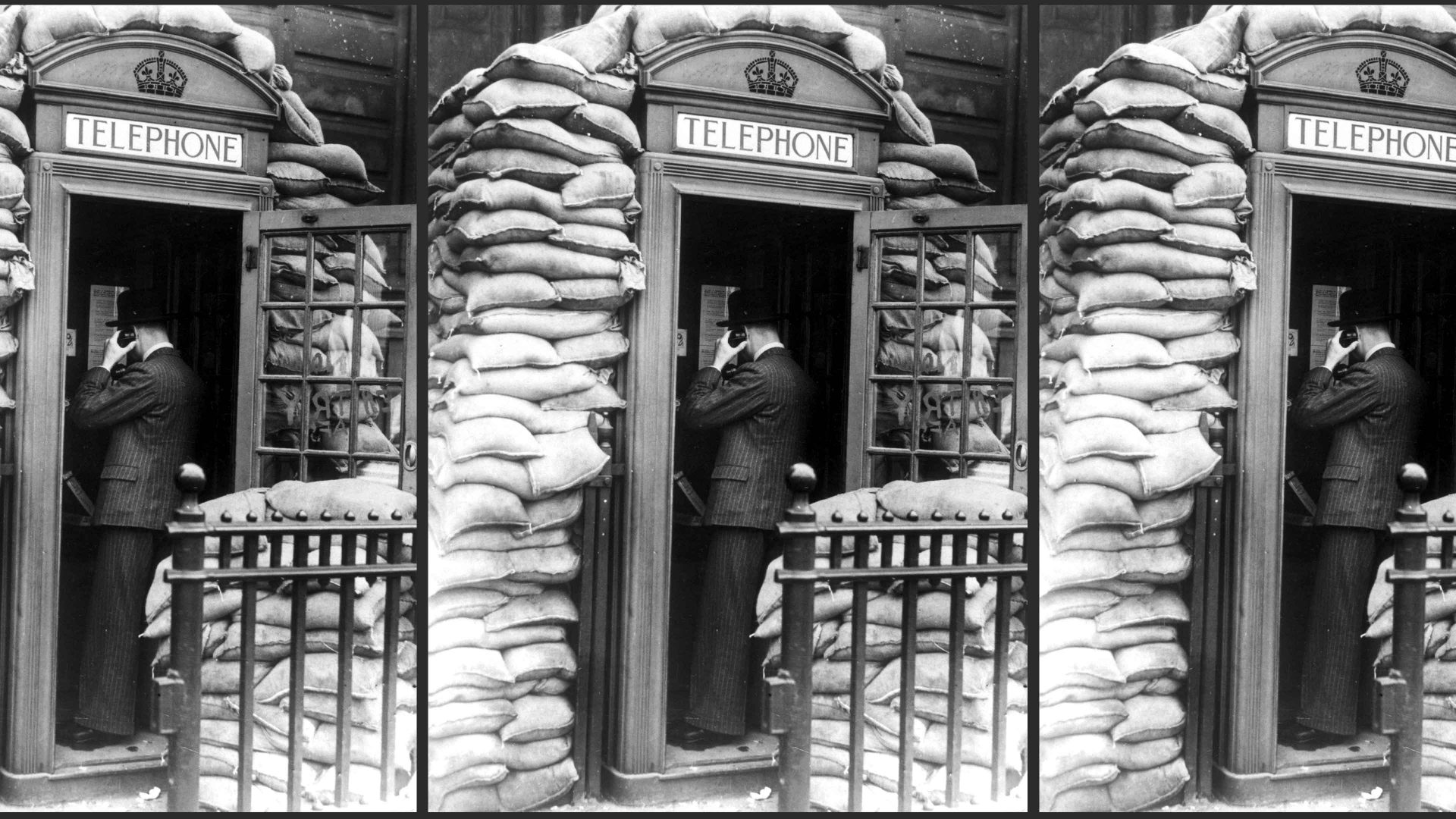
On September 4, 1939, minutes after Neville Chamberlain declared war on Germany, a civil servant called Ronald Wells dashed to the basement of the Home Office to send out dozens of telegrams bearing the codeword: “Acid”. It was the instruction to local police chiefs to close all cinemas. He had already ordered censorship of all letters posted, and all telegrams, the day before.
Wells had been working on the Home Office “War Book” since 1935: a detailed set of instructions to police, fire and prison authorities on what to do in wartime, which had been maintained continuously by the British state since 1911. Alongside these draconian instructions came emergency powers: parliament voted to give the executive the right to rule by decree, with almost no judicial oversight. Some 377 such decrees – known as Defence Regulations – were issued during the war, severely limiting freedom of speech, movement, the right to strike and even to trial by jury.
Today we have no War Book, though the chief of the defence staff Sir Richard Knighton revealed this month that the government is working on one. And though we have the Civil Contingencies Act, its powers have never been used since it was passed in 2004. Nor, more importantly, does any civil servant, judge, MP or citizen have any memory of what it’s like to operate what legal scholars call a “state of exception”.
So as the government prepares its Defence Readiness bill, set for parliament in 2027, it faces an unenviable task: to design a wartime state, write an instruction manual for it, and convince the public that passing powers “in reserve” today is a vital investment in case the country is attacked in future.
In 1939 the emergency powers cleared the Commons with just four votes against – from pacifist Labour MPs. Today there are MPs in parliament who despise our democracy and inhabit milieux awash with foreign crypto-currency. With a splintered society and fractious politics, the legitimate debates around the Defence Readiness bill are bound to attract foreign interference and disinformation.
Suggested Reading
Yes, AI can make our lives better. Here’s how
So it is vital we get this right. The principle behind designing wartime powers in peacetime is simple: we need the “exception” to follow the rules laid down under the norm. If we are – as in 1939 – to give the government powers to intern enemy nationals without trial, or censor the media, they must be clearly understood as temporary exceptions, placed under constant parliamentary scrutiny, revocable by MPs and certain to be reversed once the danger is over.
The alternative is to let the government of the day, on the eve of any attack, make it all up from scratch. Put bluntly, I would rather these powers were designed with Lord Hermer as attorney general, rather than under a coalition of Nigel Farage and Kemi Badenoch.
It’s clear from Sky’s The War Game podcasts that the problems we would face in wartime are vastly different from those faced by Wells’s generation.
First, there might never be a “last days of peace” period of the kind that Wells’s memoir describes. Russia and China practise hybrid warfare – a mixture of sabotage, including by crooks paid through the gig economy, disinformation, pressure and unattributable attacks just below the threshold of warfare, such as severing the cables and pipelines on which our island country depends.
Second, there is cognitive warfare. This is a new discipline, pursued by both China and Russia, in which a mixture of technology, psychological pressure and the continuous stoking of division and uncertainty aim to shatter our willingness to resist. When you hear Tommy Robinson supporters say “I won’t fight for this country” – because it’s full of Muslims and migrants, or “the real war is here”, you are seeing the results of Russian cognitive warfare, not just British racism.
Suggested Reading


The Iran war has taught Australia a new, brutal truth about itself
In response, the state needs better tools, institutions and permissions to fight back. In peacetime, in a democratic state, it is unthinkable for the British “deep state” to carry out operations such as this. In wartime it would be obligatory – to name and shame those spreading pro-Russian narratives, disrupt their ability to do so, and spread our own divisive narratives into the enemy’s society.
In September 1939 this was not a huge problem: there were fascists who supported Hitler, but their newspapers were banned and their leaders interned; the Communist Party – until it received orders to the contrary – actually supported the war. And the government could control the means of production and distribution of information – not just of newspapers and the radio, but even the telegram system.
Today, with digital networks, there are just two options: shut them down, as Iran has done during the present war, or institute a diluted version of the internet controls that China uses – to filter posts using keywords and ban the virtual private networks people use to get around the filters.
Do I trust the British state to get this right? Not without democratic oversight and advance design. Which is, again, why I’ve authored a detailed report* on the challenges, with colleagues at the University of Exeter.
Third, there is the question of critical national infrastructure. Most of our energy, water, rail, data centres and communications cables are privately owned. The government can shape their operation through regulation but does not directly command them. In wartime that would need to change: the most critical nodes – power stations and transformers, water treatment plants and landing points for data cables – would need to be guarded by something more lethal than the Dad’s Army of the second world war. Government would need powers to command these private companies to put national survival before profits.
Most emergency planning in the UK is done around local resilience forums, where council leaders, police and fire chiefs meet to coordinate plans for floods, pandemics and the like. Everyone in this domain understands that, in times of crisis, they might call the army in to evacuate flooded areas, or build Nightingale hospitals and staff vaccination centres.
Suggested Reading
The truth about Trump’s Iran downfall? The worst is yet to come
Few, however, understand that the process can happen in reverse, where the armed forces, together with thousands of reservists, have to fight, and where the protection of power stations and the like might have to be done by people with minimal training and experience.
If you are wincing at the prospect of having to do this, so am I. But by studying both British history and the practice of states like Ukraine, which are four years into dealing with these problems for real, I’ve become convinced we have to face them now, while we still have time.
Wells, who saw his War Book partly activated during the Munich Crisis of September 1938, drew a stark conclusion: any idea that you can just hand civil servants, police and local councils a secret manual and tell them to get on with it is false. As they dusted off their telegrams and instructions, Wells’s colleagues realised they had no idea of the cascading inter-dependencies of their orders. That means, in a complex society like ours, large numbers of people need to know what they would do if Britain or a Nato ally were attacked.
Both the Swedish and Taiwanese governments issue detailed printed pamphlets to every household about stockpiling food and water, having a grab-bag handy, knowing the phone numbers of their neighbours, and where they would shelter in an attack. They are told to form close local neighbourhood networks, to help each other during a crisis.
So far, despite the rising tension in the world, no British government has gone beyond advising people to have a week’s worth of food in the cupboard. That needs to change.
On the first day of the war, after listening to Chamberlain’s historic broadcast, Wells laid down on the bed in his office and sobbed. Chamberlain had been trying to stop the war, he wrote, “while I had been trying, to the best of my powers, to prevent us entering one in a state of muddle”. Wells’s modern equivalents will necessarily be devising their plans in secret. But it is for us, and the MPs representing us, to make sure any muddles remain minimal, and that any powers taken are reversible.
* Search: Paul Mason, Exeter University, wartime state