From now on, we must learn to think only about the effects of Donald Trump’s behaviour – not cause, intent, or reasoning. The more we try to fathom what he is trying to achieve, the more it will fry our brains. Because, as the Iran fiasco shows, he is at root simply a chaos engine.
After six weeks of war against Iran, Trump has achieved a spectacular strategic failure. This is not the same as defeat, but it sure ain’t victory.
The Iranian regime has shown that it can endure everything the US military can throw at it, and that it can also maintain the capability to strike back. It has turned its control of the Strait of Hormuz into the equivalent of a nuclear deterrent.
It has forced the US to initiate a ceasefire in which – according to Trump himself – the UN Convention on the Law of the Sea, which guarantees the right of transit through the Strait, might be overridden in a money-spinning deal between Washington and Tehran.
Or maybe not. As I write, America is set to begin its own blockade of the Strait, aimed at pressuring China to force Iran to reopen the world’s most important waterway. Maybe this was in the plan all along. But I doubt it.
If we list the ever-changing US goals during operation Epic Fury, only one of them – the destruction of the Iranian navy – has been achieved. The nuclear programme is degraded but not destroyed; the missile stockpile may be less than half depleted; and Iran’s terrorist proxies are operating unrestrained in Iraq, Gaza, Lebanon and Yemen.
To cap off these achievements Trump sent his vice president to Hungary, to echo Kremlin talking points in support of the doomed strongman Victor Orbán, and threatened once again to annexe Greenland. But Orbán crashed and burned and, again at the time of writing, Greenland is still under Danish sovereignty.
At some stage, European leaders and their electorates have to recognise that we’re not dealing simply with an unreliable ally here: the US under Trump has begun to act systematically against our interests.
I am certain Trump will lose control of both houses come November, but that’s scant consolation – because he is already ruling by decree domestically, and has the power to screw up Western collective security so badly that we are left open to an opportunist attack by Russia, whose simple and logical aim would be to demonstrate that the North Atlantic Treaty is a dead letter.
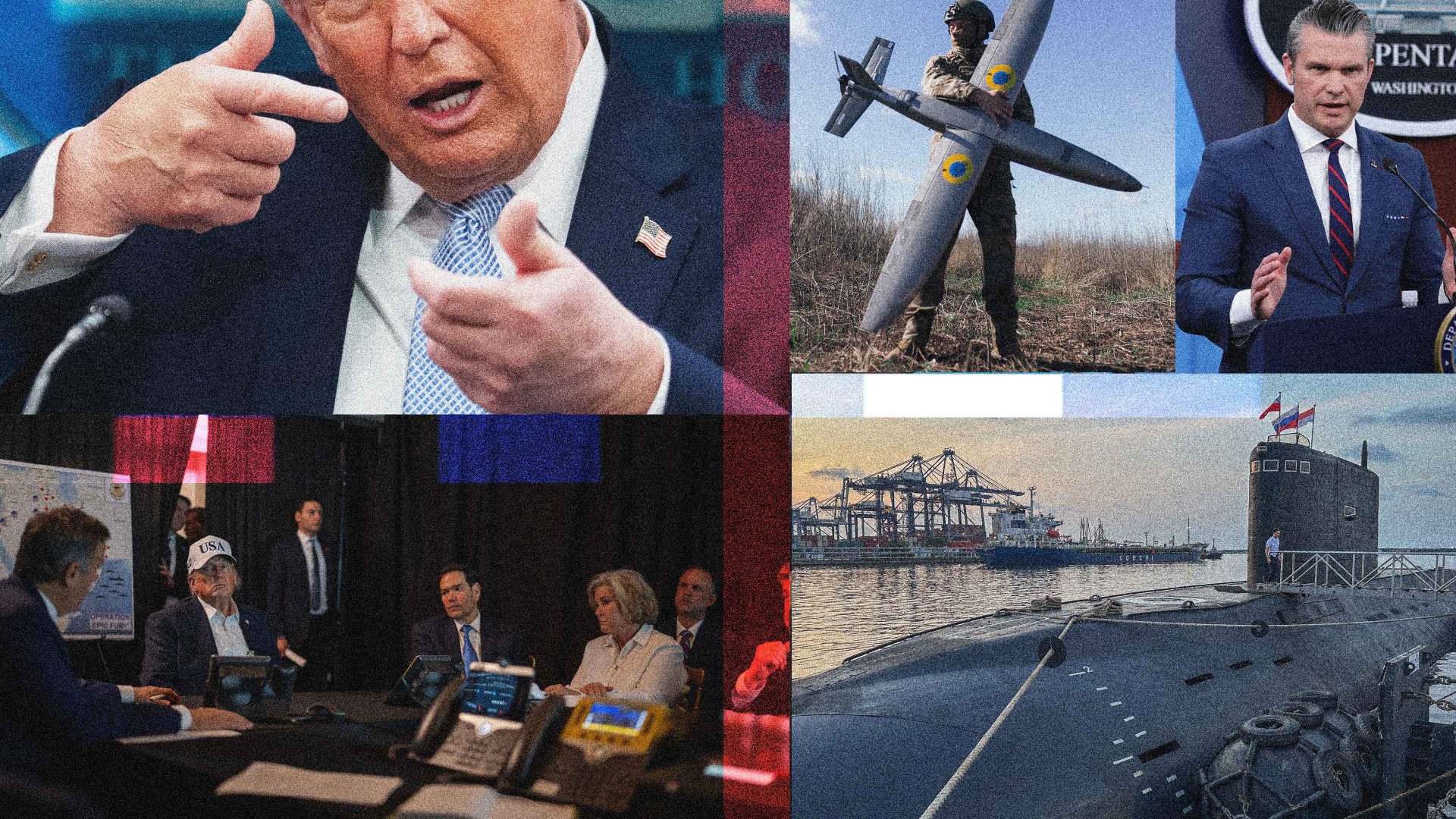
It is clear from reporting in the New York Times that Trump went to war with Iran because Benjamin Netanyahu fooled him into accepting a plan that could not work. Surrounded by spineless sycophants, even those in the situation room who knew it would fail shrugged and left the final call to Trump.
Trump is said to have laughed off the possibility of the Strait being closed. He failed either to warn or prepare Gulf allies for the retaliatory strikes they’ve suffered. And if he’s really unlucky, the entire petrodollar economy will be replaced by one centred on the Chinese renminbi.
We are facing a phenomenon that seems strange to contemporary political science but very familiar to historians: a large state run by stupid people, surrounded by clever sycophants, steering towards disaster.
Stalin’s politburo on the eve of Operation Barbarossa, or Hitler’s bunker scene in Downfall spring to mind: teams led by poorly educated braggarts and narcissists, making up facts to fulfil fantasies, with devastating effect.
It may be too soon to fully assess the damage Trump’s failure in the Gulf will cause, but let’s list what’s obvious.
Iran – whose proxies launched the genocidal attack on Israel on 7 October 2023, and whose regime just murdered tens of thousands of oppositionists – has achieved the right to sit, face-to-face with US negotiators for 21 hours, in Islamabad, and to decide the future of the Gulf. Those negotiations determined not just whether ships will transit, but whether the fragile monarchic economies can survive in their present form.
China, by proxy, was also at the table in Islamabad. The same was true of Russia. Although it had no representative at the talks, its targeting intelligence allowed Iran to hit strategically important US radar systems, and destroy an American AWACS aircraft on the ground.
Out of the room was the rest of the West, which Trump now disparagingly calls “NATO”. He no longer speaks of NATO as an alliance the US is part of, but as a treacherous third party.
If you think Vladimir Putin or Xi Jinping somehow has not noticed this, prepare to be shocked by what happens next. Because Iran just demonstrated one of the geostrategic truths of 21st century warfare. Cheap, long-range, precision guided missiles can close any chokepoint in the world – obviating the need for navies.
Unless you are prepared to invade the coast and hold it, the revolution in missile and guidance technologies leaves the initiative with the defender in every one of the world’s maritime bottlenecks. And Trump’s blockade gambit creates the perfect legal precedent for China to do likewise in the Taiwan Strait, and Russia in the emergent sea route across the Arctic.
Suggested Reading

Dear progressives, stop being wimpish on Trump
Having shown the limitations of the US military machine, and expended a decade’s worth of interceptor missiles – each of which costs on average four times the projectile it is designed to stop – Trump has sent an open invitation to aggressors everywhere to have a go themselves.
It is ironic that, for a man with so little cognitive ability, Trump is able to achieve such massively destabilising cognitive effects.
Both Russia and China maintain psychological warfare agencies whose entire purpose is to “manipulate the enemy’s cognition”. Their aim is to disintegrate our collective ability to process reality, both at the level of high politics, military decision making and mass consciousness. On all readings of the past six weeks, Trump has aided and abetted that.
He has forced allies into silence over gross breaches of international legal principle. Not a single NATO government has been prepared to characterise his threat to wipe out Iranian civilisation as criminal. No NATO country publicly contradicted his claim to have destroyed the Iranian nuclear programme last year.
Though they have sidled away from Trump’s Board of Peace as if from a dungheap, no western leader has been prepared to call it what it is: a scam, incapable of bringing either peace or justice to the Middle East, but designed to enrich its authoritarian members.
We need to recognise what this self-imposed dumb-show is doing to our politics. Democracies whose politicians cannot speak plainly about the wrongdoing, stupidity, folly and cruelty of their allies degrade themselves and undermine their own security.
For, as the NATO chief scientist Steen Søndergaard wrote in a landmark report last December, the West is locked in a battle for “cognitive superiority”. The adversary is trying to disorient the state, destabilise and polarise society, and reduce individuals to a state of helplessness and confusion.
Politicians who cannot narrate cannot govern effectively. So to see NATO’s boss Mark Rutte, and Keir Starmer here, repeatedly avoid criticizing either the outcome of the conflict or the criminal statements of Trump himself is not sustainable.
There is only one strong argument coming out of accounts of how America made the decision for war – and it was put by Pete Hegseth, who said: since we will have to “take care of the Iranians eventually, we might as well do it now”.
This is a rationale straight out of Clausewitz, the 19th century strategist whose book On War remains a bible for Western military thinkers. But there’s one telling problem: for Clausewitz, the advice to attack sooner rather than later was aimed at small states whose adversaries were only going to get stronger.
If we take Hegseth’s argument to its logical conclusion, the geostrategic issue becomes clear: Iran could attack Israel, stage provocations in Lebanon and the Red Sea, and build a stockpile of up to 20,000 missiles because its ultimate sponsor, China, refuses to restrain the regime.
America’s hawks and isolationists, who’ve been lecturing Europeans about how they’re quitting Europe and the Middle East to focus on the Chinese threat, just got taught a lesson in the global character of the challenge. What’s more, if international shipping companies are now forced to pay Tehran for passage through the Strait, it won’t matter whether they pay in dollars or renminbi. The power shift away from the US will be palpable.
Whether the ceasefire holds or fails, the UK government must take action to mitigate the impact of a prolonged oil price and supply shock in Britain. We must rapidly rearm – using the lessons emerging from both the Gulf and Ukraine to replace stuff that no longer looks necessary with stuff that is now mandatory: cheap missile defence, autonomous minesweepers and above all satellites. Because satellites give you the ability to do everything from targeting an enemy to letting opposition movements communicate. Right now there are 763 UK owned objects in space, but only five military satellites, each of which was launched by a foreign country.
Keir Starmer was right to keep Britain out of the war. But he cannot keep us out of its chaotic denouement and aftermath. Reopening the Strait by force is off the agenda – not just because of the military difficulty but because Russia and China seized the first opportunity to veto a UN resolution that could have justified that task.
Finally, to state the obvious, we must wean ourselves off fossil fuels fast. I am not averse, in the coming months, to a temporary switch-on of any gas and oil that can be quickly pumped out of the North Sea. But that cannot be the substitute for a strategic move to wind, solar and nuclear power.
In a century where China is rising, America is a chaotic and untrustworthy ally, and Russian submarines are probing our vital energy pipelines, those vast arrays of offshore wind, and the pylons that transport the power they produce – all built in the teeth of opposition from Britain’s far right – are our best insurance policy.
Paul Mason’s new book Reds: A Global History of Communism is published on August 27