
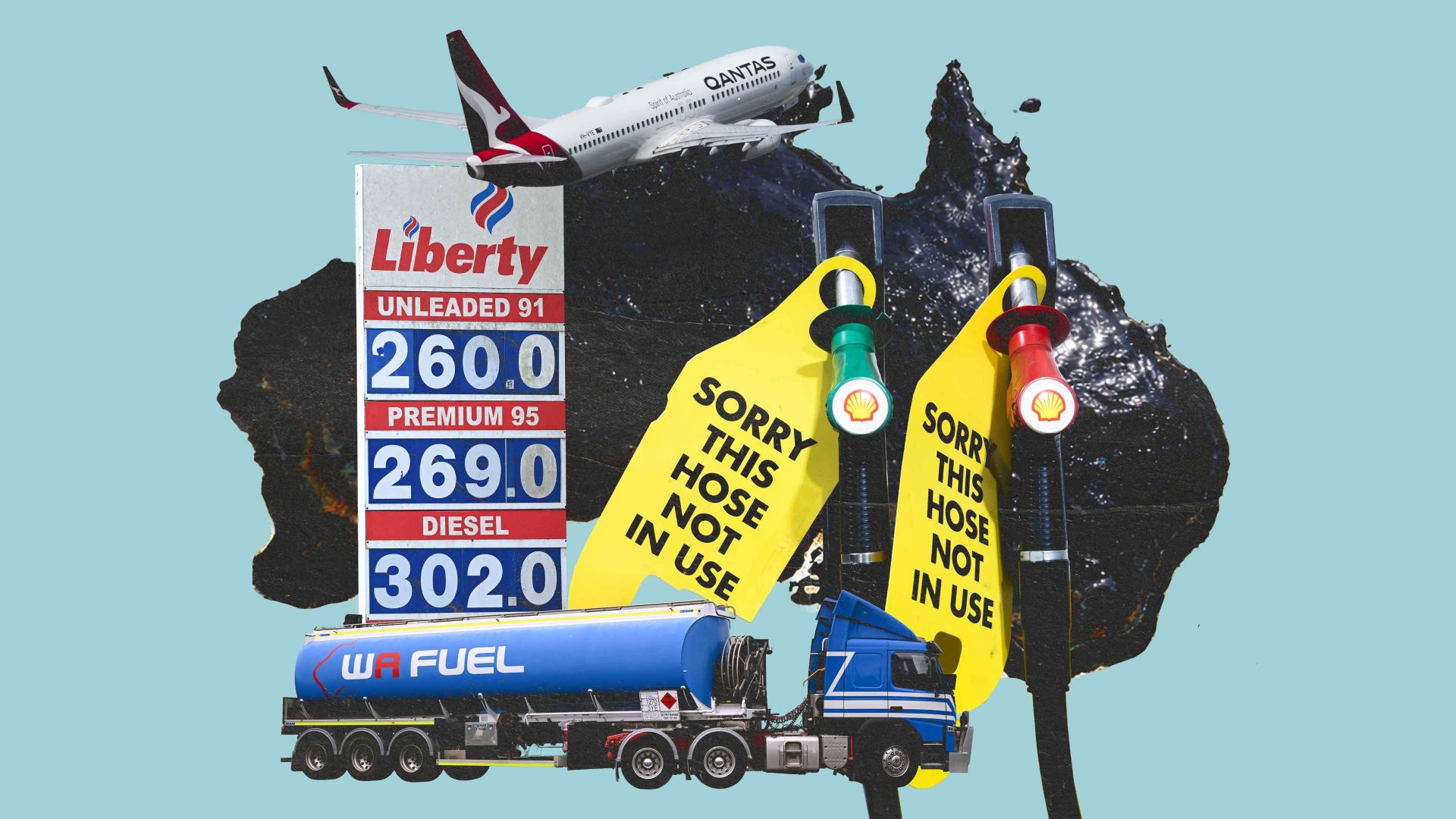
Australia is a land crisscrossed by asphalt arteries, roads that bind together far-flung, isolated communities. What runs through them is diesel – powering trucks, farms and the far edges of the grid. When that flow falters, the country feels it fast. That moment has arrived.
A fire at a key regional refinery – one of only two remaining on the continent – has caused fresh alarm about fuel supplies, compounding the shock triggered by war in the Gulf and exposing just how little fuel buffer Australia has left.
Prime minister Anthony Albanese, who only weeks ago warned that “the months ahead may not be easy,” has been in Asia trying to secure fuel supplies, moving with an urgency that reflects a government racing events rather than managing them.
He returned to inspect the smouldering Viva Energy refinery outside Melbourne as Energy Minister Chris Bowen described the blaze as an untimely “set back”.
Emergency shipments from Brunei and South Korea of more than 100m litres of diesel, are now being rushed in to shore up supply.
The oil shock triggered by Donald Trump’s assault on Iran and the effective closure of the Strait of Hormuz arrived on Australia’s shores with unusual speed. Australia imports up to 90% of its fuel. Within weeks, prices surged, supply tightened, and some petrol stations began running dry.
The price of diesel jumped more than 60% in the first three weeks of the war. As farmers prepared to sow winter crops, fertiliser costs rose by more than 70%, compounding the shock across the agricultural sector. Food prices are expected to follow.
The effects are not abstract. They are measured in the distances that define Australia.
Out on the highways, the vast army of “grey nomads” – millennials and retirees who criss-cross the continent in caravans and campervans – are already adjusting. Trips are shorter, routes tighter, budgets blown out. A journey that a year ago cost a few thousand dollars is now more than double that, forcing travellers to stay longer in fewer places or abandon plans altogether.
It is not just a lifestyle story. The nomads are an economic system on wheels, carrying cash into small rural towns that depend on them. When they stop moving, those places feel it first.
Further out, the numbers become starker. Diesel has pushed past $3 a litre across much of regional Australia, and far higher in remote communities. At the loneliest roadhouses, it is already over $4.
Shane and Tracey Collins, from Victoria, cancelled plans to drive north to Darwin and the Kimberley – along with accommodation booked months in advance – largely due to fuel costs and availability. Mark and Cherile Haigh abandoned a four-month trip across the Nullarbor when fuel estimates blew out from $5,000 to more than $13,000.
Suggested Reading


How the Aussie media got Harry and Meghan’s visit all wrong
This is what an oil shock looks like in a country built on the long haul.
As I planned my move back to Australia – a process that took more than six months as my cat navigated the maze of phytosanitary checks and veterinary clearances – I joked about Nevil Shute’s On the Beach, the Cold War novel imagining Australia as the last refuge at the end of the world.
Now that I am back, the joke lands a little differently.
Australia is not insulated. It is acutely exposed to the fragility of global energy routes. What once looked like distance as protection now reads as risk.
This is not simply a spike in fuel prices. It is a structural vulnerability laid bare.
Over decades, Australia has shut down most of its refining capacity and opted for a model based on imports. When those routes falter, the shock is immediate.
A war launched in Washington has translated, within weeks, into a supply shock that Canberra can do little to manage. If this feels sudden, it is only because the vulnerability has been ignored for so long.
Australia dismantled its refineries because fuel is cheaper when it arrives from elsewhere – until it doesn’t. Today, Australia holds only a fraction of the strategic fuel reserves recommended by the International Energy Agency, with some stored offshore in the United States, which makes clear how far energy security has been outsourced.
In normal times, this arrangement is invisible. Tankers move, markets function, and distance looks like insulation. In disruption, distance becomes exposure.
When shipping lanes tighten through the Strait of Hormuz, Australia is not first in the queue. Cargoes are diverted, insurance costs surge, transit times stretch. What was a just-in-time supply chain starts to fray, along with the assumption that fuel will always be available.
And as the farmers must decide whether to plant and supermarkets adjust their prices, what begins as an oil shock becomes a cost-of-living crisis.
For Canberra, the questions are no longer theoretical. Should a continental-sized country import almost all of its fuel? How does it balance a US alliance that can trigger global shocks with an economic dependence on Asia that requires stability?
For years, energy security has been approached as a technical problem, to be solved with stockpiles, new infrastructure, new regulation. This moment reveals the issue as fundamentally strategic and exposes a deeper assumption that has underpinned policy for a generation: that the global system would remain open, markets would self-correct any disruption, and allies would guarantee stability. Australia’s prosperity depends on stability in the Gulf; its security rests with an America now willing to unsettle it.
Canberra has never looked so exposed.
Lynne O’Donnell is associate editor, The New World