This September, the Kremlin branded Andrey Zvyagintsev a “foreign agent”. Labelling Russia’s pre-eminent film-maker an “enemy of the state” is the sort of despotic reaction we’ve come to expect from a paranoid, repressive regime.
His “crime”? To criticise the Ukraine war as he was accepting the Grand Prix for Minotaur at Cannes this year.
Many dissidents worth their salt are now “foreign agents” in Vladimir Putin’s eyes – so for Zvyagintsev’s fans, the Kremlin’s sanction is almost a badge of honour, another accolade for this Oscar-tipped director and screenwriter.
Zvyagintsev was living in exile before 2022 – the year Putin launched his “special military operation” – having been hospitalised in Germany with a severe case of long Covid that left him paralysed. He now resides in France. Given the distance and safety of exile, you would expect his first film since 2017 to pull no punches in its attack on Putinism.
Yet you’d be mistaken to want anything as on-the-nose as anti-war grandstanding in Zvyagintsev’s new film. Minotaur, a largely French production shot on location in Latvia, doesn’t make a song and dance of its critique of the Ukraine war. Absent are any noble speeches, acts of self-sacrifice or mass street protests. That isn’t Zvyagintsev’s style.
Suggested Reading
The frontline of our war with Putin is the phone in your pocket
In his previous films Elena (2011), Leviathan (2014) and Loveless (2017), the Russian auteur judiciously skirted direct attacks on Putin, focusing instead on sideswipes at corruption, greed and family dysfunction in modern-day Russia; subtle critiques fine-tuned to pass under the radar of state censors.
Whether Zvyagintsev was simply accustomed to keeping his head down or because he has made a trademark of his muted, matter-of-fact aesthetic, the anti-war barbs in Minotaur are done quietly, slyly smuggled on to the screen, often eliciting no reaction from its characters.
Early on, we get the briefest glimpse of a car daubed with a “Z”, the post-2022 symbol of “patriotic” support for Russia’s military. A little later, a woman views footage of explosions in Ukraine on her computer; then, as war panic seeps into people’s lives, the staff of a logistics company watch the news on a colleague’s smartphone – this time of the exodus of tens of thousands of Russians fleeing, in gridlocked cars, across the border to Georgia to escape conscription. One wealthy businessman quips that he’ll fly to Thailand for a few days “until it blows over”.
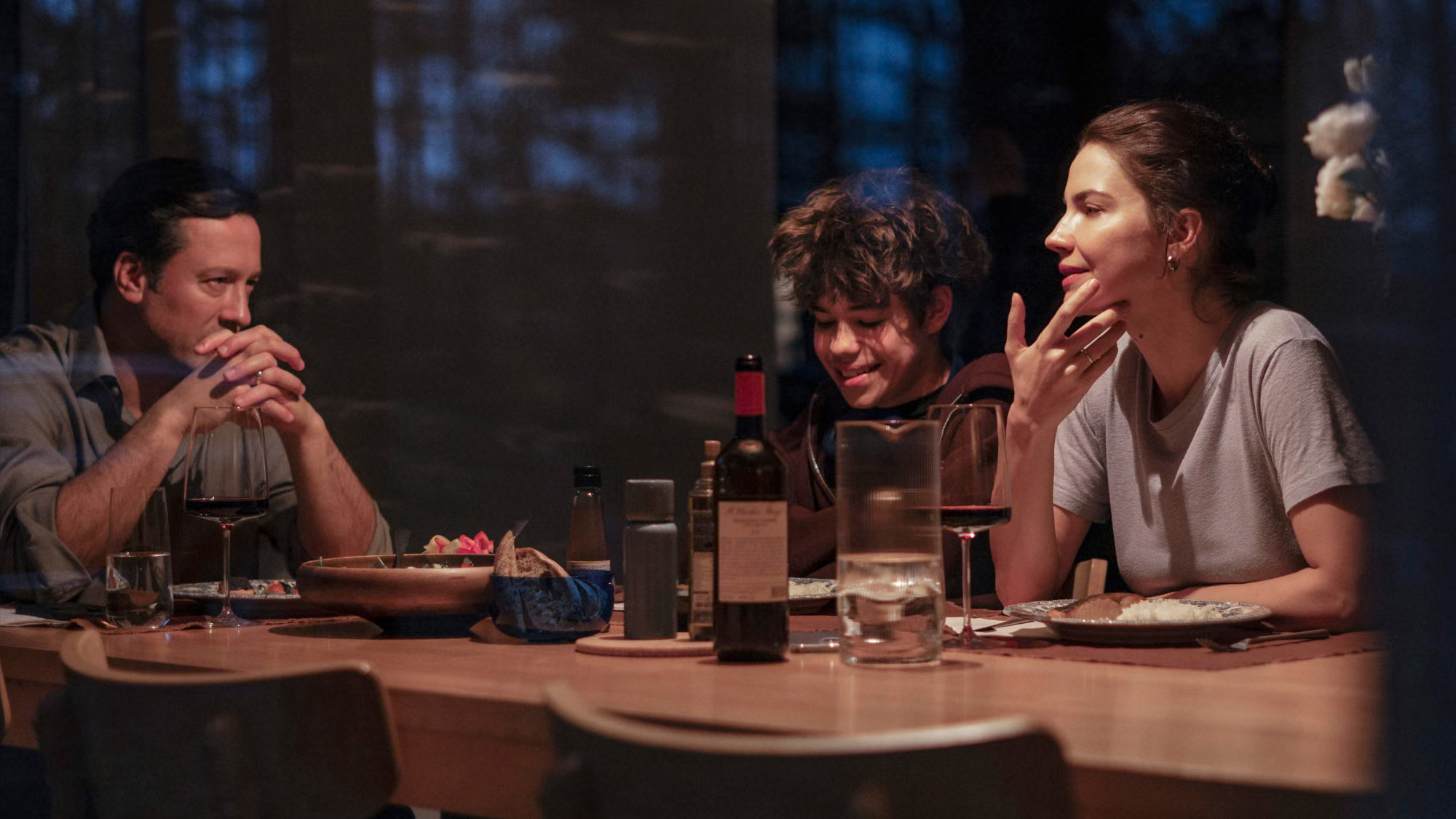
The head honcho of the logistics business is an oligarch-like figure called Gleb (Dmitry Mazurov). He has an architect-commissioned house that wouldn’t look out of place in a Nordic noir: glassy, spacious, all designer furniture and lighting – an image of the “new” capitalist Russia hoped for after the Soviet collapse. Zvyagintsev’s regular cinematographer Mikhail Krichman immerses us in a vision of wealth insulated from the outside world, a spotlight on separateness amid encroaching darkness.
Gleb clearly has wealth – and power too. He wields that power against 14 unsuspecting blokes he hires to occupy phantom jobs, only to pack them off to the feared recruiting officers conscripting troops for the front. Minotaur’s title refers to the sacrifice of 14 victims in the tale of Greek mythology.
Yet Gleb’s wealth is no defence against external forces, from the war threatening his business to the crumbling of his marriage to Galina (Iris Lebedeva). Here, as war looms at the edge of bourgeois lives, Minotaur is a nearly scene-by-scene remake of Claude Chabrol’s 1969 classic La Femme infidèle.
As in Chabrol’s icy thriller, Gleb pays for surveillance of his wife to track down her lover – a bohemian photographer called Anton – then confronts him at the flat where they conduct their thrice-weekly trysts.
Suggested Reading

Putin’s greatest enemy? It’s laughter
One difference, central to Minotaur’s sly commentary on the war, is that Gleb disposes of his private eye by getting him conscripted too – as revealed in a chilling later scene where the hired spy appears on a poster honouring the “eternal glory” of those killed at the front.
Gleb is venal, cynical, ruthless. It’s not hard to see his relationships as a metaphor for Putin’s Russia. The only advice he has for his bullied teenage son Seryozha is, “Threaten to smash his face in”.
Meanwhile, Galina’s bid to escape from Gleb’s shadow manifests itself in her affair with Anton. Gleb deals with this threat to his control over Galina in the only way he knows – the same way Putin responded to Ukraine’s bid for freedom – with violence.
Minotaur is in UK cinemas now.
Paul David Gould is an FT staff journalist whose novel Last Dance at the Discotheque for Deviants is set in 1990s Russia