England’s first World Cup finals game kicks off against Croatia at 9pm on June 17 in Dallas, Texas. Plastic flags of St George are already available at supermarket checkouts. They don’t look remotely biodegradable. Don’t buy them. Sustainability has been suspended and they’re destined for landfill.
Prepare for confusion, though, as lampposts at roundabouts are adorned with them. Who will know whether they’re expressions of anti-immigrant aggression, of football patriotism, or of both? Perhaps Reform UK will get a boost from all this, with the Makerfield by-election taking place the day after the England match. Andy Burnham had better establish a link with the England flag before Nigel Farage and his rabble start claiming it as theirs and theirs alone.
Given the role football plays in so many people’s lives, philosophers haven’t had much to say about it. Most of the traffic has been in the other direction. Liverpool manager Bill Shankly’s comment hasn’t been bettered: “Some people believe football is a matter of life and death. I’m very disappointed with that attitude. I can assure you it is much, much more serious than that.”
Brian Clough, as well as being for a time the best football manager on the planet, was one of the game’s great philosophers. Some of his quips are worthy of Diogenes.
Suggested Reading

Calling it a “tradition” is no defence
On dealing with players who disagreed with him, he explained, “We talk about it for 20 minutes and then we decide that I was right.” After a life-saving operation, he said, “Don’t send me flowers when I’m dead. If you like me, send them while I’m alive.” On playing the long aerial ball: “If God had meant us to play football in the clouds, he’d have put grass up there.” And so on.
For those who prefer a more cryptic approach, Eric Cantona’s “When the seagulls follow the trawler, it is because they think sardines will be thrown into the sea” is still a classic. But I prefer Paul Gascoigne’s paradoxical remark – one worthy of the great baseball manager Yogi Berra: “I never predict anything and I never will.”
Albert Camus was a goalkeeper. He once claimed, “what I know most surely about morality and obligations, I owe to football”. That has raised a few eyebrows.
In the analytic tradition, AJ Ayer was a passionate Spurs fan and a regular at White Hart Lane and did occasionally write about the sport, though not in a philosophical vein. But for most academic philosophers, football and philosophy are separate spheres.
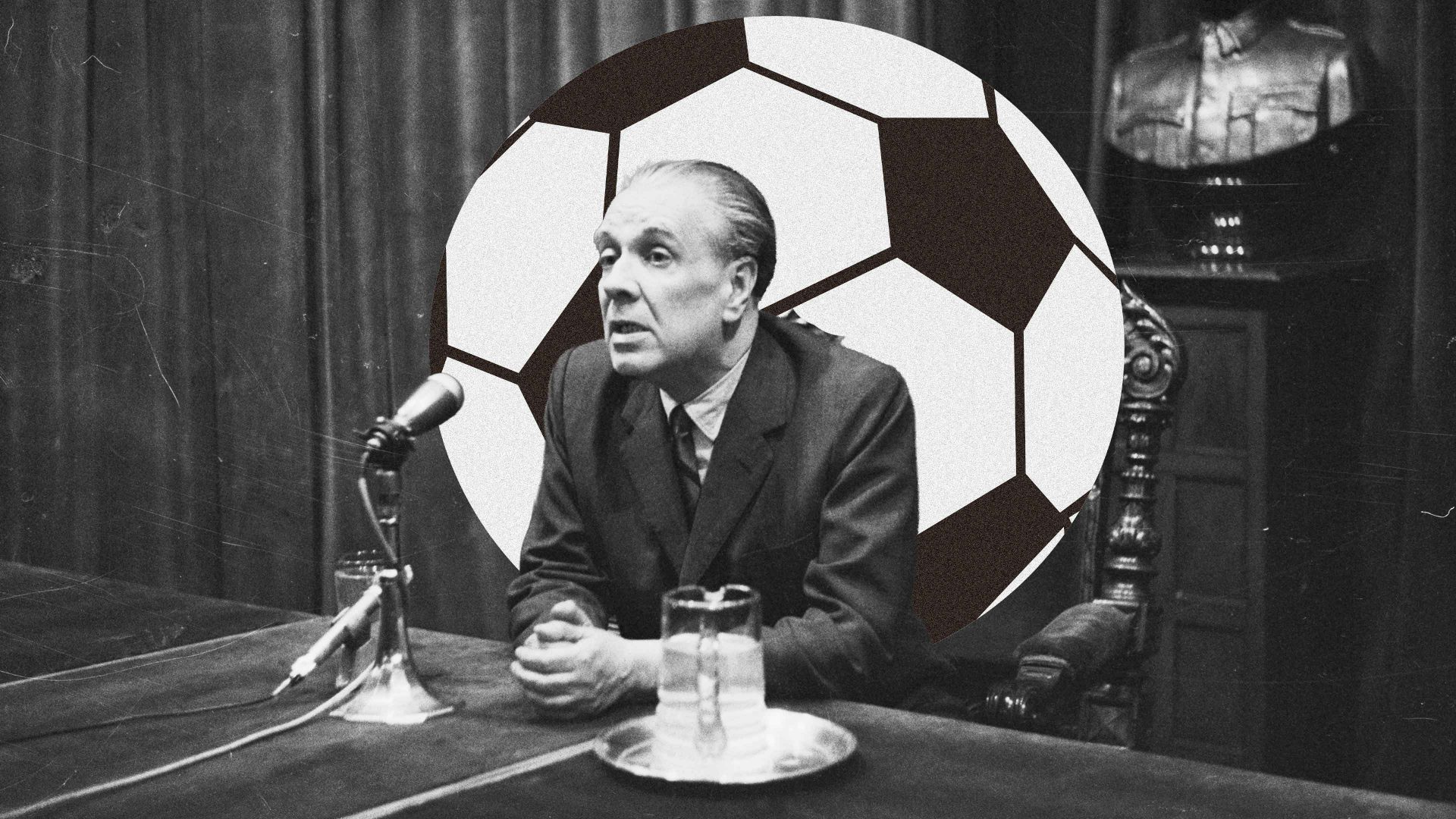
Jorge Luis Borges, the great Argentinian author of philosophical stories, detested the game. That’s never been a common attitude in Argentina or elsewhere. Football is sport’s lingua franca.
Borges, however, suggested that it is only popular because stupidity is popular, and described its invention as “one of England’s greatest crimes”. Bizarrely, he even claimed it was “aesthetically ugly” (and before you say, “How did he know, since he was blind?”, he lost his sight in the second half of his life).
Borges wasn’t simply an intellectual looking down his nose at a predominantly working-class sport. What he hated most about football and football fandom was the focus on supremacy, an attitude which he linked with fascism. When it came to international matches, the fervour that games evoked was terrifying.
“Nationalism,” Borges wrote, “only allows for affirmations, and every doctrine that discards doubt, negation, is a form of fanaticism and stupidity.”
Suggested Reading
My mission to meet all the World Cup final scorers
That’s more a criticism of some nationalistic football fans’ approach than of the game itself. Borges was badly wrong about the aesthetics of soccer – there’s a good reason why it’s known as “the beautiful game”. But on the borderline madness of football crowds, he wasn’t so far from the truth. It’s a cliché but still true that football partisanship and triumphalism easily tips over into tribalism and even violence.
This World Cup, presented as a joyful global celebration of sporting excellence and camaraderie, could live up to the billing. I really hope it does. International football can bring out the best in us as well as the worst.
But there are plenty of authoritarian politicians looking for ways to amplify their delusions of supremacy by associating themselves with the tournament. They want to promote their visions of exclusive nationalism and stir anti-migrant fervour.
I’d like to see England go far, but if that means front-page images of Nigel Farage draped in the flag of St George, I’d rather they didn’t. Worse still, imagine Donald Trump in a MAGA cap holding the World Cup aloft as if he’d won it himself…