
We love cetaceans. Dolphins, porpoises, whales – they’re beautiful, intelligent animals, with a sense of play, and complex social relations. So it’s easy to understand the attempt to save “Timmy” the humpback whale found stranded on a sandbank in the Baltic Sea off Germany in March.
Timmy managed to get free but repeatedly ran aground. People travelled long distances to see and commune with this unfortunate animal. He became front-page news in Germany and beyond. After numerous livestreamed rescue attempts, marine biologists advised against further action. Euthanasia was the only humane solution to end his suffering, which had gone on for two months. Either that or to let him die in peace.
The German public disagreed. The government hadn’t done enough. A privately funded plan costing over £1m took shape and, against the advice of experts, Timmy was pushed on to a water-filled barge and then released. He died shortly afterwards. His bloated carcass with its tracker device attached was washed ashore in Denmark.
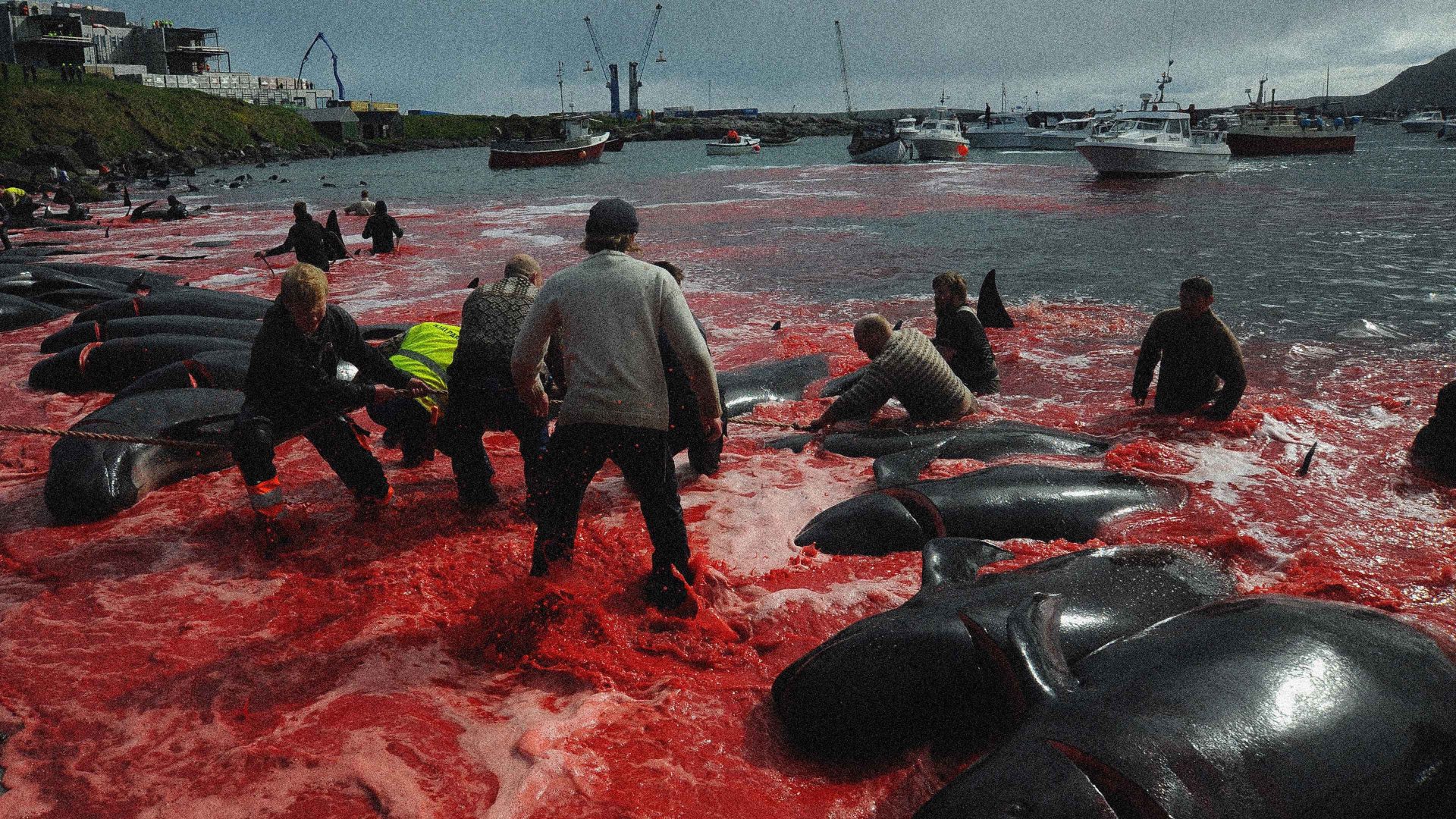
Some people love cetaceans, not just for their beauty or intelligence, but for their blubber. In May in the Faroe Islands, the annual grindadrap or “grind” took place. Timmy got far more press coverage, but according to Sea Shepherd, an organisation that monitors and protects marine life, in a single day last week, around 700 pilot whales (a type of dolphin, despite the name), were surrounded by small boats and forced into shallow bays. The terrified animals were dragged ashore using blunt instruments hooked into their blowholes, or else were butchered in the water using lances and long knives.
The grind is a bloody cultural tradition dating back to the 9th century, one the Faroese don’t want to relinquish. Defenders say it’s an important part of their heritage, compatible with marine conservation, and that the use of lances to sever the spinal cord minimises the suffering.
Suggested Reading


The strange phenomenon of “an agreeable kind of horror”
Is it hypocrisy then for those of us who eat seafood or meat to protest against this practice?
The strongest philosophical arguments about animal welfare are based on the relevance of animal pain to our ethical choices. Jeremy Bentham’s much-quoted line captures this: “The question is not Can they reason? nor Can they talk? but Can they suffer?”
We might reasonably question whether a stick insect or a fly could suffer in a meaningful sense, but there’s no doubt whatsoever that whales and dolphins can and do. They suffer intensely not just from physical damage, but also from psychological terror. It is not anthropomorphism to believe that, it’s good science.
Yet who hasn’t passed a lorry-load of sheep or pigs on a motorway on a hot day on the way to the slaughterhouse, and felt some disgust at their treatment? Aren’t we turning a blind eye to the suffering involved in much of the livestock industry on a far greater scale? Isn’t the Faroe Islands grind just another way that humans cause animal suffering as a by-product of producing meat?
It’s easiest to condemn the grind from the position of ethical veganism. There’s no hypocrisy in refusing to eat meat generally because of animal suffering and campaigning against the grind. But do those of us who are prepared to eat some meat with higher welfare standards, or from wild animals that have been shot, or fished in a sustainable way, have a case against it?
I think we do.
First, the cultural tradition shouldn’t be given much weight. Some cultures have had a long tradition of slavery, or of female genital mutilation, but that doesn’t make these practices morally acceptable.
Suggested Reading

Are plants conscious?
Second, we know that dolphins are highly intelligent, communicate with one another, and demonstrate group concern. A case could be made that their potential for suffering, both physical and psychological, is very close to that of humans, and that these higher animals, like the great apes, need special protection for that reason, irrespective of whether they are an endangered species. Some people have even argued, contra Bentham, that animals’ reasoning capacity is relevant to their moral treatment, and that cetaceans and great apes should have the legal status of persons.
Beyond that, even if we were to accept that eating dolphin meat (despite its high mercury content) is sometimes acceptable, it’s implausible that the grind, with the inevitable terror experienced by the prey both during the chase and while being stabbed among the writhing bodies of the rest of their pod, is the most humane way to harvest these beautiful animals. They deserve much better. It’s time to end the grind.