PICK OF THE WEEK
Criminal Record (Apple TV+, April 22)
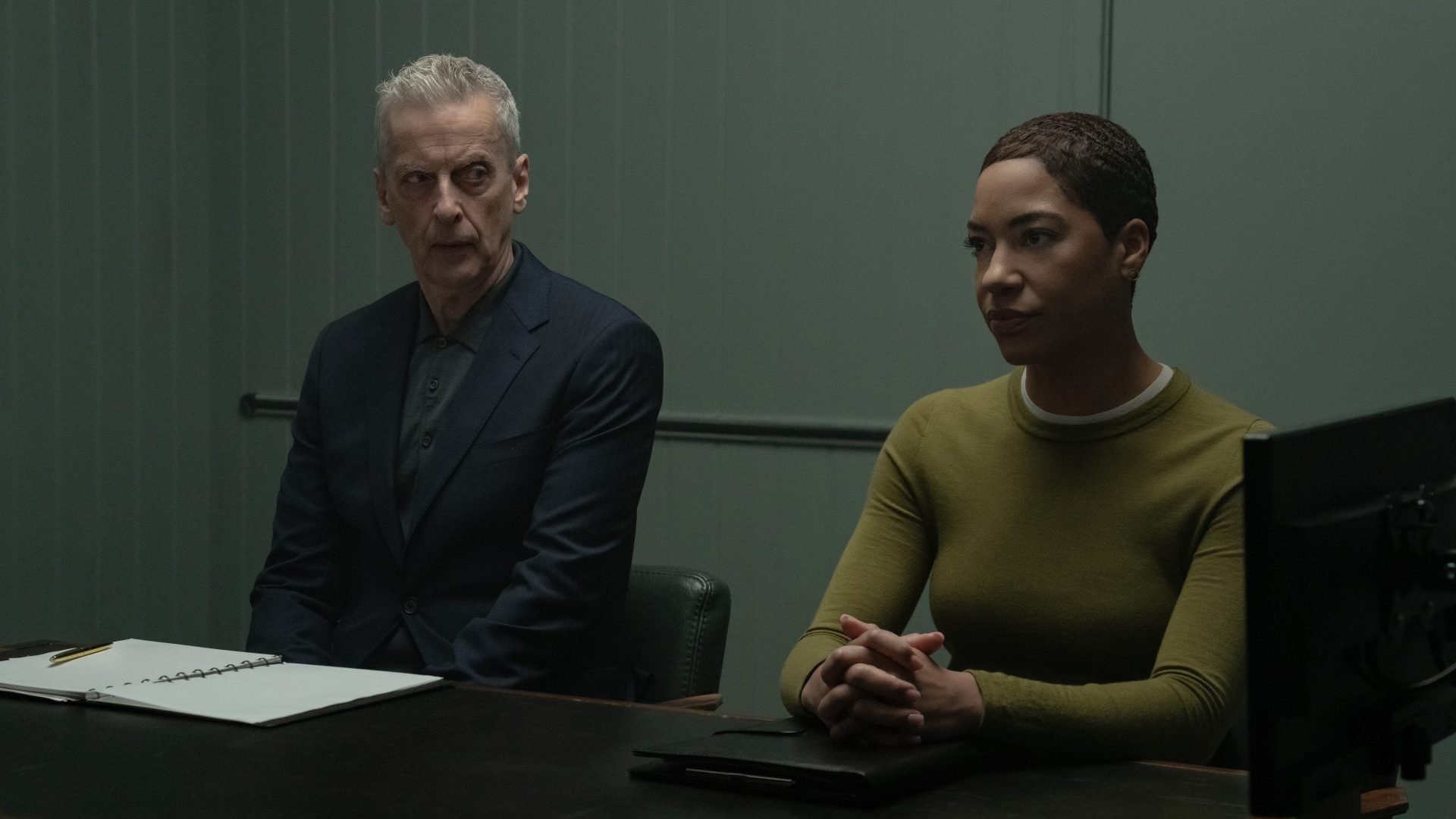
When it launched in January 2024, Paul Rutman’s excellent crime thriller did not seem an obvious candidate for a second season. In a tale that hinged on a wrongful murder conviction, veteran cop DCI Dan Hegarty (Peter Capaldi) sparred with DS June Leneker (Cush Jumbo) over ethical compromise, the tension between integrity and practical necessity, and the precise location of the line over which cops, as servants of the public trust, should not step. After eight episodes, their story felt complete.
But with two actors as mighty as Capaldi and Jumbo, you always want more, and this second season shifts the scene, changes the tempo and finds a compelling way to continue the saga. Now promoted to detective inspector, Leneker is on the ground at a protest rally outside the Ministry of Defence which is attacked by far right militants – leading to the fatal stabbing of young Rohan Hussain (Manvir Bawa). She is sure that she recognises one of the thugs as Billy Fielding (Luther Ford), who has been imprisoned for the murder of a teenage girl. Out of the blue, Hegarty texts her and invites her for coffee.
Far from being retired, as she had believed, her old nemesis has been moved to intelligence and explains that Billy has escaped from prison and is embedded in a neo-Nazi gang led by Cosmo Thompson (Dustin Demri-Burns, chilling) who has his own fascistic livestream show (“I’m not a violent man. I’m an entertainer, really!”) Convinced that the cell, which has its base in a run-down MMA gym, is planning a major terror attack, Hegarty seeks her help – the sell being that they should also be able to find out who killed Rohan.
As gaunt as a desert prophet, Capaldi is mesmerising in the role. In series one, he was the voice of old-school policing. In season two, he is morally repositioned as the slippery prophet of a transformed criminal landscape, trying to persuade his colleagues to confront reality: “I don’t have to tell you it’s a new world out there – one arm tied behind our backs”; and “We’re facing down tanks and drones, on a horse, with a fucking catapult.”
No less interesting is Leneker’s evolution, which Jumbo tackles with the nuance and power that make her one of the very best actors of our time. Her relationship with her partner Leo (Stephen Campbell Moore) is in tatters and her son Jacob (Jordan Nash) wants to move in with his father.
What Hegarty identifies – and exploits – is her mounting obsession with getting the job done. “Don’t beat yourself up for doing the right thing,” he tells her. And later: “Don’t make me drag you where you know you want to be.” Incrementally, a complex and ambiguous bond forms between the former antagonists.
In its portrayal of violent nativism, online disinformation, illegal weapons trafficking and the fear of race war, this tranche of eight episodes feels fiercely contemporary and boasts uniformly first-class performances. What started as a one-off drama now has the makings of a multi-season classic.
Suggested Reading


What everyone gets wrong about The Stranger
BOOK
The Illuminated Man: Life, Death and the Worlds of JG Ballard by Christopher Priest and Nina Allan (Bloomsbury Continuum, April 23)
In January 2023, the award-winning science-fiction writer Christopher Priest started work on a biography of JG Ballard, the great explorer of “inner space” and seer of hypermodern dystopia. Six months later, Priest was diagnosed with terminal cancer, from which he died in February 2024, having written 65,000 words.
In a remarkable act of homage to her late husband and to Ballard, Nina Allan, also an acclaimed novelist, has completed the book, which is now much more than a standard biography; interpolating deeply personal memories of palliative care and grief with the best account yet of the life of one of the great English-language writers of the last century (superseding John Baxter’s The Inner Man, which was published in 2014).
Do not be deterred by this hybridisation. First of all – as any reader of The Atrocity Exhibition (1970) can attest – Ballard loved genre mash-up and textual dislocation. Second, as a former Cambridge medical student, he was much preoccupied in his fiction by illness, physical trauma, and doctors: in his memoir Miracles of Life (2008) he writes movingly of his own cancer diagnosis (he died, aged 78, in April 2009). Third, he would, I think, have admired Allan’s fearless candour about the reality of dying – when “the only way to escape [the pain] is through non-existence” and personhood is reduced to a “mind trapped in stale meat, gasping for release.”
Exemplary in detail and analysis, The Illuminated Mind is a page-turning portrait of an author whose work feels more bracingly relevant than ever. Though Ballard claimed to reject the psychoanalytic orthodoxy that “all disturbing and violent experience is inherently damaging”, the traumas of his life – particularly his childhood years in a Japanese internment camp, fictionalised in Empire of the Sun (1984), and the death from pneumonia of his 34-year-old wife Mary in 1964 – pervade his fiction.
Ballard’s influence upon subsequent writers, notably William Gibson, Will Self, and Iain Sinclair, upon bands, like Joy Division and the Manic Street Preachers, and philosophers such as Jean Baudrillard and John Gray (whom he greatly admired) is a matter of record. What is ever-more striking is the prophetic character of his work.
Upon publication, his most controversial novel Crash (1973) was widely regarded as a pornographic outrage; a succès de scandale that was amplified by David Cronenberg’s movie adaptation in 1996. Today, what Ballard called its “warning against that brutal, erotic and overlit realm that beckons more and more persuasively to us from the margins of the technological landscape” seems more prescient than ever. One longs to know, too, what the author of Cocaine Nights (1996) and Kingdom Come (2006) would have made of the age of Ozempic, Xanax and vaccine wars; or what the laureate of deranged spectacle would have had to say about TikTok and Instagram.
Ballard is often mischaracterised as a chilly misanthropist who only relished the urban brutalism, media madness, environmental disaster and fragmenting of the self of which he wrote with such panache. One of the many services that Priest and Allan perform for him is to restore a sense of his irreducible, playful humanity. As he wrote in 1984: “I believe in the power of the imagination to remake the world, to release the truth within us, to hold back the night, to transcend death, to charm motorways, to ingratiate ourselves with birds, to enlist the confidence of madmen.”
FILM
Lee Cronin’s The Mummy (general release)
Well, it isn’t Boris Karloff unwinding his bandages in The Mummy (1932). And it certainly isn’t the next instalment of Brendan Fraser’s blockbuster adventures as treasure hunter Rick O’Connell (1999-2008) – the fourth of which is, in fact, expected in 2028.
It is to avoid such confusions that the name of Irish writer-director Lee Cronin is included in the title. Also, perhaps, as a fair warning to the squeamish or faint-hearted: from its earliest scenes, this is fully leaded, Olympic-standard, dialled-to-11 horror.
In Cairo, Charlie Cannon (Jack Reynor), a television reporter, and his nurse wife Larissa (Laia Costa) are devastated when their young daughter Katie (Emily Mitchell) is abducted. Eight years later, back in Albuquerque, New Mexico, they are called by the Egyptian authorities to be told that she is alive – found in an ancient sarcophagus at a plane crash site near Aswan.
Now played by Natalie Grace, the 16-year-old Katie is scarred, gnarled and catatonic. What follows, as the dark spirit within her awakes, is a relentless, adrenaline-soaked riff on The Exorcist (1973), with telekinesis, ceiling scuttling, and the kind of headbutting you’d expect in a Motherwell pub. Truth to tell, Katie makes the possessed Regan MacNeil (Linda Blair) seem like a pretty well-adjusted kid.
As for body horror: by comparison, The Substance (2024) is the mildest vanilla. It is many years since I heard an audience gasp collectively so often. But they laughed a lot, too: Cronin understands that the best horror is also punctuated with a sense of the absurd. He draws on the rich tradition of Italian giallo, as well as zombie classics and contagion horror, especially the REC and Ringu franchises (in honour of which a VHS cassette is crucial to the plot).
Like Kirill Sokolov’s They Will Kill You last month, Lee Cronin’s The Mummy revels in the excesses of grindhouse midnight movies and – for those who love that glorious subgenre – is splendid entertainment.
STREAMING
Euphoria (HBO Max)
In August 2019, the arrival of Sam Levinson’s richly stylised teen drama in the UK marked a double revelation. First, that this was something new, extraordinary and crackling with imaginative ambition; as important to its era as Bret Easton Ellis’s Less Than Zero had been in 1985.
Second, it was immediately clear that Zendaya – who went on to pick up two Emmys for her performance as bereaved, highly intelligent drug addict Rue Bennett – was going to be a global star, if not president (even now, she is still six years too young to run).
For my money, there have been few better hours of prestige television in the past 30 years than the 2020 special “Trouble Don’t Last Always” which featured only Rue and her AA sponsor Ali Muhammad (Colman Domingo) shooting the breeze in a diner.
So now, after a four-year hiatus, Euphoria is back for its third and presumptively final season. The characters have left East Highland Blackhawks high school, California, the gravitational centre of the previous two, and this scattering to the winds makes for structural complications.
Rue is now – literally and figuratively – in the Wild West, working as a drug mule for Laurie (Martha Kelly) but seeking to switch allegiance to
Alamo Brown (Adewale Akinnuoye-Agbaje). “That’s the beauty of the country we call America,” he says. “Anyone can reinvent themselves”. Her long-lost love Jules (Hunter Schafer) has dropped out of art school.
Meanwhile, Nate Jacobs (Jacob Elordi) and Cassie Howard (Sydney Sweeney) are engaged, living in a suburban mansion, and arguing over her plan to pay for the $50,000 floral arrangement at their wedding by performing on OnlyFans (of course, Nate drives a Cybertruck). And Cassie’s sister Lexi (Maude Apatow) is working as assistant to Hollywood showrunner Patty Lance (Sharon Stone).
Seven years after it all began, Zendaya, Elordi and Sweeney are now huge Hollywood celebrities: as it turns out, Euphoria was their elite academy. But it is great to see them and the rest of the cast back for one last careening turn round the psychic track. So long, and thanks for all the film stars.