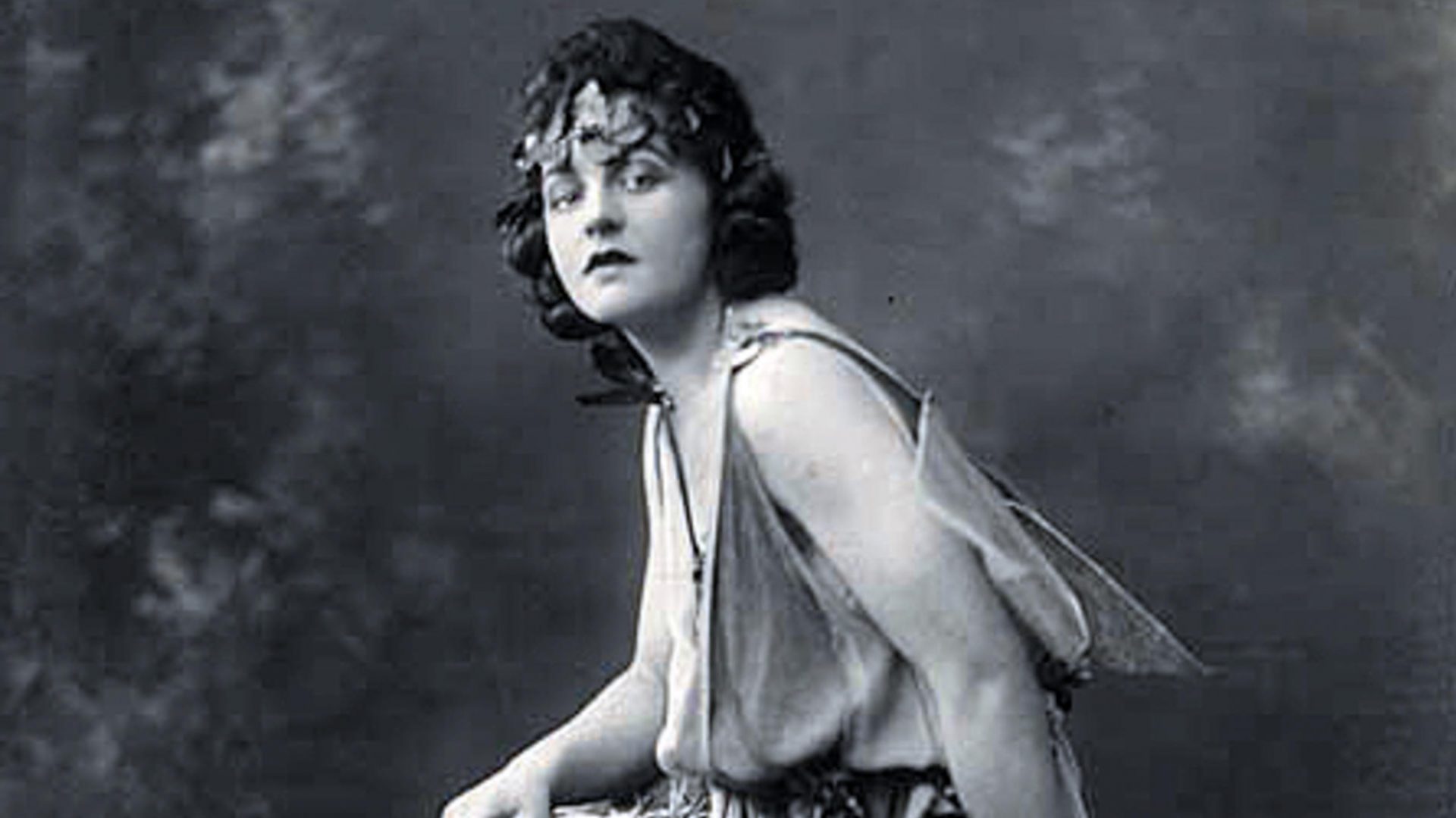
August 9, 1899 – April 23, 1996
The dancing penguins should have been a clue. There they were with Pinocchio, Captain Hook and Snow White, cavorting for the crowd outside Grauman’s Chinese Theatre in Hollywood on the night of August 27, 1964, as a tuxedoed Walt Disney posed with Julie Andrews and author PL Travers at the world premiere of his new film Mary Poppins, an adaptation of Travers’s novels.
“Just like Hollywood should be, and all thanks to Mr Disney,” the TV reporter announced as costumed characters mixed with Hollywood stars on the red carpet. But a couple of hours later, someone’s patience with Mr Disney was wearing thin.
“Tears ran down my cheeks because it was all so distorted,” Travers admitted later. She’d been present on set for some of the filming, making clear her objections to the softening of her lead character and cautioning against the use of too much animation. She’d had to cajole her way into an invite for the big night, and perhaps now she realised why the studio had been so reluctant to accommodate her.
At the after party, she found Walt Disney and told him things had to change. She hated the dancing penguins. The animations had to go.
Walt explained bluntly that this was not how the film industry worked. The movie was done and printed. “I was so shocked I thought I would never write, let alone smile again,” Travers wrote to her lawyer.
Travers had never wanted to sell the character to Disney, and did so only when she fell into financial hardship. She was fiercely defensive of the magical nanny, who she claims had blown into her life while she recovered from tuberculosis after a trip to Stalin’s Russia. “I didn’t write it,” she always insisted. “She just appeared.”
So proprietorial was Travers that, prior to filming, she had telephoned Andrews, telling her she was too pretty for the role. It was the day after Andrews had given birth. “I’m a little exhausted now,” Andrews told her, politely. “I’ve just had a baby.” Undeterred, the author continued to berate her.
While Travers recovered in a cottage in Sussex, the character of Mary Poppins emerged. Travers was born Helen Lyndon Goff in Queensland, Australia, at the end of the 19th century, to parents of Irish descent. Her dad, a bank manager and an alcoholic, loved Irish poetry and would read Yeats to her at bedtime. He died when she was only seven years old, and the young Helen started to create stories to entertain her struggling mother and two younger siblings.
Planning a stage career, she toured Australia and New Zealand as part of a Shakespearean theatre company, adopting the stage name Pamela Lyndon Travers. She wrote poems too, and when one appeared in the Irish Statesman, it came with two guineas from the publisher, Irish nationalist George William Russell, and an invitation to meet him in Dublin.
Her new mentor introduced her to Yeats, to the local literary scene and to mysticism, then highly fashionable. With her essays, reviews and poetry now regularly published, she was able to send money back to her mother in Australia. Then, in 1934, a year before Russell’s death, she brought out the book that led her to Hollywood.
She found another mentor, the mystic George Gurdjieff, who encouraged her to explore Eastern religion. For the next two decades, she shared his “quest for the meaning of existence”, spending time studying Buddhism in Japan and living among the Navajo people in New Mexico.
At the age of 40, when she heard of acquaintances in Ireland who had reluctantly decided to give their twins up for adoption, Travers went to visit. She consulted an astrologer who compared the babies’ horoscopes and recommended she take only the younger twin. She returned to London with Camillus, but not Anthony. She never told her son he was adopted, or that he was a twin, that another half of him was still in Ireland.
The twins met at 17, when Anthony tracked his brother down at his London home. “After a couple of pints I went and knocked on the door and I think I caused a bit of a consternation,” he remembered. The brothers went on to lead separate lives, but with intriguing similarities. They both married women called Frances. Camillus had a daughter called Katherine, Anthony a daughter called Kate.
Suggested Reading
The night that Purple Rain broke Prince
During the second world war, while still writing Mary Poppins stories, she worked for the UK Ministry of Information and spent two summers living among Hopi and Pueblo Indians, studying their mythology and folklore. “She was so restless, looking for something,” Camillus said about her life. “I hardly saw her, she was travelling the whole time.”
In her 1977 appearance on Desert Island Discs, Travers chose no music, selecting only poetry. Determined never to reveal anything about her private life, she used the appearance as an opportunity to un-Disney herself, presenting herself exactly how she wanted to be remembered, talking from the heart about her love of Blake and Yeats, only mentioning Mary Poppins one solitary time. “I’ve seen it once or twice and I’ve learned to live with it,” she told listeners with characteristic candour.
For all her famed dislike of the film, one vital piece of the book’s dialogue remains in the film. “First of all, I would like to make one thing quite clear,” Mary Poppins says to Mr Banks, firmly: “I never explain anything.” This could be Travers’s mantra for life, and she remains as much of a mystery as the woman with the umbrella and carpet bag.